Top BI Challenges Businesses Face and How to Solve Them?

Business Intelligence (BI) has become a mission-critical function for modern organizations. Leaders want to make faster, data-backed decisions while teams need real-time visibility into performance, market trends, and operational gaps.

However, leveraging BI isn’t always straightforward. Many businesses invest in BI tools but struggle to actually translate data into meaningful outcomes.

In this guide, we uncover the most common BI challenges businesses face and practical solutions to overcome each, so your BI initiative doesn’t just generate dashboards, but drives profitability and strategic growth.

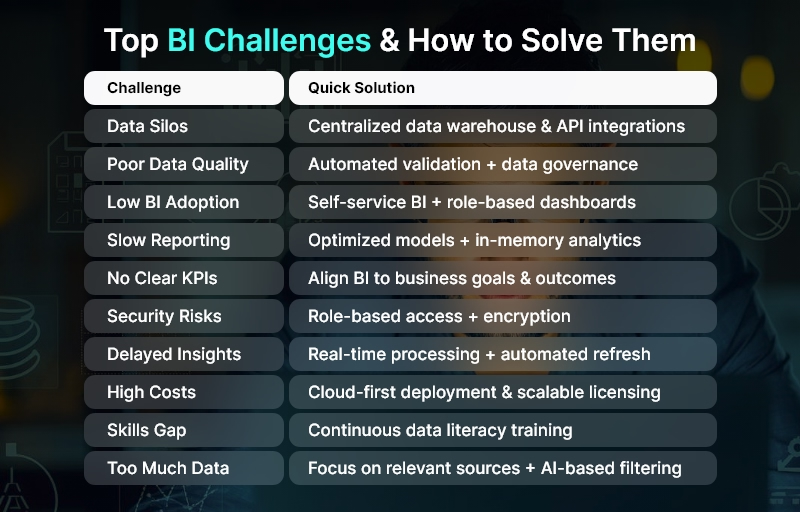
Top BI Challenges & How to Solve Them

Why Business Intelligence Often Fails: The Real Issue

Even with powerful BI tools available today, success often stalls because teams:

  • Don’t know what data is truly valuable
  • Face data accuracy or silo problems
  • Lack BI adoption across business units
  • Fail to align BI with business strategy

The good news? All these challenges are fixable.

Let’s dive into the 10 biggest BI challenges, and how to solve them effectively.

Top 10 BI Challenges and How to Solve Them

  • Data Silos and Lack of Integration

The challenge:

Data lives across multiple systems — CRM, ERP, spreadsheets, marketing tools, and more — making analytics difficult.

The solution:

  • Implement a unified data pipeline
  • Use ETL (Extract, Transform, Load) automation
  • Integrate systems via modern APIs
  • Adopt a centralized data warehouse or lakehouse

Outcome → Single source of truth that improves accuracy and data accessibility.

  • Poor Data Quality

Bad data leads to bad decisions.

Common issues:

  • Duplicates
  • Missing fields
  • Outdated records
  • Inconsistent formats

Solution strategies:

  • Automated data cleaning and validation
  • Data governance policies
  • Master data management (MDM)

Outcome → Trusted data + confident decision making.

  • Low BI Adoption Among Users

Most employees still rely on Excel and intuition — not insights.

Why adoption fails:

  • Tools are too complex
  • Limited training
  • Dashboards don’t solve real problems

How to fix it:

  • Provide intuitive self-service BI tools
  • Build role-specific dashboards
  • Offer guided onboarding and training

Outcome → BI becomes everyone’s habit — not a reporting chore.

  • Slow and Inefficient Reporting

When dashboards take minutes to load, users abandon BI.

Key improvement tactics:

  • Optimized data models
  • In-Memory analytics
  • Incremental refresh instead of full loads
  • Scalability planning

Outcome → Insights available instantly when decisions are needed.

  • Lack of Clear KPIs and Strategy

Without defined business goals, BI becomes random reporting.

How to solve:

  • Start BI with business questions
  • Identify measurable KPIs linked to goals
  • Create data-driven success benchmarks

Outcome → BI aligns directly with growth initiatives and ROI.

  • Security, Compliance & Access Control Issues

Data breaches or unauthorized access can be devastating.

Fix it with:

  • Robust role-based access permissions
  • Encryption in transit and at rest
  • Audit logs and compliance frameworks
  • Regular security governance reviews

Outcome → Secure analytics trusted by leadership and IT.

  • Real-Time Data Not Available

Outdated data = outdated decisions.

How to solve:

  • Use streaming analytics where needed
  • Implement CDC (Change Data Capture)
  • Automate refresh cycles

Outcome → Operational agility and faster risk mitigation.

  • High Cost of BI Implementation

Licensing + integrations + skilled resources = $$$

Cost optimization solutions:

  • Cloud-first BI deployment
  • Scale licensing as users grow
  • Use open-source or freemium BI tools initially
  • Focus on high-value use cases first

Outcome → Lower TCO (Total Cost of Ownership) without sacrificing capability.

  • Skills Gap in Data Literacy

BI software alone doesn’t create analysts.

Solve by:

  • Company-wide data literacy programs
  • Hands-on workshops on using dashboards
  • Embedded help within BI platforms

Outcome → Data becomes a culture, not a department.

  • Overwhelming Volume of Data

More data doesn’t mean better insights — often it’s the opposite.

How to fix:

  • Prioritize relevant data sources
  • Archive historical data strategically
  • Automate metadata management
  • Use AI to surface valuable patterns

Outcome → Right data → right insights → right actions.

Bonus: How to Ensure Long-Term BI Success

A successful BI transformation includes:

Pillar Practice
Strategy Align BI goals with business objectives
Technology Choose scalable BI tools with flexible integration
Governance Maintain data quality, security, and ownership
Skills Train users continuously
Culture Promote evidence-based decision making

BI success isn’t a one-time setup — it’s a continuous journey powered by adoption and improvement.

Conclusion

Business Intelligence can become an organization’s competitive advantage — but only when challenges like data quality, adoption, and integration are handled proactively.

By addressing these BI challenges strategically, businesses unlock:

  • Smarter decisions
  • Increased productivity
  • Reduced operational risks
  • Faster revenue growth

Start small. Focus on solving real business problems. And let data guide the future.

FAQs

1. What causes most BI failures?

Lack of adoption, poor data quality, and misaligned goals are the top reasons BI initiatives fail.

2. How can business intelligence drive ROI?

By improving decision-making, reducing errors, optimizing operations, and discovering revenue opportunities.

3. Which BI tools are most commonly used?

Tools like Power BI, Tableau, Qlik, Looker, and modern cloud-native BI platforms.

4. How do I improve BI adoption?

Deliver easy-to-understand dashboards and train users regularly.

5. What industries benefit most from BI?

Retail, manufacturing, finance, logistics, healthcare — and any data-driven business.

Top 6 Business Intelligence Service Providers in 2025–2026

In the rapidly evolving digital age, data is more than just a byproduct — it’s a vital asset. Every day, businesses across industries collect enormous volumes of information: operational metrics, customer behaviour data, supply-chain logs, financial performance, and more. However, raw data on its own rarely yields insights. Only when it is properly processed, analyzed, and visualized does it become a weapon for smarter decisions, faster strategies, and improved outcomes. That’s where Business Intelligence Service Providers come in. These firms help organizations design data strategy, build data pipelines, create dashboards, implement analytics, and deliver actionable insights — turning data overload into clarity.

Because BI is no longer optional — it’s essential. The right BI partner equips your business with real-time visibility, predictive insights, trend analysis, and strategic intelligence. As a result, companies using BI effectively gain agility, competitive advantage, better resource utilization, and improved decision-making.

Given this backdrop, we have curated a list of the Top 6 Business Intelligence Service Providers for 2025–2026. We place Andolsoft at #1 (as per your direction), and then cover a mix of global leaders, agile consultancies, and firms with strong presence in India and beyond — such as Mphasis, Persistent Systems, Stefanini, and more. Our goal is to provide a balanced, practical guide to help businesses of all sizes pick the right partner.
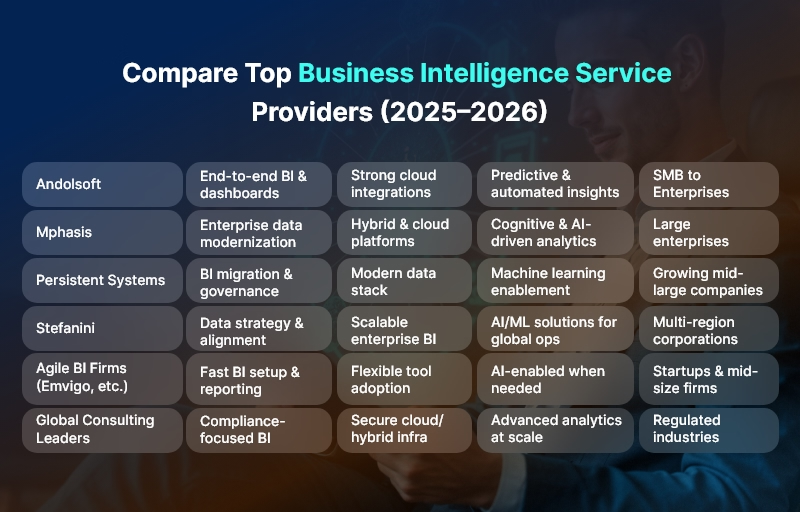
Compare Top Business Intelligence Service Providers

How We Evaluated the BI Providers

Before diving into the list, it’s important to understand the selection criteria we used. Not all BI firms are equal, and different businesses have different needs. We looked at the following factors:

  • End-to-end BI capabilities — from data ingestion and ETL, to warehousing, analytics, dashboards, reporting, data governance, and maintenance.
  • Support for modern architectures — cloud BI, hybrid deployments, streaming analytics, real-time dashboards, scalability, and future readiness.
  • Analytics maturity & advanced analytics — including machine learning, AI-driven insights, predictive analytics, and data science capabilities.
  • Industry and domain experience — ability to serve different verticals (finance, retail, manufacturing, healthcare, logistics, etc.) and understand domain-specific data patterns.
  • Track record and credibility — proven client projects, documented success stories, recognized assessments or partnerships.
  • Flexibility, customization & cost-effectiveness — tool-agnostic approach, tailor-made solutions, accelerators/migration support for legacy systems.
  • Data governance, security and compliance — especially crucial for regulated industries and global organizations.
  • Support for long-term growth and data-driven culture — including training, documentation, change management, and scalable architecture.

With these lenses, we crafted the list below.

Top 10 Business Intelligence Service Providers

Andolsoft — Best BI Partner

As the top-ranked firm on our list, Andolsoft delivers comprehensive BI solutions tailored to each organization’s unique needs. They help businesses transform fragmented, siloed data into unified, actionable intelligence — enabling data-driven decision-making across functions.

Why Andolsoft stands out:

  • They design custom, tool-agnostic BI architectures, meaning you’re not locked into a single vendor or platform.
  • They support end-to-end BI lifecycle: data ingestion → cleansing/ETL → warehousing → visualization → automated reporting → analytics → support.
  • Their dashboards and reporting systems are built to support real-time and historical analytics, enabling both daily operations monitoring and trend forecasting.
  • For organizations seeking to embed BI into their culture, Andolsoft offers ongoing support, customization, and scalability.

Hence, Andolsoft is ideal for companies that value flexibility, long-term partnership, and BI systems designed to grow with their business.

Mphasis — Enterprise-Grade BI & Next-Gen Data Analytics

Mphasis, a long-standing Indian IT-services and consulting firm, has evolved its offerings to include advanced data management, analytics, cloud BI, and AI-powered data solutions.

What Mphasis brings to the table:

  • Their Next-Gen Data Services help enterprises migrate from legacy data systems to modern, cloud-based analytics infrastructure — enabling unified data storage, faster queries, and scalable analytics.
  • Mphasis invests in AI and machine-learning through platforms like DeepInsights™, enabling cognitive analytics, intelligent data extraction from unstructured sources (documents, PDFs, images), and advanced decision support.
  • For businesses dealing with high data complexity — multiple sources, structured and unstructured data, streaming data, hybrid workloads — Mphasis offers end-to-end data strategy, governance, warehousing, and analytics under one umbrella.
  • Their services cover a wide range of industries (finance, logistics, telecom, insurance, retail), making them a reliable partner for large enterprises with diverse needs.

Best for: Large enterprises or organizations undergoing digital transformation, dealing with complex legacy data systems, hybrid cloud environments, or requiring both BI and AI-enabled analytics.

Persistent Systems — Modern Data Stack & Analytics Modernization

Persistent Systems is another strong player, especially for companies looking to modernize their data stack or migrate from legacy reporting platforms. Based in Pune, India, the firm offers comprehensive data and analytics services including cloud migration, data governance, data science, BI modernization, and more.

Key strengths of Persistent Systems:

  • Their Data & Analytics Advisory practice helps companies define data strategy, implement governance, and align analytics with business objectives — ensuring data becomes a strategic asset, not just an operational tool.
  • They offer data stack modernization, enabling migration to modern cloud data warehouses or data lakes; they support tools like Snowflake and Databricks while also offering master data management, data cataloging, and BI modernization.
  • Their data science and ML capabilities let clients move beyond reporting and dashboards — into predictive analytics, AI-driven insights, data monetization, and data-driven products/services.
  • The firm has a robust partner ecosystem and proven track record across industries, making it adaptable for mid-market businesses as well as larger enterprises.

Best for: Organizations transitioning from legacy BI/reporting systems to modern cloud-based BI, or those seeking to embed analytics and data governance into their core operations.

Stefanini — Strategic BI with Data Governance & Analytics Services

Stefanini is a global technology consultancy that offers a broad range of digital services, among which data analytics, data science, BI consulting, and data-driven transformation stand out.

What makes Stefanini special:

  • They combine data strategy consulting + technical implementation + business alignment. In other words, they don’t just create dashboards — they help you build a data culture, align analytics with business goals, and ensure data-driven decisions across departments.
  • Their services include data architecture, data governance frameworks, data engineering, BI and reporting, data science & ML — enabling a full-lifecycle analytics approach.
  • With a global presence and experience across industries like manufacturing, consumer goods, finance, and services, they can serve multinational operations with diverse, distributed data sources.
  • Stefanini’s emphasis on cloud enablement, hybrid infrastructure, automation, and security ensures that BI is not only functional but also scalable, robust, and future-ready.

Best for: Organizations aiming for a strategic, governed, enterprise-wide BI rollout — especially those needing compliance, cross-functional analytics, and long-term data governance.

Agile & AI-First BI Consultancies (Emvigo, Specialist Firms, etc.)

Beyond large IT firms and global consultancies, the BI landscape includes nimble, agile consultancies and BI specialists who offer rapid deployment, flexible solutions, and cost-efficient services. These firms are especially relevant for startups, mid-size businesses, or companies with evolving data needs.

Why they matter:

  • They often deliver quick time-to-insight, with faster setup of dashboards, reporting, and analytics. This speed helps businesses test BI use-cases, iterate quickly, and scale gradually.
  • They tend to be tool-agnostic and flexible — able to integrate with cloud data lakes, hybrid data sources, and modern analytics stacks without enforcing a rigid infrastructure.
  • For companies needing predictive analytics, custom reports, embedded analytics, or AI-based insights without major infrastructure overhaul — such consultancies provide cost-effective BI transformation.

Best for: Startups, growth-stage companies, and mid-size enterprises looking for flexible, scalable, and affordable BI solutions without committing to heavy upfront investment.

Legacy & Global Consulting Firms – Enterprise-Scale BI

Large, global consultancies and legacy BI players remain relevant in 2025–2026 — especially for enterprises with complex data landscapes, global operations, regulated industries, and compliance needs. These firms offer broad domain expertise, rigorous data governance, and enterprise-grade BI deployments.

Advantages of legacy/global firms:

  • They bring stability, compliance support, regulatory readiness, and global delivery capabilities.
  • Their teams often include experts in data architecture, data warehousing, compliance, security, cloud migrations, and cross-region data governance.
  • They serve enterprises needing full-scale BI deployments, covering multiple business units, geographies, and compliance requirements.

Best for: Multinational corporations, regulated industries (finance, healthcare), and organizations requiring extensive governance, security, and enterprise-wide BI architecture.

How to Choose the Right Business Intelligence Service Provider for You

Selecting the “right” BI partner depends heavily on where your organization stands today — and where you want to go tomorrow. Here’s a practical checklist to help you evaluate potential partners:

  • Assess Current Data & Infrastructure Readiness
    • Do you have a data warehouse, data lake, or only spreadsheets?
    • Are your data sources scattered, structured, semi-structured, or unstructured?
    • Do you need real-time data ingestion or batch data processing?
  • Define Your BI Goals & Use Cases
    • What do you need — dashboards, reporting, real-time monitoring, predictive analytics, data governance, cloud migration, or AI/ML insights?
    • Which business functions should benefit — sales, finance, operations, HR, etc.?
  • Match Provider’s Strength to Your Needs
    • For custom, scalable, long-term BI: choose flexible, full-service providers (e.g., Andolsoft, Persistent, Stefanini).
    • For rapid deployment and cost-effectiveness: consider agile BI consultancies or smaller specialist firms.
    • For enterprise-grade governance and compliance: global/legacy firms win.
  • Check Tool & Technology Compatibility
    • Ensure providers support your preferred platforms: cloud BI (Snowflake, AWS, Azure), BI tools (Power BI, Tableau, Looker, etc.), real-time streaming (Kafka, Spark), data science & ML tools.
    • Confirm they support data governance, data security, compliance standards relevant to your industry.
  • Review Track Record & Domain Experience
    • Look for case studies, client testimonials, vertical-specific implementations.
    • Prefer providers with prior experience in your industry or similar scale & complexity.
  • Consider Cost, Timeline & Scalability
    • Balance cost vs value: cheaper providers may suit small-scale BI needs; bigger firms might deliver more robust long-term value.
    • Check how easily you can scale BI as data volume grows, or as you add new data sources.
  • Plan for Culture & Change Management
    • BI success requires more than technology — it’s about adoption, data culture, user training, consistent workflows, and management support.
    • Choose a provider who offers training, documentation, and long-term support.

Benefits of Working with the Right BI Provider

Partnering with a good Business Intelligence Service Provider can bring multiple benefits:

  • Accelerated decision-making — with real-time dashboards and consolidated data, leaders get timely insights.
  • Improved operational efficiency — BI helps highlight inefficiencies, drive process improvements, reduce costs.
  • Better forecasting and strategic planning — with historical data, predictive analytics, and trend analysis.
  • Enhanced data governance and compliance — especially useful for regulated industries.
  • Scalability — as the business grows, BI platforms and data architecture scale along, avoiding bottlenecks.
  • Data-driven culture — empowers teams across departments to make informed, data-backed decisions.

Ultimately, the ROI from a well-implemented BI solution — whether in productivity, cost-savings, or strategic advantage — often outweighs the investment many times over.

Final Thoughts

In 2025–2026, the role of data and analytics in business decision-making will only grow stronger. Companies that harness data effectively will lead markets; those that ignore it risk falling behind.

The firms above — from agile, AI-first consultancies to enterprise-scale global players — represent the best of what BI consulting has to offer today. By carefully matching your business needs, data maturity, and strategic goals with the right provider, you can build a robust, scalable, and future-ready BI foundation.

If you seek flexibility and customization, consider Andolsoft. If you manage complex enterprise data across legacy systems and cloud, firms like Mphasis, Persistent Systems, or Stefanini may be better fits. For smaller companies or quick deployments, agile consultancies and BI-specialist firms offer speed and cost-effectiveness.

Whatever your choice — remember: data without insight is just noise. The right BI provider turns noise into clarity, confusion into strategy, and data into decisions.

FAQs

Here are some frequently asked questions about choosing and working with BI providers:

1. What exactly do Business Intelligence Service Providers do?

They help collect, clean, integrate, store, analyze, and visualize data — turning raw data into actionable insights. This includes building data warehouses or lakes, ETL pipelines, dashboards, reporting systems, and analytics models.

2. Which industries benefit most from BI?

Virtually all industries — finance, retail, healthcare, manufacturing, logistics, telecom, tech, services — benefit. BI helps with operational visibility, customer analytics, forecasting, risk management, and strategic planning.

3. How long does a full BI implementation take?

It varies. A basic BI deployment with dashboards might take 1–3 months. A full-scale enterprise BI rollout — including data migration, architecture overhaul, analytics, governance — could take 4–9 months or longer, depending on complexity.

4. Does BI always require cloud infrastructure?

Not always. Some business intelligence solutions can run on-premise. However, cloud BI is increasingly popular because it offers scalability, flexibility, easier data collaboration, and lower infrastructure overhead.

5. Can BI providers help with unstructured data (e.g. documents, images)?

Yes. Leading providers increasingly support unstructured data analytics, leveraging tools like AI/ML, natural language processing (NLP), cognitive computing to extract insights from documents, images, logs, social media, etc.

6. What BI tools are commonly used?

Popular tools include Power BI, Tableau, Looker, Qlik, Sisense, Domo, along with true cloud data platforms like Snowflake, Databricks, AWS/Azure/GCP data stacks, streaming tools (Kafka/Spark), and custom ML/AI solutions.

7. What’s the difference between BI and advanced analytics/data science?

Business intelligence traditionally covers descriptive analytics — reporting, dashboards, historical trend visualization. Advanced analytics and data science add predictive, prescriptive analytics, machine-learning models, forecasting, anomaly detection, pattern recognition — going beyond “what happened” to “why it happened” and “what will happen.”

8. How do I know when my business needs BI?

If you face data overload, multiple data sources, delayed or inconsistent reporting, manual spreadsheets, lack of insight-driven decisions, or want better forecasting — it’s time to adopt BI.

9. What makes a great BI partner?

A great partner offers end-to-end services, aligns with your business goals, supports scalability, handles data governance, delivers clean and user-friendly dashboards, ensures timely support/training — and adapts as your data needs evolve.

10. Does BI adoption guarantee success?

BI is a tool — its success depends on data quality, adoption by teams, consistent governance, and using insights in decision-making. With the right strategy and partner, BI greatly increases chances of success.

Top 10 Power BI Alternatives with Better Customization

BIIn an era when the demand for data-driven decision-making is skyrocketing, businesses are increasingly seeking more flexible and customizable analytics platforms than traditional tools. According to market data, the global business intelligence market is projected to nearly double from ~ $34.8 billion in 2025 to over $63 billion by 2032, as companies across industries ramp up investments in data and analytics. For many organizations, however, Microsoft Power BI — while popular — can feel limiting in terms of deep customization, embedded analytics, or integration flexibility. That is why exploring Power BI alternatives has become a critical step for CTOs, product managers, and business leaders.

In this blog, you’ll discover the top 10 Power BI alternatives that deliver superior customization, scalability, and control. Moreover, you’ll learn how a seasoned development partner like Andolasoft can help integrate and extend these tools to build truly tailored BI/analytics solutions for your enterprise needs.

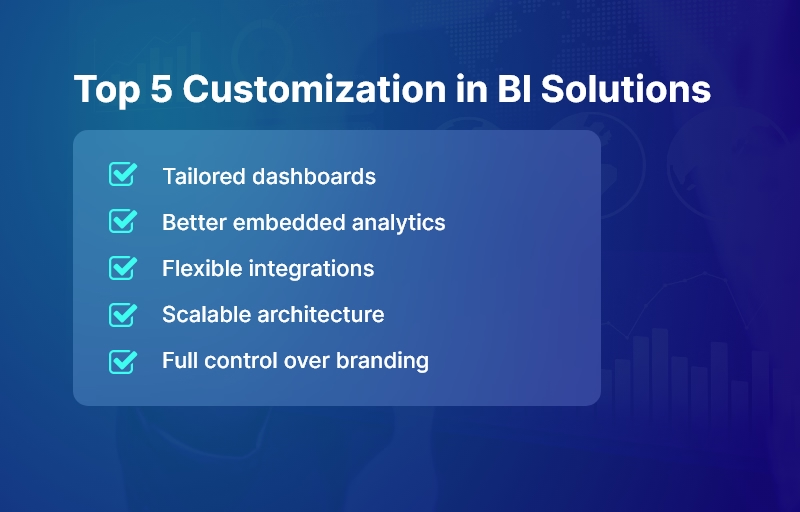
Top 5 Customization in BI Solutions

Why Customizable BI Tools Matter for Growing Businesses

Business intelligence (BI) is no longer a “nice-to-have” — it’s a strategic imperative. As defined by industry experts, BI encompasses the processes and platforms organizations use to collect, analyze, and interpret data to inform decisions.

For growing businesses — whether in healthcare, logistics, eCommerce, education, fintech, or manufacturing — the benefits of BI are tangible: improved operational efficiency, better forecasting, data-driven decision-making, and competitive advantage.

Challenges with Traditional or Out-of-the-Box BI Solutions

  • Many organizations still suffer from low BI maturity: according to a report, over 87% of companies fall into “basic” or “opportunistic” BI maturity levels — relying heavily on spreadsheets or siloed data efforts.
  • Off-the-shelf BI tools may lack the flexibility or extensibility required to adapt to unique business logic, complex workflows, or custom integrations — especially in industries with specialized needs (e.g. multi-warehouse supply chain analytics, real-time IoT data from manufacturing, or compliance-heavy fintech).
  • Without strategic BI implementation, companies risk inefficiencies, poor data governance, security vulnerabilities, and lost revenue opportunities due to underutilized data.

Hence, modern enterprises need customizable, scalable, and secure BI platforms — not patchwork solutions or “quick fix” dashboards.

That’s where exploring Power BI alternatives makes sense — and why partnering with a full-stack development and BI services provider like Andolasoft becomes strategic.

What Makes a Good Alternative? Key Criteria & Best Practices

Before diving into specific tools, it’s useful to understand the criteria and best practices that define a successful BI platform — especially one that seeks to go beyond Power BI’s standard capabilities.

Essential Capabilities to Look For

  • Customizable analytics & dashboards: The ability to build deeply customized reports, dashboards, and visualizations tailored to your domain and metrics.
  • Self-service BI for business users: Non-technical users should be able to explore data, build ad hoc reports, and access insights without deep coding or IT dependence.
  • Scalable, modern architecture: Cloud-native or hybrid platforms that scale with data volume, user load, and complex workflows, with robust governance and security.
  • Integration and flexibility: Ability to integrate with existing data warehouses, data lakes, ETL tools, third-party services, APIs, and custom applications.
  • Embedded & composable analytics: Options to embed BI/analytics within your own web or mobile applications — giving you full control over UI/UX, workflow, permissions, and branding.

Best Practices & Implementation Tips

  • Define your data & analytics strategy first. Establish goals, KPIs, data sources, governance, and ownership before selecting tools — so the BI platform helps solve concrete problems, not just add dashboards.
  • Adopt a modular architecture (data warehouse → analytics engine → presentation layer). This ensures flexibility and future-proofing as data volume and complexity grow.
  • Enable self-service while maintaining governance. Balance user autonomy with data quality, security, and consistent data definitions across the organization.
  • Iterate dashboards & data models over time. Don’t treat BI as a one-time project. Evolve dashboards based on user feedback, changing business requirements, and data volume growth. (Recent research shows that dashboards become more useful when continuously refined.)
  • Use automation, DevOps, and CI/CD for BI pipelines. Treat data pipelines, ETL jobs, models, and dashboard deployments as first-class software — so updates, scaling, and maintenance are systematic and manageable.
  • Ensure scalability and security from day one. As data grows, make sure performance, access control, and compliance remain robust.

Because of these requirements, many businesses find that integrating or customizing a BI tool — rather than using default configurations — yields far higher value. That’s exactly where a partner like Andolasoft brings value, combining expertise in BI, data analytics, SaaS engineering, DevOps, cloud infrastructure, and custom application development.

Top 10 Power BI Alternatives with Better Customization

Here are ten BI tools and platforms that often outshine Power BI when it comes to customization, flexibility, and integration potential. Each of these can be tailored — or embedded — to align with your unique business requirements.

Fully Custom-Built BI Solution by Andolasoft

Sometimes, no standard BI tool fits unique workflows — especially in domains like:

  • Fintech (compliance-heavy custom dashboards)
  • Multi-warehouse logistics (real-time IoT + GIS data)
  • Healthcare (HIPAA-compliant insights)
  • EdTech (student lifecycle analytics)

A full-custom BI solution provides:

  • Controlled data pipelines + governance
  • Tailored dashboards matching exact roles + KPIs
  • Data models specific to business workflows
  • Embedded analytics inside core products
  • Own the full IP + no vendor lock-in

Andolasoft builds these using:

  • Data warehouses (Snowflake, BigQuery, Redshift, etc.)
  • Custom visual layers (React, Angular, mobile apps)
  • Secure pipelines (Airflow, dbt, serverless ETL)
  • AI/ML insights on top of structured metrics

Best suited for:

  • Product-led companies wanting complete control
  • High-growth enterprises needing future-proof scalability
  • Industry-specific use cases NOT supported by generic BI

Google Cloud Looker

Looker is a modern BI platform built around LookML, a semantic modeling layer that ensures consistent business metrics across dashboards, teams, and applications.

It offers extreme flexibility for embedding analytics into web or mobile products — with fully customizable UI/UX and brand-level control. Because Looker queries data in place (no extracts needed), it works seamlessly with any cloud data warehouse.

Best suited for:

  • SaaS products wanting embedded analytics
  • Enterprises needing governed, centralized metrics
  • Organizations working with multi-cloud data architectures

Key customization strengths:

  • Custom modeling with LookML
  • API-first platform for building tailored analytics experiences
  • Pixel-perfect control over front-end analytics

Qlik Cloud Analytics®

This BI solution stands out with its Associative Engine, enabling users to explore all possible relationships in data — not just predefined queries.

Qlik Cloud Analytics® offers high customization through extensions, custom visual scripting, and developer-friendly SDKs.

Best suited for:

  • Businesses with complex multi-source data
  • Data-intensive manufacturing, logistics, retail analytics
  • Teams needing exploratory analytics over rigid reporting

Key customization strengths:

  • Fully extensible dashboards with custom visualizations
  • In-memory engine for real-time exploration
  • Enterprise-grade architecture + advanced governance

ThoughtSpot Agentic Analytics Platform

ThoughtSpot uses AI and natural language search to generate insights — no SQL required. Its core superpower is search-driven analytics, making it incredibly self-service friendly. Developers can embed AI-powered analytics into other systems via APIs.

Best suited for:

  • Leaders who want insights instantly without analyst dependency
  • Data democratization initiatives
  • Sales, CX, operations teams requiring quick answers

Key customization strengths:

  • AI/ML insight recommendations
  • Conversational analytics + spotIQ automation
  • Embedded analytics and fully custom data workflows

Pricing:

  • Essentials (for small teams) – $25 per user/per month
  • Pro (for growing businesses) – $50 per user/per month
  • Enterprise (for large enterprises) – Custom pricing

GoodData

GoodData was designed specifically for composable and embedded analytics, enabling companies to create custom multi-tenant BI products.

It provides headless BI, meaning you can completely control the front-end experience through APIs.

Best suited for:

  • SaaS companies adding analytics into their product
  • Organizations requiring strict governance across different user groups
  • Data products with white-label branding

Key customization strengths:

  • Custom frontend development with React components
  • Fine-grained permissions for customer-facing analytics
  • Flexible data pipelines and governed metrics layer

Sisense

The app allows developers to embed analytics anywhere — portals, dashboards, web products, and even within app workflows.

Sisense Fusion lets you create data apps and tailor analytics experiences to specific business workflows.

Best suited for:

  • Enterprise analytics inside operational systems
  • Complex custom workflows + automation needs
  • Flexible, branded analytics in SaaS

Key customization strengths:

  • White-label dashboards
  • Highly customizable via scripts + API
  • Handles large, complex data models efficiently

Tableau

Tableau is the leader in advanced visualization design with deep customization options.

Developers can extend visual capabilities with JavaScript APIs, plugins, and Tableau Extensions for embedded use cases.

Best suited for:

  • Industries demanding visual analytics and storytelling
  • Enterprises scaling self-service dashboards
  • Teams transitioning from spreadsheets to BI

Key customization strengths:

  • Custom extensions + visual development
  • Full branding control for embedding
  • Massive library of visuals for almost any model

Pricing

  • Tableau Standard – $75 user/month
  • Tableau Enterprise – $115 user/month
  • Tableau + Bundle – Contact Sales

Mode Analytics

Mode unifies SQL + Python + R for analysts and data scientists — perfect for advanced modeling and statistical analytics.

It provides customizable reporting environments, allowing data teams to build powerful models and present insights interactively.

Best suited for:

  • Companies with strong data science / analytics teams
  • Growth-stage SaaS building tailored internal analytics
  • Experiment-heavy product teams

Key customization strengths:

  • Built-in notebooks for advanced ML analytics
  • Deep control over query models + custom visuals
  • Tailored embedded analytics for data-savvy products

Metabase

Metabase is an open-source, self-hosted BI tool — highly cost-efficient with full control over your deployment.

It’s simple for non-technical users yet customizable by engineering teams.

Best suited for:

  • SMEs avoiding licensing lock-in
  • Startups needing fast, low-cost BI
  • Data-sensitive industries that prefer on-premise

Key customization strengths:

  • Complete control over hosting + data
  • Custom dashboards with branding + embedding
  • Developer API for workflow integration

Pricing

  • Open source – Free
  • Starter – $100/month + $6/month per user
  • Pro – $575/month + $12/month per user
  • Enterprise – Custom pricing

Redash (Open Source)

Redash is a lightweight, SQL-first BI and dashboarding tool. Perfect for technical teams who want complete customization without heavy enterprise overhead.

Best suited for:

  • Advanced SQL/engineering-led analytics teams
  • Internal dashboards for operations, engineering, DevOps
  • API + CLI driven BI environments

Key customization strengths:

  • Full source code access = unlimited customization
  • Ideal for embedding minimal dashboards
  • Cost-efficient + developer-friendly

Important insight: There’s no “one-size-fits-all” BI tool — the best Power BI alternative depends on your business model, data architecture, user base, and long-term goals.

How to Evaluate & Implement an Alternative: Best Practices & Actionable Tips

Here’s a framework — built upon years of industry practice — that we at Andolasoft recommend when evaluating or implementing a BI alternative.

1. Define Business Goals & Data Strategy First

  • Clarify what you aim to achieve: improved reporting turnaround, real-time dashboards, embedded analytics in product, or self-service analytics for business users.
  • Map out your data sources (databases, data lakes, third-party services, APIs, IoT, logs, etc.).
  • Define KPIs, metrics, data governance, access controls, and which teams/users need what access.

This ensures that whichever BI platform you choose — or build — aligns precisely with business needs.

2. Prioritize Customization & Embeddability

  • If you need dashboards within your product — for SaaS or internal tools — prefer BI platforms that support embedded analytics or SDKs (e.g. Looker, GoodData, Sisense, Mode).
  • Keep the semantic layer or data model separate from the presentation layer. This avoids breaking dashboards when underlying data changes.

3. Adopt Modular, Scalable Data Architecture

  • Use a modern data stack: data warehouse / data lake (e.g. cloud-based), ETL/ELT pipelines, and analytical layer.
  • Apply DevOps / CI-CD practices to BI pipelines: treat data models, queries, dashboards as code — versioned, tested, and maintained like software.
  • Build with scalability & security in mind: scale as data grows, and enforce role-based access and data governance.

4. Empower Business Users & Maintain Governance

  • Enable self-service BI for non-technical users — so analysts, marketing, sales teams can run their own reports without IT bottlenecks.
  • But also enforce data governance, consistent definitions, and a central data model to avoid data silos or conflicting metrics.

5. Iterate, Gather Feedback, Evolve Dashboards

  • Treat BI as a living product, not a one-time deliverable. Collect feedback from end-users frequently.
  • Improve dashboards over time: refine visualizations, adjust metrics, add new data sources. This approach leads to more meaningful insights and better user adoption.

6. Leverage a Skilled Engineering Partner (When Needed)

Implementing or customizing BI — especially embedding dashboards, integrating data pipelines, ensuring security, and scaling — often requires full-stack engineering, DevOps, cloud architecture, and data expertise.

Here’s why working with a partner like Andolasoft really helps:

  • We offer Custom Web / Mobile App Development — integrating BI dashboards directly into enterprise or customer-facing products.
  • We bring BI, AI & Machine Learning Solutions — enabling advanced analytics, predictive modelling, and data-driven automation.
  • We deliver SaaS Product Engineering — ideal if you are building a SaaS product with embedded analytics.
  • We handle DevOps, Cloud & Automation — setting up scalable data pipelines, data warehouses, and secure infrastructure.
  • We manage Application Modernization & Enterprise IT Services — especially helpful when migrating from legacy BI systems or spreadsheets.

With this breadth, Andolasoft stands as a trusted technology partner to help you implement a BI solution that is not just functional — but tailored, scalable, and future-ready.

Customer Success

For example, a growing logistics company, partnered with Andolasoft to build an embedded analytics dashboard — using a combination of a cloud data warehouse, custom ETL pipelines, and a flexible BI tool. Within 4 months, they replaced multiple spreadsheets and legacy reporting tools with a unified, real-time analytics portal. As a result:

  • Reporting time reduced by 85%, from hours/days to real-time dashboards
  • Manual mistakes were eliminated — improving data accuracy and decision confidence
  • Operations management gained real-time visibility into fleet utilization, delivery times, and route performance — leading to 10% cost savings and 20% faster decision cycles

Here’s what changed: the company equipped its leadership and operations teams with actionable insights — enabling data-driven decisions, dynamic route planning, and quicker responses to changing demand.

Because Andolasoft built the solution end-to-end (data pipelines + BI + embedded dashboards), now has a scalable, maintainable analytics backbone that grows as the business expands.

Key Takeaways

  • Power BI alternatives can offer far greater customization, flexibility, and control — especially when you need embedded analytics, complex data modeling, or custom integrations.
  • A one-size-fits-all BI platform rarely fits all: the right solution depends on your business model, data strategy, and long-term goals.
    Implementing a modern BI system requires strong data architecture, governance, iterative development, and scalability — not just dropping in a tool.
  • Partnering with experts like Andolasoft — who combine BI, data, cloud, and full-stack development — ensures you build a robust, future-ready analytics solution.
  • The time to modernize your BI stack is now: as data volume and complexity grow, businesses that act early gain competitive advantage, operational efficiency and strategic agility.

By choosing one of these top Power BI alternatives — and by building thoughtfully — you unlock the power of data to drive growth, innovation, and impact.

Frequently Asked Questions

  • What makes “Power BI alternatives” necessary when Power BI is widely used?

While Power BI is popular and capable, many businesses need deeper customization, embedding, or data integration flexibility. Power BI alternatives often offer better control over the data model, custom UI/UX, or embedding capabilities — especially suitable for SaaS products, enterprise apps, and complex workflows.

  • Which Power BI alternative is best for embedding analytics in a SaaS product?

Platforms like Looker, GoodData, and Sisense stand out — because they support embedded analytics, composable architecture, and custom UI. They enable you to integrate dashboards directly into your SaaS application with custom branding and controlled user access.

  • Can small or mid-sized companies benefit from Power BI alternatives?

Absolutely. Lightweight or open-source tools such as Metabase, Redash, or Mode Analytics offer affordable, flexible, and self-hosted options. They are ideal for companies wanting to avoid vendor lock-in or requiring full control of data infrastructure.

  • Is it possible to migrate from Power BI to another BI platform?

Yes — with a clear data strategy and planning. Migration typically involves exporting data models, rebuilding dashboards, setting up ETL/data pipelines, and reconfiguring permissions. Engaging a partner experienced in data migration and BI integration (like Andolasoft) can make the transition smooth and efficient.

  • What are common mistakes companies make when implementing a new BI platform?

Some common mistakes include: skipping data governance and data strategy planning; treating BI as a one-time project (rather than ongoing); neglecting scalability, security, and performance requirements; underestimating the need for DevOps in data pipelines; and not involving end-users in dashboard design, resulting in poor adoption.

  • How can Andolasoft help with implementing a customized BI solution?

Andolasoft offers end-to-end services — from data architecture, ETL pipelines, data warehouses, to analytics, embedded dashboards, and DevOps. We help you build scalable, secure, tailored BI solutions that align with your business goals and adapt as you grow.

BI Dashboards: Must-Have Metrics for CEOs and COOs

In today’s data-driven era, over 68% of CEOs agree that timely insights from BI dashboards directly improve organizational performance. Yet, many leaders still struggle with siloed spreadsheets, inconsistent reporting, and outdated visualizations.

Imagine having live, actionable metrics at your fingertips — guiding every strategic move, from revenue forecasting to operational efficiency.

This blog will help you understand:

  • Why BI dashboards are critical for modern leadership
  • The must-have KPIs for CEOs and COOs
  • Best practices to build dashboards that deliver value
  • Real-world success examples powered by Andolasoft

Let’s dive in.

BI Dashboards Metrics

Why BI Dashboards Matter for Executives

Fast-moving markets require leaders to operate on more than intuition — they need accurate, real-time insights. BI dashboards act as a strategic nerve center that consolidates data from ERP, CRM, IoT, and external APIs.

However, legacy systems commonly create:

Key Challenges Executives Face

Challenge Impact
Data Silos & Inconsistencies Conflicting numbers lead to poor decisions
Inefficient Reporting Cycles Manual reporting consumes days, delaying action
Security & Compliance Risks Data spread across tools increases exposure

Industry Impact Examples

  • Healthcare: Lack of dashboards results in poor visibility into patient flow and resource usage.
  • eCommerce: Reliance on delayed metrics causes missed sales and inventory risks.
  • Logistics: Without real-time tracking, fuel costs rise and delivery delays increase.
  • Fintech/SaaS: Inability to correlate churn with product usage slows growth.

The consequences? Revenue leakage, reduced efficiency, and slower innovation.

By partnering with Andolasoft, enterprises modernize reporting with scalable BI, AI, and ML-driven insights.

Best Practices for Building Executive BI Dashboards

To create dashboards that empower CEOs and COOs, follow these proven steps:

Define Clear Objectives

  • Align KPIs with strategic goals
  • Limit dashboards to 3–5 core objectives
  • Avoid “dashboard bloat”

Choose the Right Metrics

Example KPI Categories:

  • Revenue & Profitability → MRR/ARR, EBITDA, Gross Margin
  • Operational Efficiency → Cycle times, on-time delivery, resource utilization
  • Customer Experience → NPS, CSAT, churn rate
  • Employee Productivity → Utilization rate, project completion speed

Use Proven Frameworks

  • Balanced Scorecard → 360° organizational view
  • OKRs → Tie metrics to measurable outcomes

Ensure Data Quality & Governance

  • Standardized ETL/ELT pipelines
  • RBAC permissions, audit logs & encryption

Prioritize Usability & Design

  • Large KPI cards for priority metrics
  • Drill-downs and filters for deeper insights
  • Mobile-responsive layout for executives on the go

Optimize Scalability & Speed

  • Leverage Snowflake, BigQuery or Redshift
  • Use caching and incremental loads to improve performance

Adopt Agile & DevOps for BI

  • CI/CD pipelines for dashboard releases
  • Automated data validation and monitoring

Avoid Common Pitfalls

  • Limit to max 8 widgets per view
  • Don’t ignore mobile analytics use cases

Quick Wins for Faster Impact

  • Executive summary cards
  • Slack/email alerts
  • Industry-specific dashboard templates

Andolasoft’s Role in BI Transformation

With deep expertise in:

Andolasoft builds future-ready BI systems with modern architecture, security, DevOps automation, and scalable design.

Customer Success Story

A fintech startup partnered with Andolasoft to build a real-time credit risk dashboard. Results in 12 weeks:

Outcome Impact
40% Faster Reporting From 3 days to 30 minutes
30% Higher Conversion Optimized loan journey based on behavior insights
25% Cost Reduction Smart scaling eliminated cloud waste

Executives now make real-time, data-backed decisions, with predictive alerts and improved risk controls.

Key Takeaways

  • Define objectives before selecting metrics
  • Focus on core KPIs aligned with financial, operational, and customer outcomes
  • Ensure data governance and scalable cloud architecture
  • Use agile processes for continuous improvement
  • Partner with experts — BI dashboards aren’t plug-and-play

BI dashboards are no longer optional — they’re a strategic advantage.

FAQs

Q1. What are the most critical BI dashboard metrics for CEOs and COOs?

MRR/ARR, gross margin, cycle times, on-time delivery, NPS, CSAT, churn rate, and employee utilization.

Q2. How can I ensure data accuracy?

Standardize ETL/ELT pipelines, enforce RBAC, and automate validation.

Q3. Can Andolasoft integrate legacy systems?

Yes — we connect outdated systems to modern cloud warehouses with secure workflows.

Q4. Which BI tools are recommended?

Microsoft Power BI, Tableau, Qlik Sense, and Looker.

Q5. How fast can we deploy a dashboard?

A functional MVP can be ready in 4–6 weeks.

Predictive BI: Transforming Raw Data Into Future Insights

Predictive BI is reshaping how organizations anticipate market trends, customer behaviors, and operational bottlenecks.

According to a recent Gartner report, companies adopting predictive intelligence can improve decision-making speed by up to 50%.

In today’s hyper-competitive landscape, traditional reporting is no longer enough.

Leaders now require real-time forecasting to stay ahead — making Predictive BI: Transforming Raw Data Into Future Insights more urgent than ever.

In this post, you’ll learn:

  • Why predictive intelligence is mission-critical
  • Practical frameworks and implementation strategy
  • Real-world results from transformations

Whether you’re a CTO, founder, product manager, or engineering lead — you’ll walk away with a blueprint for implementing Predictive BI with confidence and measurable ROI.

Predictive BI The Future of Decision-Making

Why Predictive BI Matters Now

As organizations scale, data grows exponentially — from IoT sensors and SaaS interactions to ERP and CRM workflows. Without predictive intelligence, businesses risk inefficiencies and lost opportunities.

What Happens Without Predictive BI?

  • Overstocked inventory and lost sales due to poor forecasting
  • Reactive operations, leading to downtime and inefficiencies
  • Cybersecurity threats that go unnoticed until it’s too late

Where Predictive BI Is Making an Impact

  • Healthcare: Predict patient admissions to reduce staffing gaps
  • Logistics: Optimize routes to reduce fuel consumption by 15%
  • SaaS: Improve conversion rates by 20% using behavioral analytics
  • Manufacturing: Detect maintenance needs before equipment fails

The Cost of Doing Nothing

Legacy BI systems create:

  • Data silos
  • Manual reporting delays
  • High operational costs

Modern enterprises need a scalable, integrated Predictive BI ecosystem — guided by experts who understand both technology and industry context.

Predictive BI Framework & Best Practices

Implementing Predictive BI is not a one-time task — it’s a structured journey. Below is the recommended implementation roadmap.

1. Define Clear Business Objectives

Align predictive goals to measurable KPIs such as churn reduction, seasonal demand forecasting, or supply chain efficiency.

2. Conduct Data Inventory & Quality Assessment

Audit data sources (ERP, CRM, IoT sensors, finance systems) and evaluate them based on:

  • Completeness
  • Accuracy
  • Timeliness

High-quality input = reliable predictions.

3. Choose Scalable Architecture

Adopt Lambda or Kappa architecture to support:

  • Real-time analytics
  • Batch processing
  • Cost efficiency

4. Select the Right Tech Stack

Select the Right Tech Stack

5. Iterative Model Development

Use Agile sprints, A/B testing, and continuous retraining to maintain accuracy as data evolves.

6. Embed Security & Compliance

Implement:

  • Encryption
  • RBAC
  • Audit logs
  • SOC 2/HIPAA compliance

7. Monitor, Optimize & Operationalize

Deploy model drift alerts and automated dashboards.

Quick Wins:

  • Add anomaly alerts for trend deviations
  • Enable self-service access for end users

8. Build a Data-Driven Culture

Train teams, provide documentation, and make insights accessible.

Do’s & Don’ts of Predictive BI

Do: Invest in data governance early
Don’t: Overcomplicate early models

Do: Containerize deployments (Kubernetes, Docker)
Don’t: Ignore model explainability — stakeholder trust matters

How Andolasoft Accelerates Predictive BI Adoption

Andolasoft offers end-to-end expertise:

  • Custom Web & Mobile Engineering: Predictive dashboards and apps
  • SaaS Product Engineering: Scalable multi-tenant architecture
  • BI, AI & ML Solutions: End-to-end model pipelines
  • Application Modernization: Migration to cloud-native stacks
  • Cloud, DevOps & Automation: Predictive CI/CD and automated retraining

With Andolasoft as a technology partner, organizations avoid:

  • Data silos
  • Costly architectural missteps
  • Underutilized analytics investments

Customer Success Example

  • Challenge: Predict patient admission volumes to reduce ER wait times.
  • Solution: Real-time forecasting deployed with cloud-native predictive framework.

Results in 6 Months:

  • 40% reduction in ER wait times
  • 25% improvement in staffing efficiency
  • 30% infrastructure savings through modernization

MedSecure now scales confidently with predictive capabilities embedded across operations.

Key Takeaways

  • Predictive BI converts raw data into forward-looking insights that drive measurable business impact.
  • High-quality data, scalable architecture, and governance are foundational.
  • Continuous model training and DevOps practices ensure accurate forecasting.
  • Security, compliance, and explainability must be included from day one.
  • Working with Andolasoft accelerates deployment and avoids implementation pitfalls.

The Role of Embedded BI in Enhancing SaaS Products

In a world where 90% of enterprise data goes underutilized, Embedded BI in Enhancing SaaS Products is no longer optional — it’s essential. Today’s customers demand real-time insights, personalized dashboards, and seamless analytics baked right into the applications they use every day. By embedding Business Intelligence (BI) directly into your SaaS offerings, you unlock higher user engagement, drive stickiness, and differentiate your product.

In this blog, you’ll learn why Embedded BI matters for SaaS leaders, how it solves industry pain points from healthcare to logistics, and the best practices for implementation. We’ll also share a real-world mini case study that underscores measurable gains. As a trusted technology partner, Andolasoft brings deep expertise in custom web development, SaaS product engineering, BI, AI, cloud, and DevOps. Let’s dive into why Embedded BI in Enhancing SaaS Products can be your next strategic advantage.

Key Benefits of Embedded BI for Modern SaaS

Business Need & Importance of Embedded BI

Embedding BI capabilities directly into SaaS products has moved from “nice-to-have” to “must-have” for modern enterprises.

Here’s why:

  • Rapid data democratization demands self-service analytics across roles. Development teams, product managers, and business leaders need insights without toggling apps.
  • Legacy systems create data silos, leading to inefficient decision-making, security vulnerabilities, and frustrated users. A report by Gartner reveals that siloed analytics can incur a 20% productivity loss.
  • Industries such as healthcare require compliance-ready dashboards to monitor patient outcomes in real time. eCommerce companies need embedded sales trend analysis to optimize promotions on the fly. Logistics providers rely on shipment analytics to reduce delays, while fintech platforms embed risk models for instant alerts.

Without strategic BI integration, companies face inefficiencies, increased security risks, and revenue leakage from poor customer experiences. In manufacturing, delayed insights can halt production lines. In education technology, slow reporting erodes instructor trust.

Rather than piecing together legacy point solutions, progressive organizations invest in Embedded BI to ensure seamless, scalable analytics. By partnering with experts, you mitigate technical debt, strengthen data governance, and future-proof your SaaS offerings.

Best Practices, Frameworks & Actionable Tips

Implementing Embedded BI in Enhancing SaaS Products requires a holistic, future-ready approach. Below are practical steps, frameworks, and tips:

Define Clear Use Cases

  • Start by mapping primary user personas and their analytics needs (e.g., CFOs want financial KPIs, marketers need campaign dashboards).
  • Prioritize high-value scenarios that deliver quick ROI and drive user adoption.

Select the Right BI Architecture

  • Choose between embedded widgets, iFrames, or SDK-based integrations based on performance and customization needs.
  • Adopt a microservices-based architecture to decouple analytics services from core business logic, enhancing maintainability.

Ensure Data Readiness & Governance

  • Establish a centralized data warehouse or lakehouse to maintain a single source of truth.
  • Implement robust data governance policies, including encryption, role-based access, and audit trails, to meet compliance.

Optimize for Performance & Scalability

  • Leverage in-memory data processing engines or columnar databases for sub-second query responses under heavy loads.
  • Utilize auto-scaling cloud infrastructure (e.g., Kubernetes, AWS Lambda) to handle surges in user activity without downtime.

Embed User-Centric Dashboards

  • Adopt responsive design techniques to ensure dashboards render flawlessly across web and mobile.
  • Provide customizable widgets and drag-and-drop builders so end users can tailor insights to their workflows.

Prioritize Security & Compliance

  • Enforce multi-tenant data isolation and encryption at rest/in-transit.
  • Align with industry standards such as HIPAA for healthcare or PCI DSS for fintech.

Integrate AI & Machine Learning

  • Incorporate predictive analytics modules to forecast trends, anomalies, or churn probabilities directly within the UI.
  • Use AutoML pipelines for continuous model retraining, ensuring your insights stay relevant.

Follow Agile & DevOps Practices

  • Implement CI/CD for your BI components to roll out features rapidly and with minimal risk.
  • Monitor performance through automated observability tools, enabling proactive issue resolution.

Avoid Common Pitfalls

  • Don’t overload users with data: focus on actionable metrics.
  • Avoid hard-coding visualizations; instead, use dynamic query builders for flexibility.
  • Refrain from monolithic BI platforms that hamper agility—favor modular solutions for easy upgrades.

Achieve Quick Wins

  • Integrate single KPI widgets on high-traffic pages to showcase immediate value.
  • Roll out mobile-friendly reports for on-the-go decision makers, delivering early user delight.

How Andolasoft Helps You Execute

  • Custom Web Development: Tailor embedded analytics interfaces with modern JavaScript frameworks.
  • Mobile App Development: Craft native or cross-platform mobile dashboards for executives on the move.
  • SaaS Product Engineering: Build multi-tenant, scalable BI modules aligned with your roadmap.
  • BI, AI & Machine Learning Solutions: Embed predictive analytics to uncover hidden patterns.
  • Data Analytics: Establish clean data pipelines and warehousing for reliable insights.
  • Application Modernization: Migrate legacy reporting tools to modern, cloud-native architectures.
  • Enterprise IT Services: Ensure compliance, data governance, and hybrid-cloud strategies.
  • DevOps, Cloud & Automation: Enable rapid, risk-free deployments with automated testing and monitoring.

By selecting Andolasoft as your development partner, you leverage a proven delivery framework, cross-industry expertise, and a collaborative approach that ensures Embedded BI in Enhancing SaaS Products delivers measurable business value.

Customer Success Example

For example, FinSecure, a leading fintech company, partnered with Andolasoft to build embedded compliance dashboards. Within just four months, they achieved:

  • 60% faster report generation through in-memory analytics optimization.
  • A 45% reduction in manual audit preparation by automating compliance checks.
  • 30% higher user engagement as customers accessed real-time risk scores directly in their portal.

Here’s what changed: FinSecure’s product team replaced static, PDF-based reports with interactive visualizations.

End users could drill down into transaction anomalies, set custom alerts, and share insights seamlessly.

The result was improved customer satisfaction, reduced support tickets, and a clear competitive edge in a crowded market.

Key Takeaways & Closing

  • Embedded BI in Enhancing SaaS Products transforms data into actionable insights that drive user engagement and revenue growth.
  • Modern analytics architectures, coupled with AI-powered models, deliver real-time, predictive capabilities at scale.
  • Avoid data silos and legacy patchwork by adopting a strategic, modular approach to BI integration.
  • Prioritize user-centric dashboards, robust security, and automated DevOps workflows to ensure performance and compliance.
  • Partnering with Andolasoft means gaining end-to-end expertise — from data engineering to cloud-native deployments — for lasting, measurable impact.

Adopting Embedded BI in Enhancing SaaS Products now positions your organization for sustainable growth, stronger customer loyalty, and data-driven decision-making. Let’s turn your analytics vision into reality.

FAQs

What is Embedded BI in Enhancing SaaS Products?

Embedded BI involves integrating analytics capabilities directly into SaaS applications, enabling users to access dashboards, reports, and insights without leaving the product interface.

How does Embedded BI boost user engagement?

By offering real-time, context-specific insights, Embedded BI keeps users within the application, reduces context switching, and increases feature adoption and customer stickiness.

Which industries benefit most from Embedded BI integration?

Healthcare, fintech, eCommerce, logistics, manufacturing, and education all leverage Embedded BI for compliance dashboards, predictive maintenance, sales trend analysis, and personalized learning analytics.

What security measures are critical for Embedded BI?

Key practices include multi-tenant data isolation, encryption at rest/in-transit, role-based access controls, and adherence to industry standards like HIPAA or PCI DSS.

How long does it take to implement Embedded BI?

Implementation timelines vary, but organizations can often achieve “quick wins” within 4–6 weeks by embedding core KPI widgets, followed by full rollouts in 3–6 months.

What are common pitfalls when embedding BI in SaaS?

Overloading users with too much data, hard-coding dashboards, and relying on monolithic BI platforms can hamper flexibility, scalability, and user adoption

Why partner with Andolasoft for Embedded BI?

Andolasoft offers end-to-end expertise — from data pipeline design to cloud-native DevOps — ensuring your embedded analytics solution is scalable, secure, and aligned with business objectives.