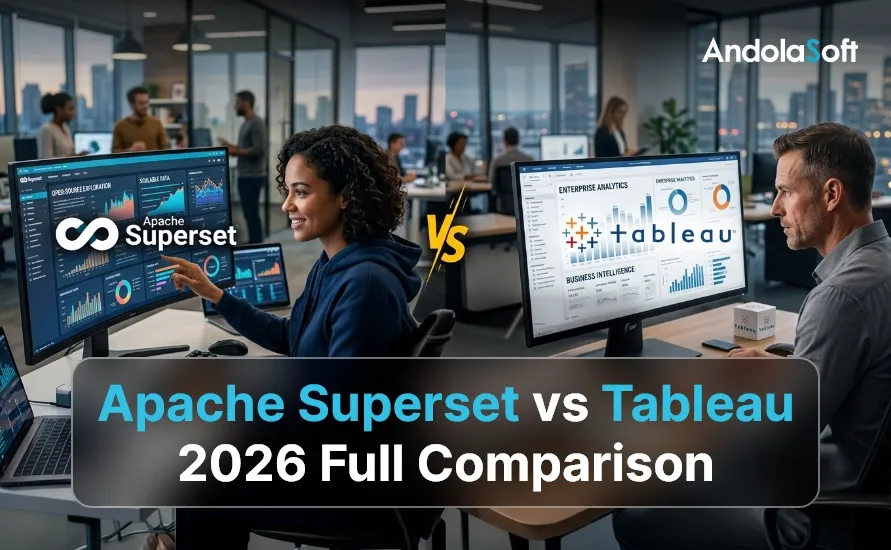
Apache Superset vs Tableau: 2026 Full Comparison

Choosing the right business intelligence tool can make or break your data strategy.

In 2026, the Apache Superset vs Tableau debate is hotter than ever. Both platforms help teams visualize data, build dashboards, and drive smarter decisions. However, they differ sharply in cost, complexity, and scalability.

So, which tool should you choose? In this guide, we break down everything — pricing, features, performance, and real-world use cases — so you can decide with confidence. If you’ve already seen how companies cut BI costs by 83% with Superset, you know why this comparison matters.

What Is Apache Superset?

Apache Superset is a free, open-source business intelligence platform built for modern data teams. Airbnb originally developed it in 2015 and donated it to the Apache Software Foundation.

Today, it’s one of the world’s most widely used open source BI tools. Superset connects to nearly any SQL-compatible database. Additionally, it supports interactive dashboards, advanced chart types, and custom SQL metrics.

The key advantage? Enterprise-grade analytics at virtually zero licensing cost. However, Superset requires technical expertise to set up. Therefore, many companies rely on Apache Superset development services to get started quickly and correctly.

What Is Tableau?

Tableau is a premium, commercial BI platform owned by Salesforce. It’s famous for its intuitive drag-and-drop interface and stunning visual outputs.

From startups to Fortune 500 companies, Tableau enjoys widespread adoption. However, that popularity comes with a significant price tag. As your team scales, so do the licensing costs — and that’s where our BI migration services help businesses make the switch without disruption.

Apache Superset vs Tableau: Head-to-Head Comparison

1. Pricing — The Biggest Differentiator

Let’s start with the number that usually decides everything: cost.

Apache Superset is 100% free. You only pay for hosting, which typically runs $50–$500/month. Our cloud infrastructure services team can set up a production-ready Superset environment on AWS or GCP affordably.

Tableau, by contrast, charges per user every month:

  • Tableau Viewer: $15/user/month
  • Tableau Explorer: $42/user/month
  • Tableau Creator: $75/user/month

For a 50-person team using Creator licenses, that’s $45,000 per year — just in licensing fees. With Superset, your total annual cost could be under $3,000. According to G2’s independent comparison, Superset consistently wins on value for money.

2. Ease of Use — Who Wins?

Tableau wins this round, and it’s not close. Its drag-and-drop interface requires no coding. Business analysts, marketers, and executives can build dashboards in minutes.

Superset has a steeper learning curve. You’ll need SQL knowledge to write data queries. Additionally, initial setup requires a developer. However, once properly deployed, the interface is clean and intuitive.

If your team lacks in-house technical resources, our data visualization consulting team bridges that gap — handling setup and training so your analysts can focus on insights, not infrastructure.

3. Data Connectivity

Tableau connects to 100+ data sources — Excel, Google Sheets, Salesforce, REST APIs, and more.

Superset supports 40+ databases via SQLAlchemy — PostgreSQL, MySQL, BigQuery, Snowflake, Amazon Redshift, and more. Our data analytics services team can also build custom database connectors for any non-standard data source.

For teams working primarily with SQL databases, Superset is more than sufficient. However, for non-SQL connectors out of the box, Tableau holds the advantage. Visit Superset’s official documentation for the full list of supported databases.

4. Visualization & Dashboard Design

Tableau offers 20+ chart types with pixel-perfect design flexibility. Its dashboards look polished right out of the box.

Superset offers a strong visualization library too — bar charts, line charts, heatmaps, geospatial maps, pivot tables, and funnel charts. Furthermore, you can extend it with custom JavaScript plugins. Our custom dashboard development team builds Superset dashboards that rival Tableau’s visual quality.

5. Performance & Scalability

Superset natively integrates with Apache Druid and Presto — making it a powerhouse for large-scale, real-time data workloads. Our Python development services team can build custom Superset extensions to push performance even further.

Tableau performs well, too. Its Hyper extract technology speeds up queries. However, performance can degrade with very large datasets without proper infrastructure. For enterprise-scale analytics, Superset gives you greater control over performance tuning.

6. Security & Governance

Both tools take security seriously. Tableau provides SSO, row-level security, LDAP, and OAuth out of the box, plus comprehensive audit logs.

Superset supports the same features. Additionally, since you self-host it, your data never leaves your own environment. This is a major advantage for companies with strict compliance requirements. Our enterprise software development team ensures Superset deployments meet the highest security standards.

7. Community & Support

Tableau has a massive ecosystem — thousands of tutorials, Salesforce’s enterprise support team, and a vibrant user community.

Superset’s community is growing quickly. The Apache Foundation actively maintains it. However, for enterprise-level support, many companies partner with a trusted Apache Superset implementation partner like Andolasoft. We offer dedicated open source software development and ongoing maintenance.

Apache Superset vs Tableau: Feature Comparison Table

Feature Apache Superset Tableau
Annual Licensing Free (open source) $75–$115/user/mo
Ease of Use Strong (V4+) Industry-Leading
Data Scale Petabyte-scale Degrades at TBs
Custom Visualizations Full React SDK Extension API Only
Embedding SDK Native Guest Tokens Tableau Server Only
SQL Lab Full IDE Built-in Not Available
Cloud Native K8s / Docker Native Partial Cloud
Open Source Apache Licensed Proprietary

Who Should Choose Apache Superset?

Superset is the right choice if you:

  • Have a limited BI budget and need to minimize licensing costs
  • Have SQL-capable data engineers or analysts on your team
  • Want full control over your data environment and infrastructure
  • Are you building on an open-source or cloud-native tech stack
  • Need to scale BI access without escalating per-user costs
  • Are you considering a BI migration away from expensive proprietary software

Our business intelligence solutions team specializes in Superset implementation for businesses of all sizes.

Who Should Choose Tableau?

Tableau is the right choice if you:

  • Need a zero-code, self-service BI tool for non-technical teams
  • Have a larger BI budget and need a rapid time-to-dashboard
  • Require extensive vendor support and a well-documented ecosystem
  • Need to connect to non-SQL data sources without custom development

According to Tableau’s official pricing page, enterprise licensing can scale significantly — making it worth comparing total cost of ownership before committing.

Frequently Asked Questions

1. Is Apache Superset better than Tableau?

It depends on your team’s needs and budget. Superset is better for cost-conscious, technical teams that want full control and flexibility over their BI environment. Tableau is better for non-technical teams that prioritize drag-and-drop ease and vendor support. Our BI consulting team can assess which tool best fits your organization.

2. Can Apache Superset replace Tableau entirely?

Yes — for most use cases. Superset covers all core BI functionality, including dashboards, charts, SQL queries, filters, and role-based access. Many companies have fully replaced Tableau with Superset and saved 70–85% on annual costs. Read our detailed Superset implementation guide to see how the transition works.

3. Is Apache Superset free to use?

Yes. Apache Superset is completely free and open source under the Apache 2.0 license. You only pay for the hosting infrastructure (typically $50–$500/month, depending on scale). There are no per-user fees, no annual license contracts, and no feature paywalls. Visit the official Apache Superset website for full documentation.

4. How long does it take to set up Apache Superset?

With the right partner, a production-ready Superset environment can be live in 1–2 weeks. This includes server provisioning, database connections, SSO setup, and security configuration. Our Apache Superset development team handles the entire setup end-to-end, so your analysts can focus on insights from day one.

5. What databases does Apache Superset support?

Superset supports 40+ SQL-compatible databases through SQLAlchemy. This includes PostgreSQL, MySQL, BigQuery, Snowflake, Amazon Redshift, Apache Druid, Presto, Trino, ClickHouse, and more. Our data analytics services team can also build custom connectors for non-standard or proprietary data sources.

6. Is Apache Superset secure enough for enterprise use?

Absolutely. Superset supports SSO, LDAP, OAuth 2.0, row-level security, column-level security, and role-based access control. Since you self-host it, your data never leaves your own environment — a significant advantage over cloud-hosted BI tools for compliance-heavy industries. Our enterprise software development team configures Superset to meet SOC 2, GDPR, and HIPAA requirements.

7. How does Tableau perform compared to Superset on large datasets?

Both tools handle large datasets well with the right configuration. Superset natively integrates with Apache Druid and Presto for real-time, petabyte-scale queries. Tableau uses its proprietary Hyper extract engine for fast aggregations. However, with Superset, you control your own infrastructure — meaning you can tune performance without any vendor constraints. Our cloud infrastructure services team optimizes Superset for your specific data volumes.

8. Can non-technical users use Apache Superset?

Yes — once it’s set up. Non-technical users can navigate dashboards, apply filters, drill down into data, and export charts without any SQL knowledge. The learning curve applies mainly to dashboard creation. Tableau remains easier for non-technical users to build dashboards independently. If your team needs self-service dashboard creation without SQL, consider pairing Superset with our data visualization consulting team to pre-build templates your users can customize.

9. What does it cost to migrate from Tableau to Apache Superset?

Migration costs vary based on the number of dashboards, data sources, and the complexity of your current Tableau setup. However, most migrations pay for themselves within 1–3 months of saved Tableau licensing fees. Our BI migration services team provides a detailed cost estimate and ROI projection during the free consultation so you know exactly what to expect before committing.

10. Does Andolasoft provide ongoing Apache Superset support after migration?

Yes. Andolasoft offers dedicated post-migration support, including bug fixes, performance optimization, new dashboard development, user training, and version upgrades. We also provide SLA-backed support plans for enterprise clients who need guaranteed response times. Contact our BI experts to discuss a support plan tailored to your team size and usage needs.

Final Verdict: Apache Superset vs Tableau in 2026

Here’s the bottom line.

If cost efficiency is your priority, Apache Superset wins. It delivers enterprise-grade analytics at a fraction of Tableau’s price. Additionally, it gives you full ownership of your data environment.

If ease of use and vendor support matter most, Tableau wins. Its no-code interface and professional support make it ideal for non-technical teams.

However, for most growing businesses in 2026, Apache Superset offers the best return on investment. With the right implementation partner, you get everything Tableau offers — without the price tag.

Let Andolasoft Build Your Superset BI Environment

At Andolasoft, we specialize in Apache Superset development, custom dashboard design, and BI migration. Our expert team handles everything — from initial setup to advanced dashboard design and ongoing support.

We’ve helped clients across e-commerce, healthcare, fintech, and SaaS industries unlock the power of open-source BI. Learn more about our team and approach.

Ready to make the switch? Contact our BI experts today and get a free consultation. We’ll help you cut costs, scale fast, and never look back.
Dual-Axis Line Chart Plugin for Superset 4.1: Unlock Dual Perspectives in Dashboards

In a data-driven world, organizations are not looking for more dashboards — they are looking for deeper clarity. A single metric rarely tells the complete story:

  • Revenue must be evaluated against cost
  • Application usage must be compared to latency
  • Inventory must be analyzed alongside demand

Yet, BI tools often restrict how many perspectives can be visualized together.

That’s the gap our Dual-Axis Line Chart Superset plugin solves.

Why Dual-Axis Visualization Matters More Than Ever

High-growth teams in fintech, NBFCs, SaaS, logistics, and manufacturing rely on understanding how metrics influence each other.

A Dual-Axis Line Chart provides:

  • Two independent Y-axes
  • Clear comparison of two metric trends
  • Distortion-free visual correlation
  • A single chart that narrates multi-layered insights

However, Superset does not provide a native dual-axis line chart. So — we built one.

Dual-Axis Plugin for Superset Key Capabilities

Introducing Our Dual-Axis Line Chart Plugin for Superset

Built using ECharts and fully integrated with Superset 4.1, our plugin enables:

  • Seamless native behavior in dashboards
  • Visualization at scale with high performance
  • Accurate multi-axis comparison for analytics teams

It’s engineered for enterprise BI — without compromising Superset’s performance model.

Crafted Using ECharts for Maximum Flexibility

ECharts powers advanced visual control including:

  • Smooth animated transitions
  • Independent Y-axis formatting (currency, %, units)
  • Custom theming to match your brand
  • Tooltip synchronization
  • Dynamic legend interactions

Just drop it into your dashboard — no manual configuration required.

Built for Superset 4.1 and Beyond

This Dual-Axis Line Chart Superset plugin:

  • Works natively with Superset’s latest plugin architecture
  • Adapts to filters and cross-filters
  • Supports all standard query APIs
  • Efficiently handles large datasets
    • Remains compatible with Superset 6.x visualization roadmap

Your analytics experience stays future-ready.

Perfect for NBFC & Financial Analytics

NBFCs rely heavily on correlated metric intelligence.

This plugin enables powerful financial comparisons like:

Metric Compared With
Loan Disbursement Collections Trend
Portfolio Growth Risk Exposure
Overdue Ratio Receivables
Customer Acquisition CAC
Interest Income Operational Cost

Compliance + risk analysis become faster and more accurate.

Easy Deployment for Enterprise Environments

We ship everything needed for smooth deployment:

  • Packaged plugin bundle
  • Optional CI/CD automation scripts
  • Full DevOps documentation
  • Compatibility validation with your Superset setup

Supported setups include:

  • Docker/Kubernetes
  • Multi-instance Superset clusters
  • Cloud-native deployments
  • Secure, air-gapped environments

Install → Restart → Enable → Start visualizing multi-axis insights

Why This Dual-Axis Plugin Matters for Your Organization

Better insight leads to better decisions:

  • Reduces dashboard clutter
  • Strengthens executive reporting
  • Enhances decision-making clarity
  • Unlocks BI capabilities beyond native Superset
  • Supports multi-dimensional data narratives

Your teams shift from reactive analytics to proactive strategy.

More Superset Possibilities for Your Enterprise

This plugin is just the beginning. We help enterprises build:

  • Custom visualization plugins
  • Domain-specific KPI widgets
  • Industry-focused dashboards
  • Superset upgrades & migrations
  • Advanced analytics UI experiences

If Superset doesn’t support it — we will engineer it.

Bring Multi-Axis Intelligence to Your Dashboards

Your data has more stories.

Moreover, your dashboards deserve richer intelligence.

Your leaders need clear, contextual insights.

With our Dual-Axis Line Chart Superset plugin, you deliver exactly that.

Apache Superset vs Power BI vs Tableau: Which BI Tool Fits Your Enterprise?

Analytics is no longer a single tool decision; it’s a platform choice that shapes your data architecture, governance model, and talent strategy. Cloud data lakes, lakehouses, and streaming sources have expanded, AI is now table stakes, and governance-by-design is the default expectation from CIOs and CISOs. With budgets under pressure, leaders must balance capability, cost, and vendor lock-in. This guide compares Apache Superset, Microsoft Power BI, and Tableau using enterprise-grade criteria so you can select a platform that fits your architecture, scale, and compliance needs—without surprises later.

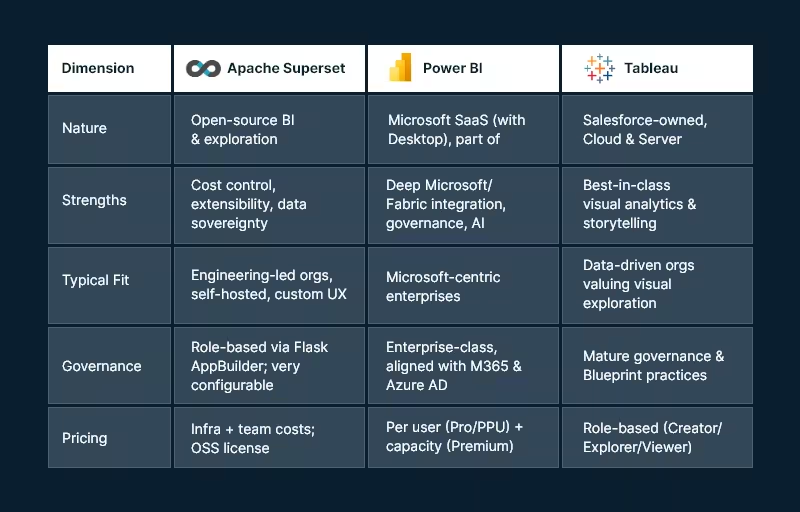
Snapshot: the three platforms at a glance

Apache_Superset vs. Power BI vs. Tablue

Core evaluation criteria

  1. Data connectivity & modeling
  2. Visualization & self-service
  3. Governance, security & compliance
  4. Pricing & TCO
  5. AI & automation
  6. Deployment, scalability & performance
  7. Ecosystem & extensibility

Data connectivity & modeling

Apache Superset

Superset connects to SQL-speaking databases through Python DB-API drivers and SQLAlchemy dialects — great for lakehouses and modern warehouses. This approach offers broad coverage and makes adding new engines straightforward, provided drivers/dialects exist.

Modeling approach: SQL-first. You’ll define datasets as saved queries or table references. Complex semantic modeling (like ragged hierarchies or row-level calc logic) is possible but typically handled in the data layer (dbt, views, materializations) or via custom code.

Power BI

Power BI provides multiple modes (Import, DirectQuery, Direct Lake with Fabric) and a robust semantic model (tabular) supporting measures, relationships, and calculations via DAX. The product is increasingly intertwined with Microsoft Fabric (Lakehouse, Dataflows Gen2, Pipelines) to unify ingestion, transformation, and modeling.

Tableau

Tableau connects broadly and emphasizes flexible joins/relationships via the Tableau Data Model, plus Tableau Prep for visual data prep. Prep Builder (authoring) and Prep Conductor (orchestration) integrate into a governed pipeline with the Data Management add-on.

Bottom line:

  • Choose Superset if your team is comfortable modeling in SQL/dbt and wants to leverage your warehouse semantics directly.
  • Choose Power BI if you need a governed semantic layer with DAX and tight integration to a Fabric Lakehouse.
  • Choose Tableau if you want visual modeling and prep that business users can learn quickly.

Visualization & self-service analytics

Apache Superset

Superset’s chart gallery covers essentials (time-series, categorical, geospatial, ECharts) and supports custom visualizations. The focus is on efficient exploration and lightweight dashboard authoring. Power users can extend visuals or embed dashboards into internal apps.

Power BI

The Power BI also blends pixel-perfect visuals with enterprise reporting patterns. Shared datasets, Apps, and reusable semantic models support organizational BI at scale. Tight integration with Office 365 and Teams helps business users collaborate around insights.

Tableau

Tableau remains the benchmark for visual exploration and storytelling. Its drag-and-drop paradigm, level-of-detail expressions, and presentation-ready dashboards make it a favorite for analysts and executives. Tableau’s strengths often show in ad-hoc discovery and interactive stories.

Bottom line:

  • Exploration/storytelling first: Tableau.
  • Standardized, governed reporting at scale: Power BI.
  • Customizable OSS exploration & embedded scenarios: Superset.

Governance, security, & compliance

Apache Superset

Authentication and authorization ride on Flask AppBuilder, enabling role-based access control with fine-grained permissions. Superset’s production security guide (v4+) lists best practices for hardening, SSO, and secrets management—important for regulated environments and self-hosting.

Power BI

Power BI’s governance aligns with Microsoft Entra ID (Azure AD), M365 security, and Fabric administration. Licensing tiers add capabilities (e.g., dataset size limits, deployment pipelines, XMLA endpoints). Premium Per User (PPU) delivers most premium features without dedicated capacity—useful for advanced workloads in smaller groups.

Tableau

Tableau offers a mature governance blueprint, with centralized, delegated, and self-governing models to align with your operating model. Its Data Management (Catalog + Prep Conductor) strengthens lineage, trust, and certified data. Deploy to Tableau Cloud (SaaS) or Tableau Server (self-managed) under role-based or core licensing.

Bottom line:

  • Superset gives you complete control — you own the controls and responsibility.
  • Power BI provides enterprise-grade governance out of the box, especially if you’re already standardized on Microsoft identity and security.
  • Tableau provides clear governance models and strong lineage/certification when combined with Data Management.

Pricing & total cost of ownership (TCO)

Apache Superset

License cost is $0 (Apache 2.0), but you’ll incur infrastructure, DevOps, and support costs. The upside: no vendor lock-in and ability to right-size infra and negotiate cloud costs. Feature parity for niche needs might require engineering effort.

Power BI

As of April 1, 2025, Microsoft lists Power BI Pro at USD $14/user/month and PPU at USD $24/user/month, with Premium capacity priced separately. These increases were announced in Nov 2024 and are now in effect.

Tableau

Tableau pricing is role-based. Official materials describe Creator / Explorer / Viewer and deployment options (Cloud/Server). Public sources commonly reference Creator ~ $75/user/month, Explorer ~ $42, Viewer ~ $15 (billed annually); always verify your regional and enterprise terms.

TCO considerations:

  • Superset can have the lowest cash outlay but requires engineering maturity.
  • Power BI offers predictable per-user economics and can reduce integration costs if you already pay for Microsoft 365/Azure.
  • Tableau can be costlier per Creator seat but may shorten time-to-insight thanks to its visual paradigm — valuable for decision velocity.

AI & automation

  • Power BI integrates with Microsoft Fabric and offers Copilot experiences for report creation and narrative insight generation, with governance controls at the tenant level. For orgs pursuing AI-assisted analytics inside a Microsoft stack, this is compelling.
  • Tableau has expanded Data Management and Prep features, with regular new releases that bolster governance and operationalization — complementary to AI-ready data foundations. (Check the current “What’s New” page for recent features relevant to your version.)
  • Superset relies on the OSS ecosystem for AI — e.g., pairing with notebooks, LLM services, or embedding AI APIs. This keeps you flexible but places more responsibility on your platform team.

Deployment, scalability, & performance

Apache Superset

Superset is cloud-native and designed to scale horizontally. You can containerize, run behind a reverse proxy, and integrate with your observability stack. Tuning is in your hands via superset_config.py and infra choices (workers, caches, async queries).

Power BI

SaaS operations are Microsoft-managed. Scaling is typically managed via capacity (Premium) and workspace governance. Fabric unifies ingestion and storage, lowering cross-tool friction and reducing operational complexity.

Tableau

You can choose Tableau Cloud for managed scaling or Tableau Server for on-prem/VMs/K8s. Tableau’s core-based licensing on Server can suit high-concurrency, view-only workloads; role-based licensing helps plan predictable per-user costs.

Ecosystem & extensibility

  • Superset: Python ecosystem, SQLAlchemy, ECharts/Chart plugins, REST API, and embeddable components—ideal for custom apps, internal portals, and bespoke workflows.
  • Power BI: Deep ISV ecosystem, certified visuals, Power Automate flows, and Azure services (Purview, Synapse, Fabric).
  • Tableau: Extensions API, accelerators, Tableau Exchange, and strong community resources for industry-specific dashboards.

Implementation playbooks (by enterprise profile)

Microsoft-centric enterprise (M365, Azure, Fabric)

  • Primary choice: Power BI
  • Why: Single-sign-on via Entra ID, Fabric lakehouse + Direct Lake for scale, governance aligned with your tenant, and Copilot for faster authoring.
  • Risks to manage: Capacity planning and DAX skill development.

Design-led analytics culture (data storytelling, exec consumption)

  • Primary choice: Tableau
  • Why: Visual exploration, LOD expressions, and storytelling make analytics stickier and speed up insight cycles.
  • Risks to manage: Role mix optimization (Creator vs Explorer vs Viewer) and ensuring certified data via Data Management.

Engineering-first platform (data sovereignty, OSS, custom UX)

  • Primary choice: Apache Superset
  • Why: Open-source flexibility, no vendor lock-in, and ability to embed analytics in internal tools.
  • Risks to manage: Operational ownership (security hardening, upgrades, scaling) and the need for internal SLAs.

Highly regulated, on-prem or hybrid

  • Primary choice: Superset or Tableau Server
  • Why: Self-hosting and granular control. Superset demands more DevOps; Tableau Server provides an enterprise-grade commercial option.

Decision worksheet (quick scoring template)

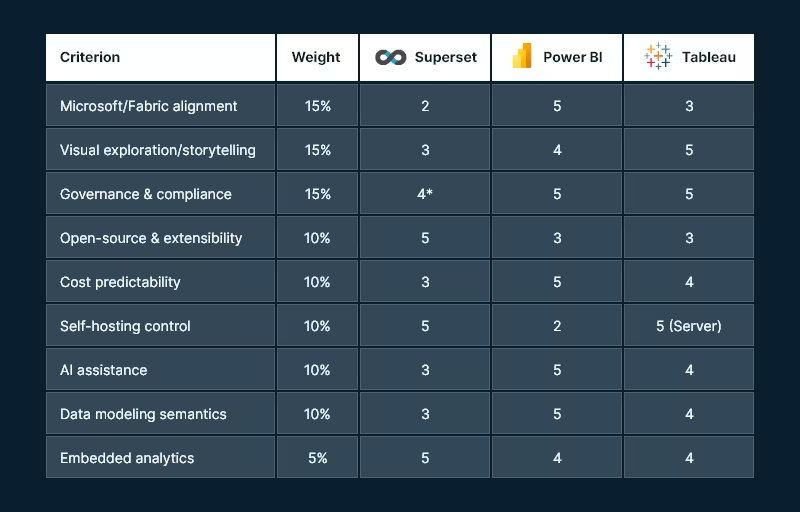
Use a 1–5 score for each criterion (5 = excellent fit). Multiply by the suggested weight to compute a weighted score.

Decision worksheet

* Superset can be excellent for governance if you invest in configuration, SSO, and hardening.

Tip: In real life, weights drive the outcome. If AI and Fabric matter, Power BI often wins. When data sovereignty and extensibility matter, Superset leads. However, when ad-hoc visual discovery is key, Tableau tends to top the list.

Recommended next steps (how Andolasoft can help)

  • Solution discovery workshop (2–3 weeks): Architecture mapping, data source inventory, governance model, and rapid POC in your preferred tool.
  • Pilot implementation: One high-value dashboard end-to-end (ingest → model → govern → publish), with CI/CD and cost telemetry.
  • Migration playbook: If you’re switching tools, we build a content inventory, semantic mapping, and automated testing harness for safe cutover.
  • Managed enablement: Training for creators/explorers, governance council setup, and a Center of Excellence playbook.

Want a hands-on assessment tailored to your stack? Andolasoft can architect and implement Superset, Power BI, or Tableau—including hybrid approaches that leverage your existing investments.

FAQs

Q1. Which tool is most cost-effective for 1,000 viewers and 50 creators?

If you’re already on Microsoft 365 and Azure, Power BI often yields the best per-user economics — especially if you can confine premium workloads to PPU or a single capacity. Tableau can be costlier for Creators but may reduce analysis time. Superset avoids license fees but requires platform engineering and ongoing ops.

Q2. Do I need Microsoft Fabric to use Power BI?

No. You can use Power BI with many data sources. However, Fabric unifies ingestion, storage, and modeling (e.g., Direct Lake) and streamlines operations—so many enterprises adopt it for scale and governance.

Q3. Can Apache Superset meet enterprise security requirements?

Yes — with the right hardening. Superset provides role-based security via Flask AppBuilder and a production security guide (v4+). You’ll need to implement SSO, secret management, and infra best practices.

Q4. What are current Power BI and Tableau prices?

Microsoft lists Power BI Pro at $14 and PPU at $24 per user/month (as of Apr 1, 2025; Premium capacity separate). Tableau uses role-based pricing (Creator/Explorer/Viewer) with commonly referenced figures of $75/$42/$15 per user/month billed annually (verify your quote and region).

Q5. Which tool is best for embedded analytics?

All three support embedding. Superset is attractive for internal app embedding in engineering-heavy orgs; Power BI and Tableau provide commercial-grade embedding SDKs supported by their broader ecosystems.

Q6. We’re a public sector/regulated enterprise — what’s safer?

If you require on-prem, consider Tableau Server or self-hosted Superset. If cloud is acceptable under your regulator, Power BI (with tenant and capacity controls) can meet stringent compliance regimes.

Conclusion: Matching the tool to your enterprise DNA

  • Pick Power BI if your business is already invested in Microsoft and wants AI-assisted analytics with unified Fabric data operations and strong governance.
  • Choose Tableau if your analytics success depends on speed of insight, story-driven dashboards, and you want proven governance models with flexible deployment.
  • Go with Apache Superset if you value open-source control, cost efficiency, and custom embedding, and you have the engineering strength to own the platform.

Most large enterprises end up multi-tool (e.g., Power BI for governed reporting + Tableau for storytelling; or Superset embedded in custom portals). The win is a governed data foundation, a clear RACI for content creation, and automation that keeps data fresh and trustworthy.

From Data to Decisions: Leveraging AI in CRMLeaf for Smarter Sales Forecasting

This edition includes richer insights, practical examples, and in-depth business function coverage across Sales, Marketing, Operations, Finance, and HR to make the content impactful and robust for a website, eBook, or PDF format.

The Forecasting Revolution

Why Sales Forecasting Isn’t Just for Sales Anymore

Forecasting used to be a sales manager’s concern. Today, every department—from operations to HR—relies on accurate predictions to stay competitive, agile, and profitable.

Traditional forecasting struggles because:

  • It’s static: Spreadsheets are outdated as soon as they’re created.
  • It’s isolated: Sales works in a silo while other departments guess.
  • It’s reactive: There’s no foresight—only hindsight.

Inaccurate forecasts cost businesses up to 15% in lost revenue annually
61% of sales leaders say their current forecasts are unreliable

That’s where CRMLeaf’s AI-driven forecasting comes in.

How CRMLeaf Makes a Difference

CRMLeaf transforms raw data into real-time, intelligent forecasts using:

  • Machine learning models
  • Historical and behavioral data analysis
  • 15-minute live forecast refreshes
  • Integrated views across teams

With CRMLeaf, forecasts are:

  • Dynamic – updated constantly as deal status and customer activity evolve
  • Cross-functional – accessible to marketing, finance, ops, and HR
  • Prescriptive – not just “what will happen,” but “what to do next”

Sales Forecasting—Evolved

Sales: Focused, Faster, More Predictable Closures

CRMLeaf’s AI analyzes thousands of data points to prioritize leads, deals, and reps’ time.

What it does:

  • Scores deals based on likelihood to close
  • Flags at-risk opportunities
  • Identifies best-performing sales behaviors

Use Case:

A SaaS company with 150 deals in Q2 ($2.1M total value) finds that only 58 deals ($1.2M) are highly likely to close.
With this insight, the sales team focuses on these deals → Close rate improves by 22%, and rep productivity jumps 30%

Key Sales Benefits

  • 25–40% reduction in time spent on dead deals
  • Accurate weekly forecasts for leadership reviews
  • Adjusts automatically based on rep inputs, client responses, and CRM changes

The Marketing, Ops, and Finance Triangle

Marketing: Data-Driven Campaign Strategy

CRMLeaf shows which lead sources convert fastest and most profitably. AI connects marketing channels to revenue impact—not just MQLs.

Use Case:

Marketing finds webinar leads are 3X more likely to convert than paid social ads. Budget is shifted accordingly → Campaign ROI increases by 37% over the quarter.

Impact:

  • Smarter spend allocation
  • Better timing of campaigns to match pipeline stage
  • Content personalization based on buyer readiness

Operations: Capacity Planning with Confidence

No more guesswork around order fulfillment, onboarding, or delivery timelines.

Use Case:

A product company forecasts a 20% Q3 sales spike. CRMLeaf alerts ops 8 weeks ahead → Extra inventory is ordered → Zero stockouts, delivery SLAs met

Impact:

  • Align resources to demand
  • Prevent over/understocking
  • Schedule field/service staff proactively

Finance: Forecast-Driven Budgeting

Finance gets early alerts on pipeline shifts, deal health, and expected revenue fluctuations.

Use Case:

AI forecasts a potential $300K shortfall for Q2. Finance adjusts monthly spending and defers new hiring → Cash flow stays positive

Key gains:

  • Timely CAPEX/OPEX adjustments
  • Revenue recognition planning
  • Forecasts sync with P&L models

HR & Strategic Leadership

HR: Predictive Workforce Planning

CRMLeaf’s forecasts help HR plan staffing based on sales and customer pipeline volume.

Use Case:

A 45% increase in enterprise sales means more customer onboarding → CRMLeaf flags this trend → HR accelerates hiring for onboarding specialists → Training begins 3 weeks early

HR wins:

  • Align recruitment with demand
  • Scale support teams as new customers onboard
  • Reduce burnout and attrition with smarter staffing

Strategic Alignment for Executives

With all functions plugged into the same forecasting engine, leadership can:

  • Review department goals with unified metrics
  • Run “what-if” growth scenarios (e.g., 10% drop in pipeline)
  • Make M&A, expansion, or investment decisions based on real-time forecast models

“CRMLeaf is our single source of truth. It connects all the dots—from marketing intent to HR strategy.”
— CEO, Fintech Startup

Real Results + Getting Started

Quantified Business Outcomes from CRMLeaf AI Forecasting

  • 35% faster decision-making across departments
  • 20–30% better forecast accuracy
  • 15% increase in revenue visibility
  • Fewer missed deadlines and operational delays
  • Optimized team utilization across HR and support

Testimonials

“Our forecast accuracy went from 62% to 91% in just two quarters with CRMLeaf.”
— CRO, B2B Software Company

“Marketing and sales now speak the same language. That alone is worth it.”
— CMO, eCommerce Retailer

Start Forecasting Smarter—Today

Implementing CRMLeaf AI forecasting takes less than 30 minutes, and the payoff begins instantly.

No more guesswork. No more reactive firefighting.

Just clear, confident decisions across your entire organization.

Schedule a Demo with CRMLeaf and turn your data into direction.

When Dashboards Started Thinking: The Journey of Superset and AI

Once upon a time, data was scattered. Teams worked in isolation, reports came late, and dashboards, though detailed, offered only a glimpse of the past. Numbers were there, but clarity was not. Insight was rare. And foresight? Almost impossible.

Then, everything changed.

The Turning Point: From Static to Smart

It started with a realization:

Traditional BI tools showed what happened, but not why. Not what’s next.

That gap led to a powerful new combination:

  • Superset—a flexible, open-source data visualization platform that democratizes data access.
  • Artificial Intelligence (AI)—A game-changer in predictive analytics, pattern recognition, and data storytelling.

Together, they turned dashboards from static charts into intelligent decision-making systems.

Superset: The Canvas for Data Stories

Superset brought visual simplicity and data exploration together:

  • Clean, intuitive interface
  • Connects to popular databases (PostgreSQL, MySQL, BigQuery, Snowflake, etc.)
  • Custom SQL-based reporting and no-code filtering
  • Drag-and-drop dashboards and a wide chart library
  • Real-time data interaction

Whether for a quick KPI snapshot or a deep-dive analysis, Superset became the go-to canvas for visual narratives.
But numbers alone don’t tell the full story. Meaning and intelligence were still missing.

AI: The Brain Behind the Dashboard

AI stepped in to fill that gap, turning data into actionable insights:

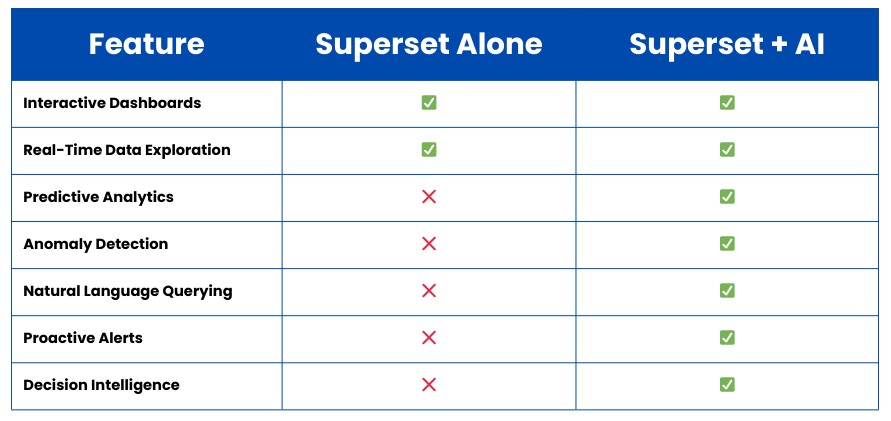
  • Trend Detection: Surfaced subtle shifts in data patterns
  • Anomaly Alerts: Spotted unusual activities instantly (e.g., revenue drops, login spikes)
  • Forecasting Models: Predicted future outcomes based on historical trends
  • Natural Language Queries (NLP): Users could ask, “Show Q2 revenue breakdown by product,” and get instant visual answers
  • Proactive Notifications: Triggered alerts when KPIs deviated from the norm

Now, dashboards don’t just show data.

They understood it, reacted to it, and anticipated what’s next.

A New Way to See and Decide

The result? Business intelligence shifted from being data-centered to decision-centered.

  • Teams made faster decisions with contextual insights
  • No more delays or backlogs in reporting requests
  • Data exploration became interactive and ongoing
  • Non-technical users could extract powerful insights without writing a line of SQL

Data was no longer a department—it became a capability across the organization.

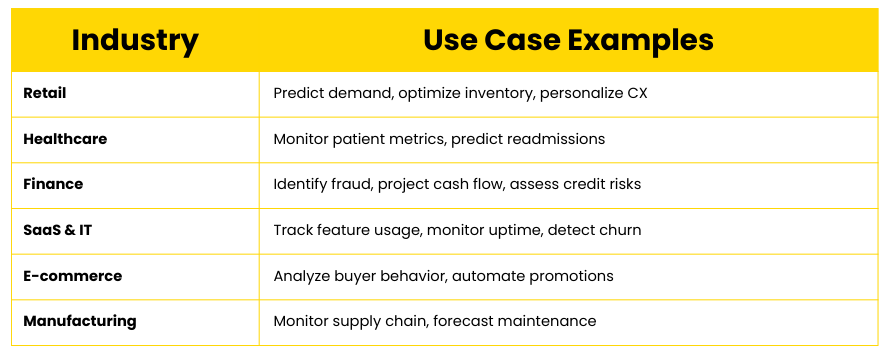
Where This Works Best

Where This Works Best

Benefits at a Glance

Benefits at a Glance

From Reactive to Proactive

This isn’t just about having prettier charts. It’s about

  • Moving from reporting to predicting
  • Turning raw data into automated decision support
  • Freeing up analyst time with self-serve insights

Superset and AI don’t just visualize the past.

They help you act on the future.

Ready to Transform the Way You Use Data?

If you’re ready to

  • Stop reacting to reports and start forecasting outcomes
  • Equip every team with smart, real-time dashboards
  • Replace isolated data teams with collaborative insight cultures

Then this is the moment to embrace Superset + AI.

Start your journey to smarter analytics today.