5 Signs You Need a Successful Digital Strategy & Transformation

⚡ TL;DR — Signs Your Business Need Digital Strategy & Transformation

  • Businesses without a clear digital strategy risk losing customers to faster, more digitally advanced competitors offering better customer experiences.
  • Manual processes, disconnected systems, and operational inefficiencies slow business growth and reduce overall productivity.
  • Data-driven businesses make faster and smarter decisions using real-time analytics, dashboards, and predictive insights instead of manual reporting.
  • Aging IT infrastructure, outdated software, and poor scalability increase security risks, downtime, and operational costs.
  • Successful digital transformation requires not only technology upgrades but also a strong digital culture, innovation mindset, and employee adoption.
  • Andolasoft helps businesses modernize operations through cloud migration, intelligent automation, enterprise integration, data analytics, and agile product development services.

In today’s hyper-competitive landscape, digital strategy and transformation is no longer a luxury reserved for large enterprises. It is a survival imperative for startups, SMEs, and SaaS businesses alike. Every month you delay, a digitally agile competitor gains ground — faster, smarter, and at a fraction of your cost.

According to McKinsey Digital, companies that successfully execute digital transformation are 1.5x more likely to achieve sustained revenue growth above 10% per year. Yet, a staggering 70% of digital transformation efforts fail — not because the technology is wrong, but because businesses lack a clear, actionable digital strategy.

At Andolasoft, we have spent over a decade helping SMEs, SaaS companies, and growing enterprises build winning digital strategies. From intelligent automation to application modernization, we know exactly what it takes to transform a business for the digital age.

In this blog, we break down the 5 critical signs that your organization urgently needs a digital strategy and transformation — and what steps you can take right now.

Sign #1: You Are Losing Customers to Digitally Advanced Competitors

One of the clearest warning signs is customer churn. When your buyers start choosing competitors not because of price, but because of experience — faster delivery, self-service portals, mobile apps, personalized journeys — you have a digital strategy problem.

Today’s customers expect seamless omnichannel experiences. They want to interact with your brand on mobile, web, chat, and social — all connected, all instant. If your business cannot deliver that, they will simply move on.

A robust digital strategy and transformation puts the customer experience at the center. It aligns your technology, processes, and people around what your customers actually need.

6 warning signs you’re losing to digital competitors:

  • Your website takes more than 3 seconds to load on mobile devices.
  • You do not offer a self-service customer portal or 24/7 digital support.
  • Customers complain about inconsistent experiences across channels.
  • Your NPS (Net Promoter Score) has declined for two or more consecutive quarters.
  • Competitor apps and platforms are attracting your target demographic away.
  • You rely on phone and email for support while rivals offer AI-powered chat and instant resolution.

With autonomous AI assistants and digital governance solutions, Andolasoft helps you build customer-first digital experiences that convert, retain, and delight.

Sign #2: Your Internal Processes Are Slow, Manual, and Disconnected

Are your employees still working across disconnected spreadsheets? Is data siloed across departments, making collaboration difficult and reporting a nightmare? These are textbook signs of a business that has not yet embraced digital operations.

Manual, repetitive processes not only drain time and money — they introduce errors, slow down decision-making, and frustrate your best talent. When operations cannot scale, growth becomes impossible.

This is where intelligent automation and enterprise integration become game-changers. By connecting your systems and automating repetitive workflows, you free your teams to focus on strategic, high-value work.

6 signs your operations need digital transformation:

  • Employees spend more than 30% of their time on manual data entry or reporting.
  • Approvals and workflows take days instead of minutes due to email-based bottlenecks.
  • Different departments use incompatible tools with no single source of truth.
  • Onboarding new employees takes weeks because processes are not documented digitally.
  • You cannot get a real-time view of business performance without pulling data manually.
  • Errors, duplicate records, and miscommunication are common due to disconnected systems.

Andolasoft’s enterprise integration services connect your CRM, ERP, HRMS, and marketing tools into one unified ecosystem. Paired with intelligent automation, you can eliminate hours of manual work every single day.

Sign #3: You Are Making Business Decisions Without Data Insights

If your leadership team is still relying on gut feel, weekly Excel reports, or end-of-month summaries to make strategic decisions — your business is operating blind. In 2026, data is the new oil. Businesses that harness it grow faster, waste less, and pivot smarter.

According to Gartner, by 2026, organizations that are data-driven are 3x more likely to report significant improvements in decision-making compared to their peers. The question is: are you one of them?

Andolasoft’s data analytics and Superset BI services give your leadership real-time dashboards, predictive analytics, and actionable business intelligence — so you stop reacting and start leading.

6 signs your business lacks data intelligence:

  • Your monthly reports take 3–5 days to compile and are outdated by the time they’re ready.
  • You lack visibility into which products, campaigns, or customers drive the most revenue.
  • Forecasting is done manually or based on historical averages, not real trend analysis.
  • Your team debates over which data source is “correct” due to multiple disconnected tools.
  • You cannot track KPIs in real time or drill down into operational performance instantly.
  • Customer behavior, churn risk, and sales pipeline data are unavailable or difficult to access.

With AI framework services from Andolasoft, you can build predictive models and machine learning pipelines that turn raw data into competitive advantage. Our loan analytics systems and BFSI dashboards are live proof of this capability.

Sign #4: Your IT Infrastructure Is Aging and Cannot Scale

Legacy IT systems are the biggest silent killer of business growth. When your software is outdated, your servers are on-premise, your security patches lag, and your development cycles take months — you are not just slow. You are vulnerable.

As your business grows, your IT infrastructure must scale with it. If every spike in demand crashes your systems or requires expensive emergency maintenance, you have outgrown your technology stack. A successful digital strategy and transformation starts with modernizing this foundation.

Andolasoft’s cloud infrastructure services and application modernization expertise help you migrate from costly legacy systems to secure, scalable cloud-native architectures — with zero business disruption.

6 signs your IT infrastructure needs urgent modernization:

  • Your on-premise servers require expensive annual maintenance contracts and frequent downtime.
  • Deploying new software features takes weeks or months due to rigid, monolithic architecture.
  • Your business experienced a security breach or compliance failure in the last 24 months.
  • Remote work or multi-location teams struggle with access, performance, and connectivity issues.
  • Your current tools do not integrate with modern SaaS platforms, APIs, or third-party services.
  • Your IT team spends more time firefighting outages than building new capabilities.

Our enterprise IT security team ensures your transformation is protected end-to-end. Combined with software quality assurance, every system we modernize is tested, secure, and production-ready from day one.

Sign #5: Your Team Lacks Digital Skills and an Innovation Mindset

Technology alone does not drive digital transformation — people do. If your leadership team does not prioritize digital innovation, if your employees resist new tools, or if your organization does not have a culture of experimentation, your transformation will stall before it starts.

According to a Harvard Business Review study, 62% of digital transformation failures are caused by cultural resistance, not technology limitations. Building digital fluency and a growth mindset across your organization is just as important as deploying the right tools.

A strong digital strategy includes a people transformation component. This means upskilling, change management, and embedding innovation into your R&D culture so that growth becomes self-sustaining.

6 signs your team needs a digital culture reset:

  • Employees resist new software tools and revert to old habits within weeks of training.
  • Your leadership team does not include a Chief Digital Officer or technology advocate.
  • There is no budget allocated for R&D, innovation labs, or technology pilots.
  • Cross-functional digital projects consistently fail due to poor collaboration and ownership.
  • Hiring for technical roles (developers, data scientists, UX designers) is extremely difficult.
  • Your organization has not launched a new digital product, feature, or initiative in 12+ months.

Andolasoft’s Innovation & Product R&D services help you build a roadmap for sustainable digital growth. Our ReactJS development and Python development teams embed directly into your workflows to accelerate delivery and build internal digital capability.

How Andolasoft Powers Your Digital Strategy and Transformation

Recognizing these signs is the first step. Acting on them is what separates businesses that thrive from those that get left behind. At Andolasoft, we do not just consult — we execute.

Our end-to-end digital strategy and transformation services include:

  • Digital Roadmap Design — We assess your current state and build a phased transformation plan aligned to your business goals.
  • Cloud Migration & Infrastructure Modernization — Move from legacy to cloud-native with zero business disruption via our cloud infrastructure services.
  • Intelligent Process Automation — Eliminate manual bottlenecks with AI-powered intelligent automation workflows.
  • Data & BI Implementation — Build real-time dashboards and AI-driven insights with our data analytics and Superset BI services.
  • Security & Compliance — Protect your digital assets end-to-end with enterprise IT security.
  • Agile Product Development — Build and launch digital products fast with our expert ReactJS and Python development teams.

Conclusion: The Right Time to Transform Is Now

Digital strategy and transformation is not a future project — it is today’s competitive necessity. If your business shows even two or three of the five signs outlined in this blog, you are already behind the curve. The longer you wait, the costlier the catch-up becomes.

Andolasoft has helped businesses across industries — from BFSI and NBFC to SaaS and retail — build and execute digital strategies that deliver measurable results. Whether you need to modernize legacy systems, automate operations, harness data, or build a digital-first culture, we have the expertise and the track record to make it happen.

Don’t let your competition define your digital future. Partner with Andolasoft to build a digital strategy that works — and transformation that lasts.

Frequently Asked Questions

Q1: What is digital strategy and transformation?

Digital strategy and transformation is the process of integrating digital technology into all areas of a business — fundamentally changing how it operates and delivers value to customers. It goes beyond simply adopting new tools; it’s about rethinking business models, processes, and culture for the digital age.

Q2: How long does digital transformation take for an SME?

The timeline varies by scope and readiness, but most SMEs see initial results within 3–6 months of starting a focused digital transformation initiative. A full enterprise-wide transformation typically spans 12–36 months, implemented in phased stages to minimize disruption.

Q3: What is the biggest risk of not having a digital strategy?

The biggest risk is competitive irrelevance. Without a digital strategy, businesses lose customers to more agile competitors, struggle to scale operations, and face mounting technical debt. Over time, this translates into shrinking market share, higher operational costs, and an inability to attract top talent.

Q4: How much does digital transformation cost for a small or mid-sized business?

Costs depend on the scope of transformation. A phased approach — starting with process automation or cloud migration — can begin at a relatively modest investment. The key is to start with high-ROI initiatives and expand from there. Andolasoft offers flexible engagement models tailored to SME budgets.

Q5: Where should a business start with digital transformation?

Start with a digital readiness assessment to identify your biggest pain points and opportunities. Focus first on areas that directly impact customer experience or operational efficiency — such as automating manual workflows, migrating to cloud infrastructure, or implementing a BI dashboard for real-time decision-making.

Must-Have Enterprise BI Features for Modern Applications

Enterprise software no longer competes on features alone. It competes on how fast decisions are made, how accurately performance is measured, and how quickly leaders can respond to change. That is exactly why enterprise BI has moved from a “nice-to-have” analytics layer to a core operating system for decision-making.

Today, every serious enterprise application — whether it is ERP, CRM, HRMS, FSM, construction management, or financial systems — must embed or integrate BI at its core.

However, not all analytics are created equal.

True enterprise BI is not about pretty dashboards. Instead, it is about governance, scale, trust, performance, security, and decision velocity. Therefore, choosing the right BI features is a strategic architecture decision, not a UI decision.

In this definitive guide, you will learn:

  • What enterprise BI really means in modern enterprises
  • Why basic reporting tools fail at scale
  • The must-have BI features for any serious enterprise application
  • How BI drives adoption, ROI, and competitive advantage
  • How to evaluate an BI platform properly

Let us begin with the fundamentals.

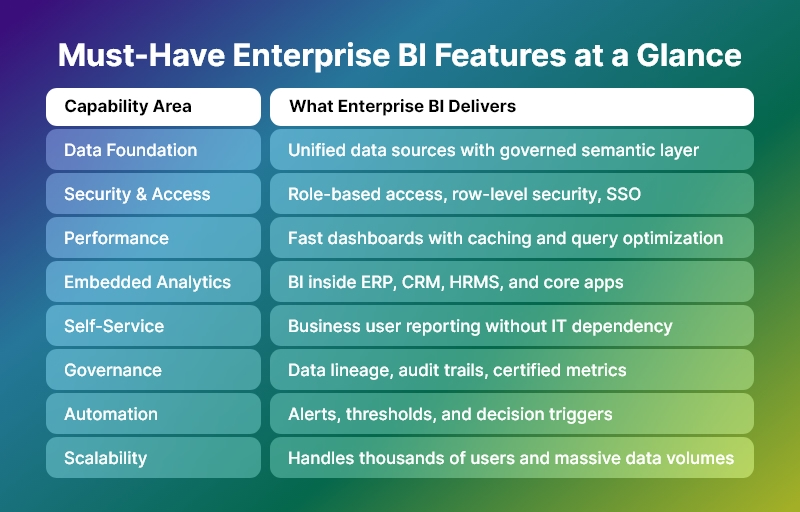
Must-Have-Enterprise-BI-Features-at-a-Glance

What Is Enterprise BI?

It (Enterprise Business Intelligence) is a scalable, governed, secure, and performance-driven analytics layer that supports decision-making across the entire organization—from frontline teams to executive leadership.

Unlike basic BI tools, enterprise BI:

  • Serves hundreds or thousands of users
  • Handles millions or billions of rows of data
  • Enforces data governance and security
  • Supports mission-critical business workflows
  • Integrates deeply into core enterprise applications

In other words, BI is not a reporting tool. It is a decision infrastructure.

Why Basic BI Fails in Enterprise Environments

Many organizations start with simple dashboards. However, they quickly hit limitations.

Basic BI fails because:

  • It cannot scale to large data volumes
  • It breaks under concurrent user load
  • It lacks role-based security and governance
  • It creates multiple versions of truth
  • It depends heavily on analysts instead of business users
  • It does not integrate deeply into enterprise workflows

As a result, enterprises either:

  • Lose trust in data
  • Slow down decision-making
  • Or build expensive, fragmented analytics stacks

This is exactly why enterprise BI exists.

The Strategic Role of Enterprise BI in Enterprise Applications

Modern enterprise applications are no longer transactional systems only. They are decision platforms.

Therefore, BI must:

  • Power daily operational decisions
  • Support strategic leadership decisions
  • Enable cross-department visibility
  • Drive process optimization
  • Enforce data accountability
  • Accelerate business execution

Consequently, BI becomes a core competitive advantage.

Must-Have Enterprise BI Features (Complete Enterprise Checklist)

Below is the definitive feature framework for evaluating or building a true BI system.

1. Enterprise-Grade Data Architecture

BI must handle complexity at scale.

It must support:

  • Multiple data sources (ERP, CRM, HRMS, IoT, Finance, Ops, external data)
  • Structured and semi-structured data
  • Large volumes and high refresh rates
  • Historical and real-time data together

Core capabilities include:

  • Data connectors and ingestion pipelines
  • Data modeling and semantic layers
  • Incremental refresh and caching
  • Support for cloud, on-prem, and hybrid data

Without this foundation, enterprise BI collapses under growth.

2. Single Source of Truth (Semantic Layer)

One of the biggest reasons BI fails is metric chaos.

Therefore, enterprise BI must provide:

  • Centralized metric definitions
  • Business-friendly semantic models
  • Reusable KPIs across dashboards and apps
  • Governance over calculations and logic

Benefits:

  • No conflicting numbers
  • No department-level data politics
  • No spreadsheet shadow systems
  • High trust in executive reporting

In short, BI must enforce truth at scale.

3. Enterprise Security and Access Control

Enterprise BI is useless if it is not secure.

It must support:

  • Role-based access control (RBAC)
  • Row-level and column-level security
  • SSO and enterprise authentication (SAML, OAuth, LDAP, etc.)
  • Audit logs and access tracking
  • Data masking for sensitive fields

Why this matters:

  • Finance, HR, and leadership data must not leak
  • Compliance requirements demand strict controls
  • Large organizations cannot rely on manual permissions

Therefore, security is not optional in BI. It is foundational.

4. Performance at Scale

Enterprise BI must stay fast even when:

  • Data grows 10x
  • Users grow 50x
  • Queries become complex
  • Dashboards become heavier

Critical performance features include:

  • Intelligent caching
  • Query optimization
  • In-memory acceleration
  • Pre-aggregations
  • Load balancing
  • Asynchronous query execution

Because in enterprises:

If dashboards are slow, decisions are slow. And slow decisions cost money.

5. Embedded Analytics for Enterprise Applications

Modern enterprise BI must not live in a separate portal.

Instead, it must:

  • Embed inside ERP, CRM, HRMS, FSM, or industry apps
  • Respect application user permissions
  • Adapt to application workflows
  • Feel like a native feature

Embedded BI enables:

  • Contextual decision-making
  • Higher adoption
  • Better user experience
  • Stronger product differentiation

Today, enterprise BI is a product feature, not a separate product.

6. Self-Service Analytics for Business Users

BI cannot depend entirely on analysts.

It must empower:

  • Managers
  • Operations leaders
  • Finance teams
  • Sales leaders
  • Department heads

Self-service features include:

  • Drag-and-drop reports
  • Filter and slice-and-dice
  • Drill-down and drill-through
  • Custom views and saved dashboards
  • Ad-hoc exploration without SQL

This ensures:

  • Faster answers
  • Less dependency on data teams
  • Higher data culture maturity

7. Advanced Dashboarding and Visualization

Enterprise BI dashboards must support:

  • Executive-level KPI views
  • Operational performance views
  • Departmental scorecards
  • Process monitoring screens

Core visualization capabilities:

  • Interactive charts and tables
  • Cross-filtering
  • Drill-down hierarchies
  • Conditional formatting
  • Alerts and thresholds
  • Storytelling views

However, remember:

Enterprise BI is not about visuals. It is about decisions enabled by visuals.

8. Real-Time and Near Real-Time Analytics

Many enterprise use cases require:

  • Live operations monitoring
  • SLA tracking
  • Incident detection
  • Financial risk control
  • Supply chain visibility

Therefore, BI should support:

  • Streaming or near-real-time data
  • Incremental refresh
  • Low-latency dashboards
  • Operational alerting

This transforms enterprise BI from reporting to control systems.

9. Alerts, Automation, and Decision Triggers

Modern BI must not wait for users to open dashboards.

It must:

  • Push alerts when thresholds are crossed
  • Trigger workflows
  • Send notifications to email, Slack, Teams, etc.
  • Integrate with business processes

Examples:

  • Alert when cash flow drops below limit
  • Alert when project cost overruns
  • Alert when churn risk spikes
  • When compliance metrics fail

This is how enterprise BI becomes proactive instead of reactive.

10. Data Governance and Lineage

At enterprise scale, governance is non-negotiable.

  • BI must provide:
  • Data lineage tracking
  • Impact analysis
  • Change management
  • Certification of datasets
  • Ownership and stewardship models

This ensures:

  • Audit readiness
  • Compliance confidence
  • Trust in enterprise-wide metrics
  • Controlled evolution of analytics

11. Collaboration and Sharing

Enterprise BI is a team sport.

It must support:

  • Shared dashboards
  • Commenting and annotations
  • Versioning
  • Scheduled reports
  • Role-based sharing

This transforms analytics into organizational conversation, not isolated analysis.

12. AI and Advanced Analytics (Optional but Strategic)

Modern enterprise BI increasingly includes:

  • Forecasting
  • Anomaly detection
  • Trend analysis
  • What-if simulations
  • Natural language queries

While not mandatory for every enterprise today, this is rapidly becoming a strategic differentiator.

13. Scalability and Future-Proof Architecture

Enterprise BI must scale across:

  • Users
  • Data volume
  • Use cases
  • Departments
  • Geographies

Therefore, it must support:

  • Modular architecture
  • API-first integration
  • Cloud and hybrid deployment
  • Horizontal scaling
  • Multi-tenant or multi-org setups

How Enterprise BI Drives Real Business Outcomes

When implemented correctly, BI delivers:

  • Faster decision cycles
  • Higher operational efficiency
  • Lower reporting overhead
  • Better leadership visibility
  • Stronger governance
  • Higher ROI from enterprise systems

In short:

BI turns data into organizational leverage.

How to Evaluate an Enterprise BI Platform

Use this checklist:

  • Does it scale to thousands of users?
  • Does it enforce governance and security?
  • Does it embed inside your application?
  • Does it support self-service safely?
  • Does it perform under heavy load?
  • Does it integrate with your data stack?
  • Does it reduce dependency on analysts?

If the answer is “no” to several of these, it is not true BI.

Final Thoughts: Enterprise BI Is Not Optional Anymore

In 2026 and beyond, BI is not an add-on.

It is:

  • A core layer of enterprise architecture
  • A strategic decision platform
  • A competitive advantage
  • A governance system
  • A performance engine

Organizations that treat BI as a strategic system will out-execute, out-learn, and out-scale those that do not.

And that is the real power of BI.

How Digital Strategy is Revolutionizing Healthcare & Life Sciences

The healthcare and life sciences industries are undergoing a massive transformation. Digital strategy is at the forefront, redefining patient care, research methodologies, and operational efficiencies.

From AI-powered diagnostics to personalized medicine, digital innovation is enabling faster, smarter, and more effective healthcare solutions.

In this blog, we explore how a well-defined digital strategy reshapes healthcare and life sciences, driving improved outcomes for patients and businesses.

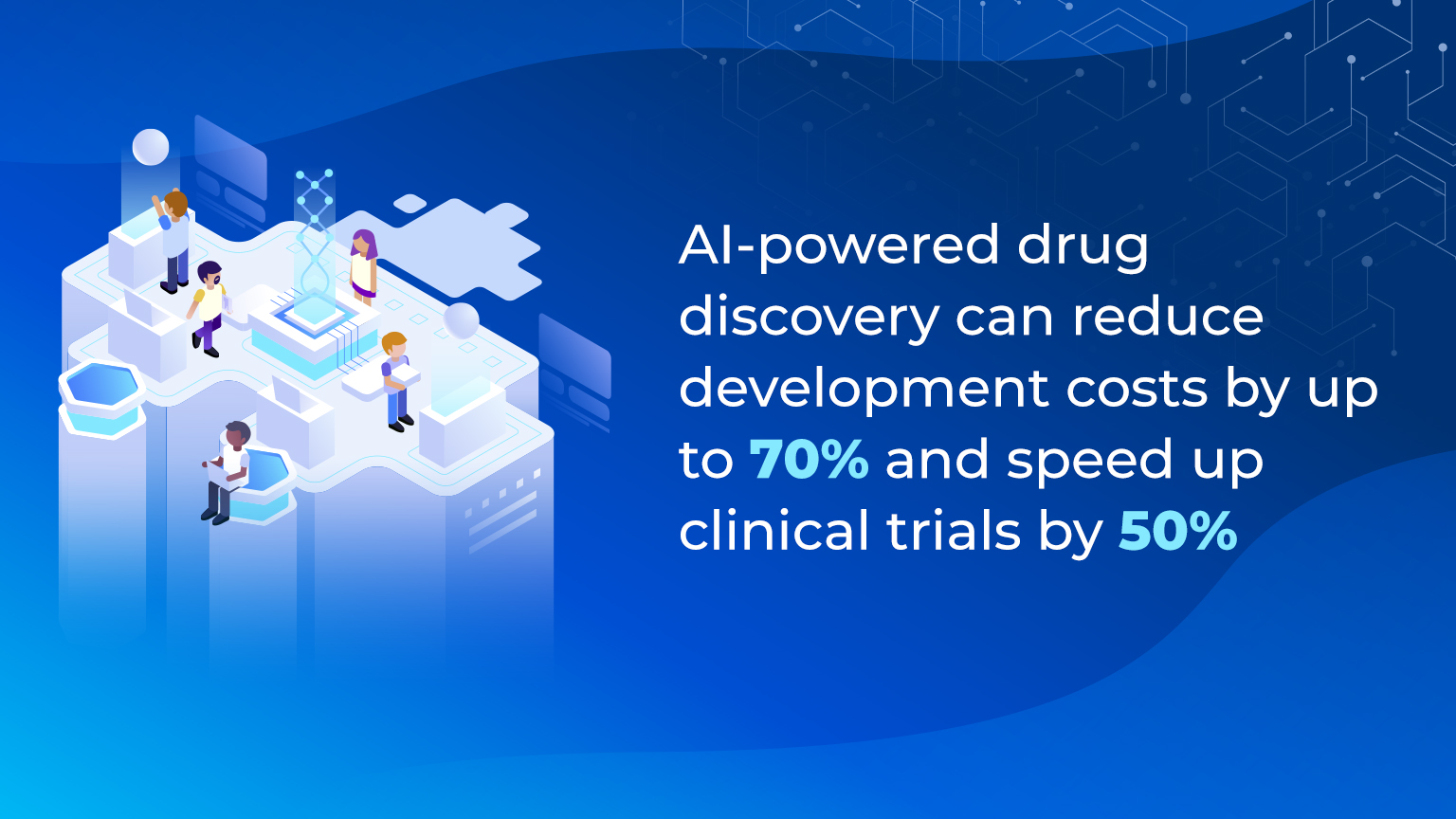
AI-powered drug discovery can reduce development costs by up to 70% and speed up clinical trials by 50%

The Need for Digital Strategy in Healthcare & Life Sciences

Inefficiencies, fragmented data, and high operational costs have long plagued traditional healthcare systems.

Meanwhile, life sciences organizations face challenges in drug discovery, regulatory compliance, and market adaptation. A robust digital strategy addresses these pain points by leveraging technology to:

  • Enhance patient care through real-time data insights
  • Accelerate drug discovery with AI and machine learning
  • Improve operational efficiencies with cloud-based solutions
  • Ensure regulatory compliance through advanced analytics
  • Enable seamless interoperability among healthcare systems

Key Digital Strategies Transforming Healthcare

1. AI and Machine Learning for Smarter Healthcare

AI is revolutionizing diagnostics, treatment planning, and patient care. Machine learning algorithms analyze medical data to detect diseases early, predict patient outcomes, and assist clinicians in decision-making.

  • AI-driven imaging solutions enhance the accuracy of radiology and pathology reports.
  • Predictive analytics help identify at-risk patients for proactive interventions.
  • Chatbots and virtual assistants streamline patient engagement and triage processes.

2. Big Data and Predictive Analytics for Better Decision-Making

Healthcare generates vast amounts of data daily. A strong digital strategy integrates big data analytics to extract meaningful insights and optimize patient care.

  • Population health analytics help identify trends and predict disease outbreaks.
  • Personalized treatment plans are created using genomic and patient history data.
  • Operational analytics optimize hospital workflows, reducing wait times and improving resource allocation.

3. Telemedicine and Remote Patient Monitoring

The rise of telemedicine has transformed healthcare accessibility. Remote patient monitoring (RPM) solutions allow doctors to track patients’ vitals and health conditions in real time, improving care for chronic disease management.

  • Virtual consultations reduce the burden on hospitals and clinics.
  • Wearable devices provide continuous health tracking, enhancing preventive care.
  • Remote monitoring ensures timely interventions, reducing hospital readmissions.

4. Cloud Computing for Secure and Scalable Healthcare Solutions

Cloud-based solutions enable seamless data sharing, scalability, and cost-effectiveness, making them a cornerstone of digital transformation in healthcare.

  • Electronic Health Records (EHR) stored on the cloud ensure easy access and interoperability.
  • Cloud-based AI models assist in drug discovery and clinical decision-making.
  • Scalable infrastructure supports healthcare providers in handling large patient databases securely.

5. Blockchain for Enhanced Data Security and Compliance

Healthcare data security is a growing concern, and blockchain offers a transparent, tamper-proof solution.

  • Blockchain secures patient records, ensuring data integrity.
  • Smart contracts automate regulatory compliance and billing processes.
  • Decentralized identity management improves patient data control and privacy.

6. IoT in Healthcare for Real-Time Monitoring

The Internet of Things (IoT) transforms patient monitoring, hospital management, and medical device efficiency.

  • Smart beds track patient movement and adjust for comfort and safety.
  • IoT-enabled medical devices send real-time alerts for critical conditions.
  • Hospital asset tracking improves resource allocation and reduces waste.

Digital Strategy in Life Sciences: Driving Innovation and Efficiency

Life sciences organizations benefit from digital transformation in multiple ways, including drug development, clinical trials, and regulatory compliance.

1. AI-Powered Drug Discovery and Development

AI and machine learning reduce the time and cost associated with drug discovery by analyzing vast datasets and identifying potential drug candidates.

  • AI models predict how compounds will interact, accelerating drug formulation.
  • Machine learning speeds up clinical trials by identifying optimal participant groups.
  • Automation reduces errors and improves efficiency in research labs.

2. Digital Twin Technology in Research and Development

Digital twins are virtual models of biological systems, helping researchers simulate treatments and test outcomes before real-world application.

  • Simulated clinical trials reduce reliance on human subjects.
  • Personalized medicine benefits from patient-specific digital models.
  • AI-driven simulations enhance the precision of biomedical research.

3. Regulatory Compliance and Data Integrity

Regulatory compliance in life sciences is complex and time-consuming. Digital strategies streamline documentation, reporting, and auditing.

  • Automated compliance tracking reduces errors and regulatory risks.
  • Blockchain ensures transparent and immutable clinical trial records.
  • AI-powered document analysis accelerates approval processes.

4. Smart Supply Chain Management

Life sciences companies rely on an efficient supply chain for manufacturing and distribution.

  • IoT-enabled tracking ensures real-time monitoring of pharmaceuticals.
  • AI optimizes inventory management to prevent shortages or overstocking.
  • Predictive analytics enhance demand forecasting and logistics efficiency.

The Future of Digital Strategy in Healthcare & Life Sciences

The integration of digital strategies will continue to evolve, enabling more personalized, efficient, and accessible healthcare services.

Key trends shaping the future include:

  • AI-driven personalized medicine tailored to an individual’s genetic profile.
  • 5G-powered telehealth for seamless remote patient care.
  • Voice and NLP technologies enhance patient interactions and documentation.
  • Edge computing in healthcare for real-time data processing with minimal latency.
  • Robotic process automation (RPA) to streamline administrative workflows.

Conclusion

A well-defined digital strategy is no longer an option but a necessity for healthcare and life sciences organizations.

From AI-powered diagnostics to blockchain-secured patient records, digital transformation is improving patient care, accelerating drug discovery, and ensuring regulatory compliance.

Organizations that embrace these digital innovations will not only improve operational efficiency but also redefine the future of healthcare.

Cloud & Infrastructure Services: Empowering Digital Transformation

Cloud and infrastructure services are the backbone of modern digital transformation—driving agility, scalability, and cost efficiency across industries.

As businesses migrate to the cloud to enhance innovation and streamline operations, understanding key service models, deployment strategies, and best practices becomes critical.

This infographic provides an in-depth look into the cloud landscape, benefits, emerging trends, and essential strategies to help organizations optimize their cloud investments for sustained growth.

Cloud & Infrastructure Services: Empowering Digital Transformation

Conclusion

Cloud and infrastructure services are pivotal in fueling digital transformation, enabling businesses to innovate, scale, and remain agile in a competitive landscape.
Organizations can unlock significant benefits by understanding various service models, deployment types, and best practices—from migration and data management to governance, sustainability, and cost optimization.
Advanced trends like edge computing, AI integration, and multi-cloud strategies further propel businesses forward.

Digital Transformation and Its Influence on Customer Satisfaction

With the rise of digital technologies and changing consumer behaviors, companies are forced to rethink how they engage with their audiences.

Digital transformation has emerged as a powerful catalyst in reshaping customer experience (CX) by harnessing innovative tools, data-driven insights, and streamlined processes.

In this blog, we’ll explore digital transformation’s profound impact on customer experience, uncovering how businesses can leverage technology to meet and exceed modern customer expectations.

Understanding Digital Transformation

Digital transformation is more than just adopting new technology—it’s a holistic shift in how businesses operate, deliver value, and interact with their customers.

At its core, digital transformation integrates digital technology into every facet of an organization, fundamentally changing the way it runs and how customers experience its services.

This process involves rethinking traditional models, embracing agile methodologies, and creating new strategies centered around the customer.

Key Components of Digital Transformation

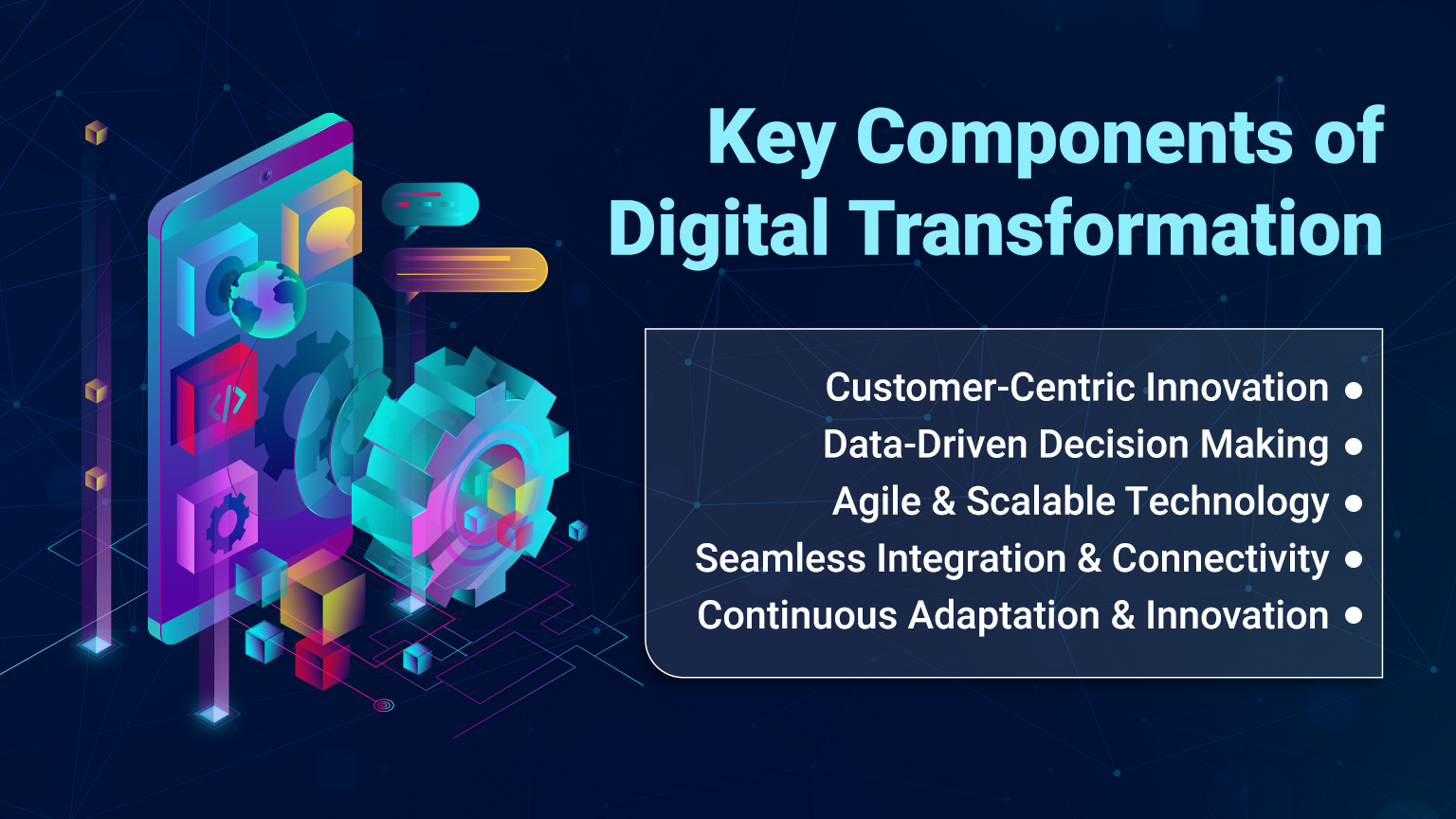
Key Components of Digital Transformation

  • Adoption of Advanced Technologies: Businesses integrate cutting-edge tools such as cloud computing, artificial intelligence (AI), machine learning (ML), big data analytics, and the Internet of Things (IoT) to streamline operations and enhance customer interactions.
  • Process Automation: Automating repetitive tasks allows organizations to improve efficiency and reduce human error, freeing up valuable resources to focus on innovation and customer engagement.
  • Data-Driven Decision Making: Leveraging analytics and real-time data enables companies to better understand customer behavior, predict trends, and tailor their strategies accordingly.
  • Cultural Change: A successful digital transformation requires an organizational culture that embraces change, encourages continuous learning, and prioritizes the customer at every level.

The Changing Landscape of Customer Experience

Customer experience has become the new battleground for competitive differentiation.
Today’s consumers expect seamless, personalized, and responsive interactions across every touchpoint—whether it’s online, in-store, or on mobile devices.

Digital transformation empowers businesses to create a unified, omnichannel experience that meets these expectations.

Personalization at Scale

One of the most significant advantages of digital transformation is the ability to deliver personalized experiences.

Through advanced data analytics, companies can gain deep insights into customer preferences, behaviors, and purchase history. This wealth of information enables them to:

  • Tailor Content and Offers: By understanding customer interests, businesses can create highly targeted marketing campaigns and deliver content that resonates with individual needs.
  • Enhance Product Recommendations: AI-powered recommendation engines analyze past behavior to suggest products or services that are most likely to appeal to the customer, increasing engagement and conversion rates.
  • Improve Customer Journeys: Personalized interactions across multiple channels ensure that customers receive consistent and relevant messaging, leading to improved satisfaction and loyalty.

Omnichannel Engagement

In an era where customers interact with brands across various platforms, delivering a seamless omnichannel experience is crucial.

Digital transformation allows businesses to integrate their online and offline channels, ensuring a smooth transition for customers as they move from one touchpoint to another.

Benefits include:

  • Unified Customer Profiles: By consolidating data from various channels, companies can build comprehensive customer profiles that enhance personalization and service quality.
  • Consistent Messaging: Omnichannel strategies ensure that customers receive the same level of service and messaging, whether they are shopping online, using a mobile app, or visiting a brick-and-mortar store.
  • Improved Customer Support: Integrated platforms allow for real-time communication and support across multiple channels, such as chatbots, social media, and email, ensuring that customer issues are resolved quickly and efficiently.

Enhanced Interactivity and Engagement

Digital technologies have transformed how customers interact with brands. Interactive tools, such as chatbots, virtual assistants, and augmented reality (AR), have become integral components of modern customer engagement strategies.

These tools offer several advantages:

  • Instant Support: Chatbots and virtual assistants provide immediate responses to customer queries, reducing wait times and improving overall satisfaction.
  • Immersive Experiences: Technologies like AR and virtual reality (VR) enable customers to experience products and services in a more engaging way, which can be particularly effective in retail and real estate.
  • Empowered Self-Service: Digital platforms allow customers to access information, manage their accounts, and resolve issues independently, fostering a sense of empowerment and satisfaction.

How Digital Transformation Enhances Customer Experience

1. Real-Time Data and Predictive Analytics

Digital transformation equips businesses with the tools to collect and analyze data in real-time. This continuous flow of data allows companies to:

  • Monitor Customer Behavior: Understand how customers interact with their brand and identify trends or issues as they arise.
  • Predict Future Needs: Use predictive analytics to forecast customer behavior and proactively address needs before they become problems.
  • Optimize Marketing Efforts: Refine marketing strategies based on real-time performance data, ensuring that campaigns are always aligned with customer interests and market trends.

2. Automation for Efficiency and Accuracy

Automation plays a critical role in streamlining processes and reducing human error. By automating routine tasks, businesses can improve the customer experience in several ways:

  • Faster Response Times: Automated systems, such as chatbots and automated email responders, ensure that customer inquiries are addressed promptly, even outside of business hours.
  • Consistent Quality: Automation ensures that processes are executed uniformly, resulting in a consistent customer experience across all interactions.
  • Resource Optimization: By automating mundane tasks, employees are free to focus on complex customer issues and creative problem-solving, leading to higher-quality service.

3. Improved Customer Relationship Management (CRM)

Digital transformation has revolutionized the way companies manage customer relationships. Modern CRM systems are equipped with advanced features that enable businesses to:

  • Track Interactions: Maintain detailed records of customer interactions, preferences, and feedback, ensuring that every touchpoint is informed by past experiences.
  • Segment Audiences: Analyze customer data to segment audiences and tailor communications to different groups, improving relevance and engagement.
  • Measure Customer Satisfaction: Implement tools to monitor customer satisfaction in real-time, allowing for swift action when issues are detected.

4. Seamless Integration of Communication Channels

The integration of various communication channels is essential for delivering a holistic customer experience. Digital transformation enables seamless integration, which results in:

  • Enhanced Connectivity: Customers can interact with a brand through their preferred channels—whether it’s social media, email, live chat, or phone—without experiencing disruptions.
  • Coordinated Support: Integrated systems ensure that customer support teams have access to all relevant information, leading to more informed and effective service.
  • Feedback Loops: Consistent communication channels create efficient feedback loops, allowing companies to gather customer insights and continuously refine their strategies.

Challenges and Considerations in Digital Transformation

While the benefits of digital transformation for customer experience are substantial, businesses must also navigate several challenges to ensure a successful transition.

Overcoming Technological Hurdles

  • Legacy Systems: Many organizations still rely on outdated systems that are not compatible with modern digital tools. Transitioning from these legacy systems to new platforms requires careful planning and investment.
  • Data Integration: Aggregating data from various sources and ensuring its accuracy can be complex. Companies must invest in robust data management systems to maintain data integrity.
  • Cybersecurity: With increased digitization comes the heightened risk of cyber threats. Businesses must prioritize cybersecurity measures to protect sensitive customer information and build trust.

Managing Organizational Change

  • Cultural Resistance: Shifting to a digital-first mindset can be challenging, particularly in organizations with deeply entrenched traditional practices. It requires strong leadership and a commitment to fostering a culture of innovation.
  • Skill Gaps: Digital transformation often demands new skill sets that may not be present within the current workforce. Investing in training and development is essential to equip employees with the necessary skills.
  • Resource Allocation: Implementing digital transformation initiatives can be resource-intensive. Organizations must balance their budgets and ensure that investments in technology yield a positive return on investment (ROI).

Ensuring a Customer-Centric Approach

  • Balancing Automation and Human Touch: While automation enhances efficiency, customers still value personal interactions. Striking the right balance between automated processes and human engagement is critical.
  • Continuous Improvement: The digital landscape is constantly evolving, and so are customer expectations. Businesses must adopt an agile approach, continually assessing and updating their digital strategies to stay relevant.
  • Feedback Mechanisms: Implementing robust feedback mechanisms is vital. Companies need to listen to their customers and adjust their digital strategies based on their experiences and expectations.

Case Studies: Real-World Examples of Digital Transformation in Action

Retail Sector: Enhancing the In-Store and Online Experience

A major retail chain underwent a digital transformation by integrating its online and offline channels. By implementing an omnichannel strategy, the company was able to:

  • Provide personalized product recommendations both online and in-store.
  • Use real-time data to manage inventory more efficiently.
  • Offer mobile payment options and self-checkout kiosks to streamline the shopping experience.

As a result, customer satisfaction increased significantly, and the retailer saw a boost in both online and in-store sales.

Financial Services: Streamlining Customer Interactions

A leading bank embraced digital transformation by deploying AI-powered chatbots and advanced CRM systems. These tools enabled the bank to:

  • Offer 24/7 customer support through virtual assistants.
  • Analyze customer data to personalize financial advice and product offerings.
  • Automate routine transactions, reducing wait times and improving service accuracy.

This transformation led to improved customer engagement and loyalty, with customers enjoying faster and more personalized service.

Healthcare: Transforming Patient Engagement

Digital transformation has had a profound impact on the healthcare industry, particularly in enhancing patient engagement. A healthcare provider implemented a digital platform that allowed patients to:

  • Schedule appointments and access medical records online.
  • Receive personalized health recommendations based on their medical history.
  • Engage with healthcare professionals through telemedicine services.

This approach not only improved patient satisfaction but also led to better health outcomes, as patients could receive timely care and advice from the comfort of their homes.

The Future of Customer Experience in a Digital World

As technology continues to evolve, the landscape of customer experience will become even more dynamic and interconnected. Here are some trends that are likely to shape the future of CX:

  • Artificial Intelligence and Machine Learning

The integration of AI and ML will further enhance personalization by continuously learning from customer interactions. These technologies will enable businesses to anticipate customer needs and provide hyper-personalized experiences in real-time.

  • Augmented Reality and Virtual Reality

Immersive technologies like AR and VR will revolutionize the way customers experience products and services. From virtual try-ons in fashion retail to immersive property tours in real estate, these tools will make customer engagement more interactive and memorable.

  • 5G Connectivity and the Internet of Things

With the rollout of 5G, the speed and reliability of digital connections will improve dramatically, paving the way for more seamless digital experiences. Coupled with IoT devices, businesses will be able to gather even more data and offer services that are finely tuned to customer needs in real-time.

  • Voice-Activated Technologies

Voice assistants and smart speakers are becoming increasingly popular. As these technologies mature, they will provide yet another channel for customer interaction, enabling hands-free, voice-driven experiences that add convenience and accessibility.

  • Enhanced Security and Data Privacy

As digital transformation progresses, customer trust will hinge on robust security measures. Future innovations will likely focus on integrating advanced security protocols and ensuring transparency in data usage, which will further strengthen customer relationships.

Strategies for Success: Implementing Digital Transformation for Better CX

For organizations looking to harness digital transformation to improve customer experience, here are some strategies to consider:

1. Start with a Clear Vision

Define what you want to achieve with digital transformation. Set clear, measurable goals related to customer experience, whether it’s reducing response times, improving personalization, or enhancing overall satisfaction.

2. Invest in the Right Technologies

Identify the tools and platforms that align with your business objectives. Whether it’s CRM systems, AI-powered analytics, or omni-channel communication platforms, make sure your technology stack is scalable and secure.

3. Prioritize Data Integration and Analytics

Data is the backbone of digital transformation. Invest in systems that can collect, integrate, and analyze data from multiple sources. This will enable you to derive actionable insights and refine your strategies in real-time.

4. Foster a Customer-Centric Culture

Ensure that every level of your organization is aligned to enhance customer experience. Training programs, clear communication, and leadership support are essential to foster a culture that embraces change and prioritizes the customer.

5. Monitor, Measure, and Iterate

Digital transformation is an ongoing process. Continuously monitor key performance indicators (KPIs) related to customer experience, gather feedback, and be prepared to iterate on your strategies. Use tools such as customer satisfaction surveys and real-time analytics to track progress and identify areas for improvement.

Conclusion

Digital transformation has fundamentally redefined what customer experience means in the modern era.

By leveraging advanced technologies, automating processes, and harnessing the power of data, companies can create personalized, seamless, and engaging experiences that not only meet but exceed customer expectations.

While the journey toward full digital transformation comes with its challenges—such as integrating legacy systems, ensuring data security, and managing organizational change—the rewards are clear: enhanced customer satisfaction, increased loyalty, and ultimately, stronger business performance.

As we move forward into an increasingly digital future, businesses that embrace digital transformation will be best positioned to adapt to evolving customer needs and stay ahead of the competition.

How Scalable Infrastructure Drive Transformation?

Digital transformation is not just a buzzword it’s a necessity for businesses that want to stay competitive and outshine in today’s fast-paced digital era.

The need for agility, speed, and innovation has never been higher, and at its center lies scalable infrastructure. Digital transformation is not just about adopting a new technology but about creating a foundation that can adapt, grow, and evolve with the demands of the market.

Without scalable infrastructure, even the best digital strategy can falter, thereby leading to inefficiency and bottlenecks. But what does it take to build such an infrastructure? And how can organizations future-proof the operation?

Scalable infrastructure is more than just a concept, it’s a strategic necessity that enables businesses to thrive in an ever-changing environment. It empowers businesses to process large amounts of data, deploy apps, and deliver a seamless experience to customers.

In this blog, we will explore what is scalable infrastructure, its role in digital transformation, and the key components that make it successful.

We will also dive into actionable strategies and emerging trends that can help your businesses stay ahead in the competitive world.

What is Scalable Infrastructure?

Scalable infrastructure refers to an organization’s ability to handle increased workloads and continue to grow without compromising performance.

It’s not just about adding more servers or storage; it’s about designing a system that can expand seamlessly even while maintaining efficiency, reliability, and cost-effectiveness.

Why Scalability is Crucial for Digital Transformation?

Digital transformation involves adopting new technologies, changing processes, and delivering top-notch customer experiences. Here are a few reasons why scalability is needed.

1. Handling Increased Data Volumes:

Digital transformation involves integrating IoT devices, creating big data analytics, and using AI to manage data. Scalable infrastructure ensures that this data is processed and stored efficiently.

2. Supporting Business Growth:

As businesses expand, their IT requirements also increase. This is why scalable systems need to grow alongside the organizations to eliminate the need for frequent overhauls.

3. Enhancing Customer Experience:

Business scalability also ensures consistent performance even during traffic spikes. It furthermore results in a seamless user experience.

4 . Cost Optimization:

Scalable systems enable businesses to pay only for what they use which significantly reduces waste and optimizes budgets.

 Key Components of a Scalable Infrastructure
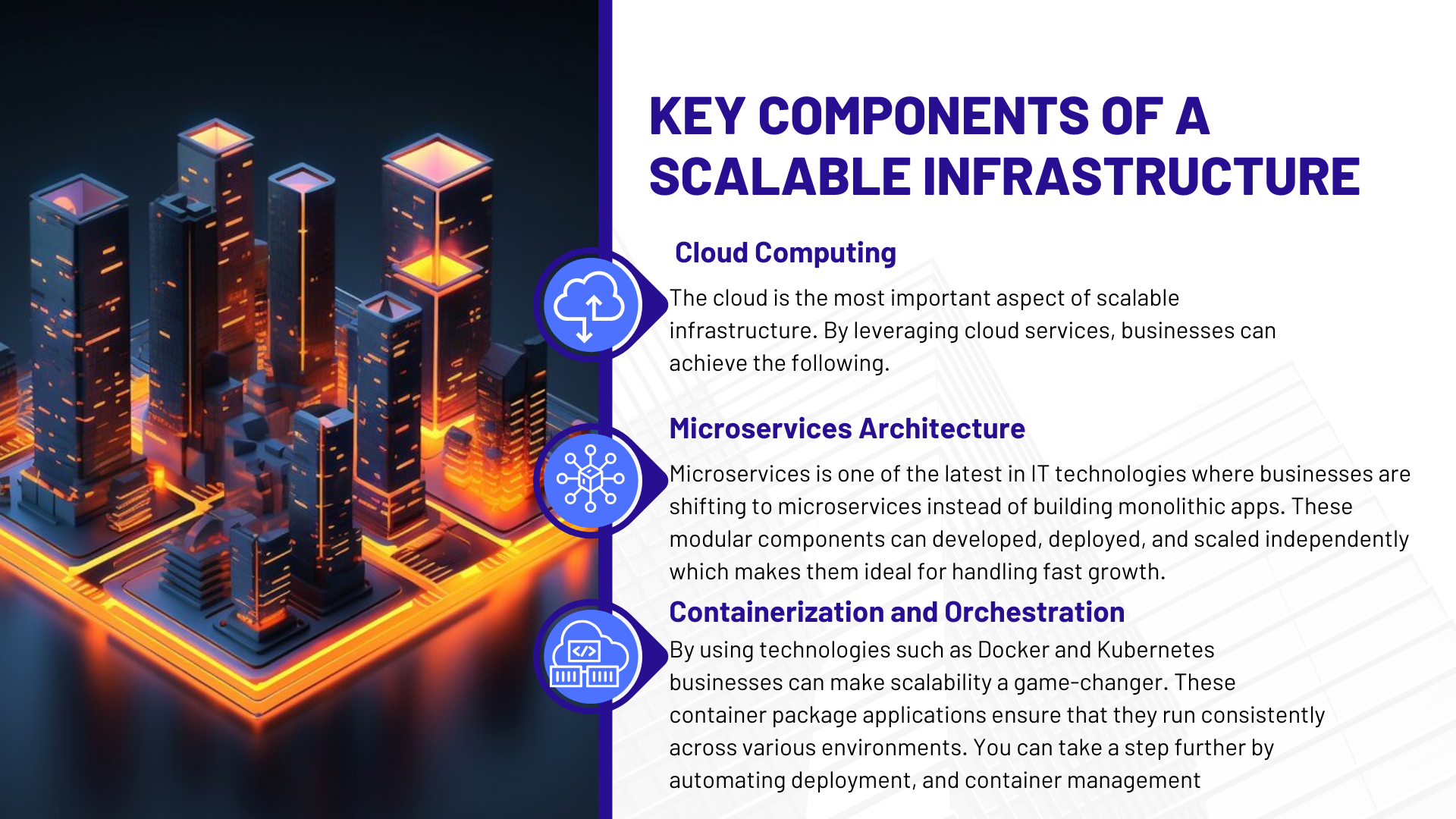
Key Components of a Scalable Infrastructure

To build a scalable infrastructure you need more than just a one-size-fits-all approach. It needs a combination of technologies, best practices, and strategic planning.

1. Cloud Computing

The cloud is the most important aspect of scalable infrastructure. By leveraging cloud services, businesses can achieve the following.

  • Scale resources based on demand.
  • Reduce capital expenditures.
  • Improve performance and reliability.

Cloud providers like AWS and Microsoft Azure offer a range of services customized to different scalability needs.

2. Microservices Architecture

Microservices is one of the latest in IT technologies, and businesses are shifting to microservices instead of building monolithic apps. These modular components can developed, deployed, and scaled independently which makes them ideal for handling fast growth.

3. Containerization and Orchestration

By using technologies such as Docker and Kubernetes businesses can make scalability a game-changer. These container package applications ensure that they run consistently across various environments. You can take a step further by automating deployment, and container management.

4. Elastic Storage Solutions

Data storage needs to evolve with growth. Storage solutions such as distributed file systems can ensure that businesses can store and retrieve data efficiently no matter how large the datasets become.

5. High-Performance Networking

A scalable infrastructure needs robust networking solutions. It can easily handle increased traffic without bottlenecks. Today it is propagated more by SD-WAN and 5G networks.

6. Automation Tools

Scalable infrastructure thrives on automation. Tools such as provisioning, monitoring, and streamlining operations can reduce manual intervention and enable businesses to scale easily.

7. Security Frameworks

As systems scale up so do their vulnerabilities. These scalable infrastructures must include security measures such as:

  • Automated threat detection.
  • Multi-factor authentication.
  • Regular security audits.
  • End-to-end encryption.

Steps to Build Scalable Infrastructure

Creating scalable infrastructure needs a strategic approach. Here are the steps to guide you:

1. Assess Current Infrastructure

Before deciding on scaling up your infrastructure you need to evaluate your existing systems. You need to identify bottlenecks, determine if the technology is outdated, and find areas of improvement. You also need to conduct performance testing to understand how your infrastructure can handle stress.

2. Define Scalability Goals

Before deciding on scaling up your business you need to define clear objectives such as:

  • Determining the number of growth in users
  • Determining data size
  • Reducing downtime

3. Adopt a Cloud-First Strategy

To leverage on-demand scalability you need to move workloads to the cloud. Hybrid cloud solutions are the perfect option for businesses to transition gradually.

4. Implement Modular Systems

You can break down applications into smaller more manageable components. You can use APIs to connect the module as well as ensure its flexibility and scalability.

5. Optimize for Performance

Use tools such as load balancers, and CDNs to optimize performance and reduce latency.

6. Invest in Automation

You could deploy tools that automate infrastructure provisioning, scaling, and monitoring. This minimizes human error and accelerates scalability.

7. Monitor and Iterate

Scalability isn’t just a one-time task, it is all about continuously monitoring systems, gathering user data, and making iterative improvements to keep pace with business needs.

Real-World Examples of Scalable Infrastructure

1. Netflix

Netflix transitioned from on-premises data centers to a cloud-first approach with AWS. By adopting microservices and automation, Netflix could easily handle billions of hours of streaming each month even during peak times.

2. Uber

Uber today supports millions of rides every day across the globe. Its scalable infrastructure relies on containerization, real-time data processing, and distributed architecture to ensure seamless user experiences.

3. Slack

Slack is one of the world’s leading collaboration platforms, and they scaled their infrastructure to accommodate millions of simultaneous users. By leveraging cloud computing and real-time messaging frameworks, Slack delivers consistent performance.

Challenges in Building Scalable Infrastructure

While scalability provides numerous benefits, it comes with its own set of challenges:

1. Cost Management: Scaling up resources dynamically can lead to unpredictable costs if not monitored closely.

2. Technical Complexity: Transitioning to scalable systems such as microservices and containers needs experience and planning.

3. Legacy Systems: Integrating and replacing outdated systems with scalable solutions is a lengthy and resource-intensive process.

4. Security Concerns: One of the biggest security concerns is that expanding infrastructure can expose vulnerabilities and make robust security essentials.

Future Trends in Scalable Infrastructure

The landscape of the scalable infrastructure is constantly evolving. Here are a few trends that are shaping the future:

1. Edge Computing: Process data accurately to reduce latency and enhance scalability.

2. AI-Driven Scalability: Machine Learning algorithms optimize resource allocation and predict scaling needs.

3. Serverless Computing: Serverless architectures provide unparalleled scalability.

Conclusion

Building a scalable infrastructure is the foundation of successful digital transformation. By adopting cloud-first strategies and leveraging modern architectures, you can prioritize performance and security.

While challenges exist, the benefits of enhanced efficiency and superior customer experience outweigh its disadvantages.

As technology evolves, scalability will remain the cornerstone of the business looking for a digital transformation strategy. Now is the time to invest in infrastructure to make your business future-proof.