Cloud & Infrastructure Services: Empowering Digital Transformation

Cloud and infrastructure services are the backbone of modern digital transformation—driving agility, scalability, and cost efficiency across industries.

As businesses migrate to the cloud to enhance innovation and streamline operations, understanding key service models, deployment strategies, and best practices becomes critical.

This infographic provides an in-depth look into the cloud landscape, benefits, emerging trends, and essential strategies to help organizations optimize their cloud investments for sustained growth.

Cloud & Infrastructure Services: Empowering Digital Transformation

Conclusion

Cloud and infrastructure services are pivotal in fueling digital transformation, enabling businesses to innovate, scale, and remain agile in a competitive landscape.
Organizations can unlock significant benefits by understanding various service models, deployment types, and best practices—from migration and data management to governance, sustainability, and cost optimization.
Advanced trends like edge computing, AI integration, and multi-cloud strategies further propel businesses forward.

How PF Trust Management Software Improves Employee Trust and Satisfaction

Employee satisfaction is the cornerstone of a productive workforce and one crucial factor that directly impacts. It is how well companies manage employee benefits, such as provident funds (PF). Provident funds are a significant part of an employee’s financial future, and managing them effectively can greatly influence their trust in the organization. This is where PF Trust Management Software comes into play.

By automating and streamlining the entire provident fund management process, this software not only improves operational efficiency but also enhances transparency, compliance, and communication between employers and employees.

This blog will explore how PF Trust Management Software contributes to improved employee trust and satisfaction.

What is PF Trust Management Software?

PF Trust Management Software is a specialized tool designed to automate the management of employee provident fund systems.

This includes automating contributions, calculating interest, managing withdrawals, handling transfers, and ensuring compliance with statutory regulations.

It also provides employees with easy access to their PF details through self-service portals, ensuring transparency in fund management.

Key Benefits of PF Trust Management Software

Improved Transparency and Communication

Transparency in PF contributions and withdrawals is critical for employee trust. With PF Trust Management Software, employees can access their accounts anytime to check their balance, contributions, and accrued interest. This openness fosters a sense of security and trust.

  • Accurate and Timely Contributions

Manual processes in PF management can lead to errors in contribution calculations, missed deadlines, or delayed payments. By automating these processes, PF Software Benefits include precise, timely contributions, which reduces errors and ensures that employees’ funds grow as intended.

  • Compliance with Regulations

PF Trust Management Software ensures that employers adhere to government regulations regarding provident funds. This reduces the risk of non-compliance, penalties, and legal troubles, giving employees peace of mind knowing their funds are being managed properly and lawfully.

  • Streamlined Pension Management

Many Software solutions integrate with pension management software to provide employees with a comprehensive view of their retirement benefits. This combination ensures employees understand how their provident fund and pension contributions are being handled, which further enhances trust and satisfaction.

Faster Claim Processing

One of the most frustrating aspects of manual PF management is the time it takes to process claims. With automated workflows, PF Trust Management Software speeds up the process, ensuring that employees receive their money when they need it without unnecessary delays.

How PF Management Improves Employee Satisfaction

  • Enhanced Financial Security

When employees can see their employee provident fund system functioning properly, they feel more secure about their future. Financial security plays a huge role in overall job satisfaction, and employees who trust that their funds are managed well are more likely to be engaged and motivated at work.

  • Empowered Employees

The self-service portals empower employees by giving them control over their fund details. Employees can track their contributions, view their fund status, and even file claims—all without needing to go through HR. This empowerment improves employee satisfaction by removing administrative friction.

  • Fewer Administrative Burdens

For HR and payroll teams, managing provident funds manually can be time-consuming and prone to mistakes. PF Software Benefits employers by reducing the administrative burden on HR staff. Employees notice when payroll and fund-related queries are resolved faster and with fewer errors, which positively impacts satisfaction.

  • Better Trust in Employer

Consistent and transparent handling of PF management for employees significantly boosts trust in the employer. When employees feel that their contributions are being managed well and that they are treated fairly, it fosters loyalty and a positive employer-employee relationship.

  • The Role of Pension Management in Employee Trust

Many PF Trust Management Software solutions offer integrated pension management software, allowing employers to manage both provident fund contributions and pension plans. Employees who see a clear plan for their post-retirement life are more likely to stay with an employer that offers a structured retirement benefits system.

Providing a seamless interface between provident fund and pension management not only simplifies administration but also reassures employees that their retirement planning is being taken seriously. This results in higher trust levels and overall satisfaction.

Conclusion

In today’s competitive work environment, retaining employees goes beyond offering attractive salaries and benefits; therefore, managing their provident fund efficiently and transparently is crucial for winning their trust and improving their satisfaction.

PF Trust Management Software offers an automated, compliant, and transparent system for managing provident funds. The improved efficiency, reduced errors, faster claim processing, and enhanced transparency not only streamline operations but also significantly enhance employee satisfaction and trust.

Investing in robust PF Trust Management Software isn’t just a smart decision for regulatory compliance. It’s a strategy to build long-term employee trust and satisfaction, ultimately strengthening the organization’s overall culture and productivity.

10 Reasons Why WooCommerce Is the Ultimate eCommerce Platform

In the fast-paced world of eCommerce, choosing the right platform is crucial for the success of your online business. With countless options available, each promising a multitude of features and benefits, navigating the landscape can be overwhelming. However, amidst this sea of choices, one platform has consistently emerged as a frontrunner – WooCommerce. Renowned for its versatility, reliability, and extensive range of features, WooCommerce development stands tall as the ultimate eCommerce platform for businesses of all sizes and industries.

As a plugin of WordPress, the world’s most popular content management system, the CMS platform seamlessly integrates with the familiar and user-friendly interface that millions of website owners already know and love. 

This integration not only simplifies the process of setting up and managing an online store but also offers unparalleled flexibility and customization options, allowing businesses to create unique and engaging storefronts that reflect their brand identity and resonate with their target audience.

Let’s explore 10 reasons why WooCommerce is the best eCommerce Platform:

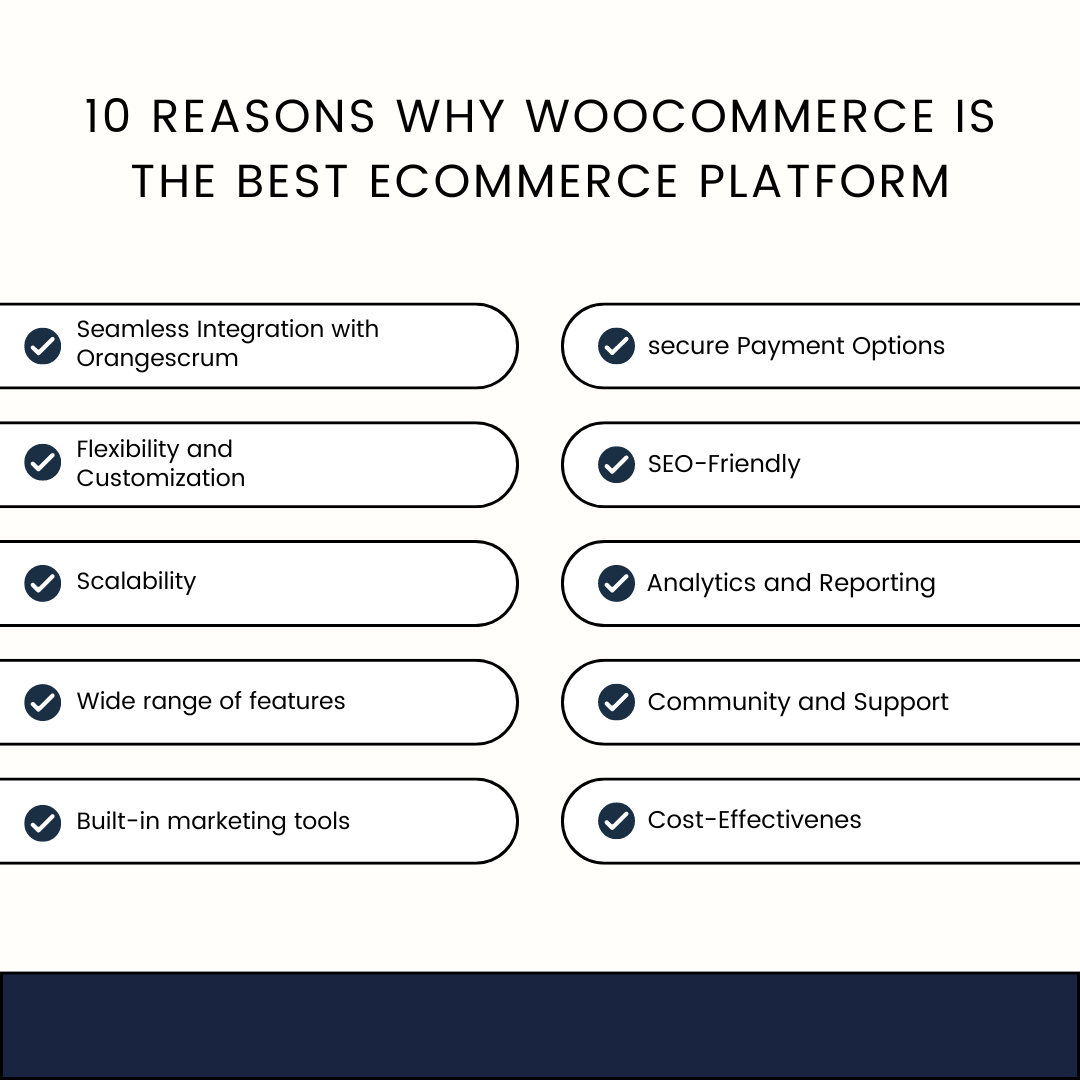
10 Reasons Why WooCommerce is The Best ecommerce platform


1. Seamless Integration with WordPress:

As a WordPress plugin, it seamlessly integrates with the world’s most popular content management system. 

This synergy allows users to harness the power of WordPress’s intuitive interface, vast plugin ecosystem, and robust customization options to create stunning and feature-rich online stores.

2. Flexibility and Customization:

The CMS platform offers unparalleled flexibility and customization capabilities, making it ideal for businesses of all sizes and industries. 

From storefront design and layout to product variations and pricing options, it provides extensive customization tools to tailor your online store to your unique brand identity and customer preferences.

3. Scalability:

Whether you’re a budding entrepreneur or a global enterprise, the CMS framework scales effortlessly to accommodate your growing business needs.

With its modular architecture and extensive library of plugins and extensions, it can seamlessly adapt to handle everything from small boutique stores to high-volume eCommerce operations with thousands of products and customers.

4. Wide Range of Features:

It comes packed with a comprehensive suite of features to power your online store. 

From product management and inventory tracking to secure payments and shipping options, it offers all the essential tools you need to manage and grow your eCommerce business effectively.

5. Built-in Marketing Tools:

It includes built-in marketing tools to help you promote and market your products effectively. 

From discounts and coupons to email marketing integrations and social media sharing options, WooCommerce empowers you to attract and engage customers and drive sales with targeted marketing campaigns.

6. Secure Payment Options:

Security is paramount in e-commerce, and the CMS software provides robust security features to protect your store and your customers’ sensitive information.

With support for secure payment gateways, SSL encryption, and PCI compliance, it ensures safe and secure transactions for all parties involved.

7. SEO-Friendly:

It is designed with search engine optimization (SEO) in mind, helping your store rank higher in search engine results and attract more organic traffic. 

With features such as customizable URLs, meta tags, and schema markup, WooCommerce development enables you to optimize your store for maximum visibility and reach.

8. Analytics and Reporting:

Understanding your store’s performance is essential for making informed business decisions. 

It offers built-in analytics and reporting tools to track key metrics such as sales, revenue, and customer behavior. 

With actionable insights at your fingertips, you can identify trends, measure performance, and optimize your store for success.

9. Community and Support:

As part of the WordPress ecosystem, it benefits from a vast community of developers, designers, and users who are passionate about helping others succeed. 

Whether you need technical assistance, customization tips, or inspiration for your store, you’ll find a wealth of resources and support within the WooCommerce community.

10. Cost-Effectiveness:

Last but not least, It offers exceptional value for money compared to other e-commerce platforms. 

With its open-source nature and flexible pricing model, it allows businesses to launch and manage their online stores without breaking the bank. 

Whether you’re a bootstrapped startup or an established enterprise, it offers a cost-effective solution that delivers unparalleled performance and functionality.

Conclusion:

In conclusion, it stands as the unrivaled champion in the realm of eCommerce platforms, offering a comprehensive suite of features, unmatched flexibility, and unparalleled user experience. 

As we’ve explored throughout this guide, Its seamless integration with WordPress, extensive customization options, scalability, and robust security features set it apart from the competition, making it the go-to choice for businesses of all sizes and industries.

Whether you’re a small startup looking to establish your online presence or a multinational corporation seeking to streamline your e-commerce operations, the CMS platform provides the tools, resources, and support you need to succeed in today’s competitive digital landscape. 

From its intuitive interface and powerful marketing tools to its secure payment options and vibrant community, the CMS platform empowers businesses to build and grow successful online stores that resonate with customers and drive results.

As the e-commerce industry continues to evolve and innovate, WooCommerce development remains at the forefront, continuously adapting and enhancing its capabilities to meet the ever-changing needs of online retailers. 

With its commitment to excellence and customer satisfaction, It has earned its reputation as the ultimate e-commerce platform, trusted by millions of businesses worldwide to power their online stores and fuel their growth.

In the dynamic and competitive world of e-commerce, choosing the right platform is crucial for success. 

With the CMS platform, you can rest assured knowing that you’re backed by a powerful, reliable, and feature-rich solution that enables you to unleash your full potential and achieve your business goals. So why wait? Join the millions of businesses already thriving with WooCommerce development services by Andolasoft and take your online store to new heights of success today.

What Is The Difference Between Artificial Intelligence And Machine Learning?

What is AI ML and why does it matter to your business?

ml meaning in technology

Machine learning is pivotal in driving social media platforms from personalizing news feeds to delivering user-specific ads. For example, Facebook’s auto-tagging feature employs image recognition to identify your friend’s face and tag them automatically. The social network uses ANN to recognize familiar faces in users’ contact lists and facilitates automated tagging.

ml meaning in technology

With a heavy focus on research and education, you’ll find plenty of resources, including data sets, pre-trained models, and a textbook to help you get started. Many companies are deploying online chatbots, in which customers or clients don’t speak to humans, but instead interact with a machine. These algorithms use machine learning and natural language processing, with the bots learning from records of past conversations to come up with appropriate responses. In an artificial neural network, cells, or nodes, are connected, with each cell processing inputs and producing an output that is sent to other neurons. Labeled data moves through the nodes, or cells, with each cell performing a different function.

It’s normal for them to need lots of computational resources and extensive training times to achieve high-quality results. In comparison, ML models, depending on the specific algorithm and application, can vary in complexity and resource needs. Some ML models are relatively simple and efficient, while others, like deep learning models, can also demand significant computational power​. A use case of machine learning for enhancing decision-making through predictive analytics can be seen in IBM’s Watson. IBM’s Watson leverages machine learning to analyze vast datasets, providing actionable insights and recommendations that help companies optimize operations, improve customer service, and drive innovation.

Artificial intelligence aims to provide machines with similar processing and analysis capabilities as humans, making AI a useful counterpart to people in everyday life. AI is able to interpret and sort data at scale, solve complicated problems and automate various tasks simultaneously, which can save time and fill in operational gaps missed by humans. In machine learning, GANs are used for data augmentation and anomaly detection, enhancing model robustness by generating synthetic data to balance training datasets.

Medical Diagnosis

Machine learning (ML) is a subdomain of artificial intelligence (AI) that focuses on developing systems that learn—or improve performance—based on the data they ingest. Artificial intelligence is a broad word that refers to systems or machines that resemble human intelligence. Machine learning and AI are frequently discussed together, and the terms are occasionally used interchangeably, although they do not signify the same thing. A crucial distinction is that, while all machine learning is AI, not all AI is machine learning. Transformer networks are a critical technology for both generative AI and advanced machine learning models, especially in natural language processing (NLP). The learning curve for implementing machine learning solutions is generally steep, which means that you’ll need a solid understanding of statistics, data science and algorithm development.

Essentially it works on a system of probability – based on data fed to it, it is able to make statements, decisions or predictions with a degree of certainty. The addition of a feedback loop enables “learning” – by sensing or being told whether its decisions are right or wrong, it modifies the approach it takes in the future. Reinforcement algorithms – which use reinforcement learning techniques– are considered a fourth category. They’re unique approach is based on rewarding desired behaviors and punishing undesired ones to direct the entity being trained using rewards and penalties. Machine learning is the core of some companies’ business models, like in the case of Netflix’s suggestions algorithm or Google’s search engine.

ml meaning in technology

If you want to start out with PyTorch, there are easy-to-follow tutorials for both beginners and advanced coders. The ability of machines to find patterns in complex data is shaping the present and future. AI tools have helped predict how the virus will spread over time, and shaped how we control it. It’s also helped diagnose patients by analyzing lung CTs and detecting fevers using facial recognition, and identified patients at a higher risk of developing serious respiratory disease. One of the most common types of unsupervised learning is clustering, which consists of grouping similar data. This method is mostly used for exploratory analysis and can help you detect hidden patterns or trends.

PCA involves changing higher-dimensional data (e.g., 3D) to a smaller space (e.g., 2D). Firstly, the request sends data to the server, processed by a machine learning algorithm, before receiving a response. This approach has several advantages, such as lower latency, lower power consumption, reduced bandwidth usage, and ensuring user privacy simultaneously. This type of ML involves supervision, where machines are trained on labeled datasets and enabled to predict outputs based on the provided training.

AI, ML, DL, and Generative AI Face Off: A Comparative Analysis

FICO, the company that creates the well-known credit ratings used to determine creditworthiness, uses neural networks to predict fraudulent transactions. Factors that may affect the neural network’s final output include recent frequency of transactions, transaction size, and the kind of retailer involved. Machine learning models have become quite adaptive in continuously learning, which makes them increasingly accurate the longer they operate. ML algorithms combined with new computing technologies promote scalability and improve efficiency.

Artificial intelligence (AI) and machine learning are often used interchangeably, but machine learning is a subset of the broader category of AI. Shulman said executives tend to struggle with understanding where machine learning can actually add value to their company. What’s gimmicky for one company is core to another, and businesses should avoid trends and find business use cases that work for them. Instead of typing in queries, customers can now upload an image to show the computer exactly what they’re looking for. Machine learning will analyze the image (using layering) and will produce search results based on its findings.

All such devices monitor users’ health data to assess their health in real-time. Every industry vertical in this fast-paced digital world, benefits immensely from machine learning tech. Fueled by the massive amount of research by companies, universities and governments around the globe, machine learning is a rapidly moving target.

Google improved its translation service by replacing its statistical methods with deep learning methods. Microsoft successfully implemented a deep learning based speech recognition system which provided the similar accuracy as human transcribers. I always prefer to describe AI as https://chat.openai.com/ an umbrella term which covers everything in this world. AI is a research field in computer science that focuses on developing methods which can perform tasks that a human can accomplish. With machine learning, billions of users can efficiently engage on social media networks.

Predicting the value of a property in a specific neighborhood or the spread of COVID19 in a particular region are examples of regression problems. Generalized AIs – systems or devices which can in theory handle any task – are less common, but this is where some of the most exciting advancements are happening today. You can foun additiona information about ai customer service and artificial intelligence and NLP. Often referred to as a subset of AI, it’s really more accurate to think of it as the current state-of-the-art. As data volumes grow, computing power increases, Internet bandwidth expands and data scientists enhance their expertise, machine learning will only continue to drive greater and deeper efficiency at work and at home. There are four key steps you would follow when creating a machine learning model. By studying and experimenting with machine learning, programmers test the limits of how much they can improve the perception, cognition, and action of a computer system.

You can use your own algorithm or choose the relevant algorithms from an open source library like scikit-learn. Once you choose an algorithm, you can start testing different combinations of hyperparameters. In general, good data has consistent labels and can reflect the real inputs the model is expected to work with in production. If you are using interaction data, you also need to make sure it comes with context, including the action and outcome of the interaction. Deployment involves taking a prototype model in a development environment and scaling it out to serve real users. This may require running the model on more powerful hardware, enabling access to it via APIs, and allowing for updates and re-training of the model using new data.

Pinterest uses computer vision, an application of AI where computers are taught to “see,” in order to automatically identify objects in images (or “pins”) and then recommend visually similar pins. Other applications of machine learning at Pinterest include spam prevention, search and discovery, ad performance and monetization, and email marketing. In 1957, Frank Rosenblatt – at the Cornell Aeronautical Laboratory – combined Donald Hebb’s model of brain cell interaction with Arthur Samuel’s machine learning efforts and created the perceptron. The software, originally designed for the IBM 704, was installed in a custom-built machine called the Mark 1 perceptron, which had been constructed for image recognition.

Self-driving cars may remove the need for taxis and car-share programs, while manufacturers may easily replace human labor with machines, making people’s skills obsolete. Algorithms often play a part in the structure of artificial intelligence, where simple algorithms are used in simple applications, while more complex ones help frame strong artificial intelligence. For example, a maps app powered by an RNN can “remember” when traffic tends to get worse.

Limited memory AI has the ability to store previous data and predictions when gathering information and making decisions. Limited memory AI is created when a team continuously trains a model in how to analyze and utilize new data, or an AI environment is built so models can be automatically trained and renewed. In marketing, machine learning analyzes customer data to create targeted campaigns.

It encompasses a broad range of techniques and approaches aimed at enabling machines to perceive, reason, learn, and make decisions. Machine learning, Deep Learning, and Generative AI were born out of Artificial Intelligence. Artificial Intelligence (AI) is an evolving technology that tries to simulate human intelligence using machines. AI encompasses various subfields, including machine learning (ML) and deep learning, which allow systems to learn and adapt in novel ways from training data.

Some disadvantages include the potential for biased data, overfitting data, and lack of explainability. The three major building blocks of a system are the model, the parameters, and the learner. As technology continues to evolve, Machine Learning is expected to advance in exciting ways. ML is already being used in a wide variety of industries, and its adoption is only going to grow in the future. These are just a few examples of the many ways that ML is being used to make our lives easier, safer, and more enjoyable. As ML continues to develop, we can expect to see even more innovative and transformative applications in the years to come.

Such a proactive approach helps to mitigate risks and ensure secure transactions for millions of users worldwide. Machine learning makes use of deep learning and neural network techniques to generate content that is based on the patterns it observes in a wide array of other content. Although this content is classified as original, in reality generative AI uses machine learning and AI models to analyze and then replicate the earlier creativity of others. It taps into massive repositories of content and uses that information to mimic human creativity. Generative AI is a form of artificial intelligence designed to generate content such as text, images, video, and music. It uses large language models and algorithms to analyze patterns in datasets and mimic the style or structure of specific content types.

Business Intelligence and ReportingBusiness Intelligence and Reporting

By and large, machine learning is still relatively straightforward, with the majority of ML algorithms having only one or two “layers”—such as an input layer and an output layer—with few, if any, processing layers in between. Machine learning models are able to improve over time, but often need some human guidance and retraining. Although not all machine learning is statistically based, computational statistics is an important source of the field’s methods. Recommendation engines, for example, are used by e-commerce, social media and news organizations to suggest content based on a customer’s past behavior.

However, due to the complication of new systems and an inability of existing technologies to keep up, the second AI winter occurred and lasted until the mid-1990s. This paper set the stage for AI research and development, and was the first proposal of the Turing test, a method used to assess machine intelligence. The term “artificial intelligence” was coined in 1956 by computer scientist John McCartchy in an academic conference at Dartmouth College.

However, over time, attention moved to performing specific tasks, leading to deviations from biology. Artificial neural networks have been used on a variety of tasks, including computer vision, speech recognition, machine translation, social network filtering, playing board and video games and medical diagnosis. Semi-supervised learning falls between unsupervised learning (without any labeled training data) and supervised learning (with completely labeled training data). In 2022, deep learning will find applications in medical imaging, where doctors use image recognition to diagnose conditions with greater accuracy.

  • Now, we have to define the description of each classification, that is wine and beer, in terms of the value of parameters for each type.
  • The fundamental difference between supervised and unsupervised learning algorithms is how they deal with data.
  • User comments are classified through sentiment analysis based on positive or negative scores.
  • To mitigate these risks, ethical guidelines and verification mechanisms should be set up to ensure the responsible use of generative AI technologies.

NLP applications attempt to understand natural human communication, either written or spoken, and communicate in return with us using similar, natural language. ML is used here to help machines understand the vast nuances in human language, and to learn to respond in a way that a particular audience is likely to comprehend. Chat GPT As technology, and, importantly, our understanding of how our minds work, has progressed, our concept of what constitutes AI has changed. Rather than increasingly complex calculations, work in the field of AI concentrated on mimicking human decision making processes and carrying out tasks in ever more human ways.

If you search for a winter jacket, Google’s machine and deep learning will team up to discover patterns in images — sizes, colors, shapes, relevant brand titles — that display pertinent jackets that satisfy your query. There are two main categories in unsupervised learning; they are clustering – where the task is to find out the different groups in the data. And the next is Density Estimation – which tries to consolidate the distribution of data. Visualization and Projection may also be considered as unsupervised as they try to provide more insight into the data.

Each node in the tree represents a decision or a test on a particular feature, and the branches represent the outcomes of these decisions. Together, ML and symbolic AI form hybrid AI, an approach that helps AI understand language, not just data. With more insight into what was learned and why, this powerful approach is transforming how data is used across the enterprise. This step may involve cleaning the data (handling missing values, outliers), transforming the data (normalization, scaling), and splitting it into training and test sets. The energy sector is already using AI/ML to develop intelligent power plants, optimize consumption and costs, develop predictive maintenance models, optimize field operations and safety and improve energy trading.

That same year, Google develops Google Brain, which earns a reputation for the categorization capabilities of its deep neural networks. Frank Rosenblatt creates the first neural network for computers, known as the perceptron. This invention enables computers to reproduce human ways of thinking, forming original ideas on their own. Alan Turing jumpstarts the debate around whether computers possess artificial intelligence in what is known today as the Turing Test. The test consists of three terminals — a computer-operated one and two human-operated ones.

Convolutional neural networks (CNNs) are algorithms that work like the brain’s visual processing system. They can process images and detect objects by filtering a visual prompt and assessing components such as patterns, texture, shapes, and colors. Reinforcement learning is used to help machines master complex tasks that come with massive data sets, such as driving a car. For instance, a vehicle manufacturer uses reinforcement learning to teach a model to keep a car in its lane, detect a possible collision, pull over for emergency vehicles, and stop at red lights. The easiest way to think about AI, machine learning, deep learning and neural networks is to think of them as a series of AI systems from largest to smallest, each encompassing the next. Unsupervised machine learning holds the advantage of being able to work with unlabeled data.

Generative AI is used to augment but not replace the work of writers, graphic designers, artists, and musicians by producing fresh material. It is particularly useful in the business realm in areas like product descriptions, and can create many variations to existing designs. Here are some of its use cases, ranging from generative AI enterprise use cases to smaller scale implementations. Sonix automatically transcribes, translates, and helps you organize your audio and video files in over 40 languages. Data preparation, or data preprocessing, is the process of transforming raw data into usable information.

  • This means that human labor is not required to make the dataset machine-readable, allowing much larger datasets to be worked on by the program.
  • Deep learning is based on Artificial Neural Networks (ANN), a type of computer system that emulates the way the human brain works.
  • According to a 2024 survey by Deloitte, 79% of respondents who are leaders in the AI industry, expect generative AI to transform their organizations by 2027.

The Internet of Things (IoT) has the potential to fall into the general pit of buzzword-vagueness. Artificial intelligence (AI) often falls into the same trap, particularly with the advent of new terms such as “machine learning,” “deep learning,” “genetic algorithms,” and more. That’s the premise behind upstarts like Wealthfront and Betterment, which attempt to automate the best practices of seasoned investors and offer them to customers at a much lower cost than traditional fund managers.

This makes neural networks useful for recognizing images, understanding human speech and translating words between languages. First, a massive amount of data is collected and applied to mathematical models, or algorithms, which use the information to recognize patterns and make predictions in a process known as training. Once algorithms have been trained, they are deployed within various applications, where they continuously learn from and adapt to new data. This allows AI systems to perform complex tasks like image recognition, language processing and data analysis with greater accuracy and efficiency over time. An ML algorithm is a set of mathematical processes or techniques by which an artificial intelligence (AI) system conducts its tasks. These tasks include gleaning important insights, patterns and predictions about the future from input data the algorithm is trained on.

The creation of intelligent assistants, personalized healthcare, and self-driving automobiles are some potential future uses for machine learning. Important global issues like poverty and climate change may be addressed via machine learning. The MINST handwritten digits data set can be seen as an example of classification task.

ml meaning in technology

These interfaces are designed to help users interpret data insights and make informed decisions. Additionally, machine learning models assist in credit scoring and risk assessment, providing more accurate evaluations of financial profiles​. It’s also not uncommon to find machine learning used to provide personalized investment advice that’s adapted to individual financial goals and risk tolerance.

Recurrent neural networks

Finally, it is essential to monitor the model’s performance in the production environment and perform maintenance tasks as required. This involves monitoring for data drift, retraining the model as needed, and updating the model as new data becomes available. Once the model is trained and tuned, it can be deployed in a production environment to make predictions ml meaning in technology on new data. This step requires integrating the model into an existing software system or creating a new system for the model. Once trained, the model is evaluated using the test data to assess its performance. Metrics such as accuracy, precision, recall, or mean squared error are used to evaluate how well the model generalizes to new, unseen data.

Artificial Intelligence – Shell Global

Artificial Intelligence.

Posted: Thu, 29 Feb 2024 10:12:25 GMT [source]

Machine learning uses a massive amount of structured and semi-structured data so that a machine learning model can generate accurate result or give predictions based on that data. Machine learning is an algorithm that enables computers and software to learn patterns and relationships using training data. A ML model will continue to improve over time by learning from the historical data it obtains by interacting with users. To keep up with the pace of consumer expectations, companies are relying more heavily on machine learning algorithms to make things easier. You can see its application in social media (through object recognition in photos) or in talking directly to devices (like Alexa or Siri).

ml meaning in technology

These computer programs take into account a loan seeker’s past credit history, along with thousands of other data points like cell phone and rent payments, to deem the risk of the lending company. By taking other data points into account, lenders can offer loans to a much wider array of individuals who couldn’t get loans with traditional methods. A technology that enables a machine to stimulate human behavior to help in solving complex problems is known as Artificial Intelligence. Machine Learning is a subset of AI and allows machines to learn from past data and provide an accurate output. It also helps in making better trading decisions with the help of algorithms that can analyze thousands of data sources simultaneously. The most common application in our day to day activities is the virtual personal assistants like Siri and Alexa.

ml meaning in technology

While machine learning is probabilistic (output can be explained, thereby ruling out the black box nature of AI), deep learning is deterministic. Monkeylearn is an easy-to-use SaaS platform that allows you to create machine learning models to perform text analysis tasks like topic classification, sentiment analysis, keyword extraction, and more. While artificial intelligence and machine learning are often used interchangeably, they are two different concepts. For example, the algorithm can identify customer segments who possess similar attributes. Customers within these segments can then be targeted by similar marketing campaigns. Popular techniques used in unsupervised learning include nearest-neighbor mapping, self-organizing maps, singular value decomposition and k-means clustering.

“It may not only be more efficient and less costly to have an algorithm do this, but sometimes humans just literally are not able to do it,” he said. The retail industry relies on machine learning for its ability to optimize sales and gather data on individualized shopping preferences. Machine learning offers retailers and online stores the ability to make purchase suggestions based on a user’s clicks, likes and past purchases. Once customers feel like retailers understand their needs, they are less likely to stray away from that company and will purchase more items.

Together, ML and DL can power AI-driven tools that push the boundaries of innovation. If you intend to use only one, it’s essential to understand the differences in how they work. Read on to discover why these two concepts are dominating conversations about AI and how businesses can leverage them for success. Machine Learning (ML) has proven to be one of the most game-changing technological advancements of the past decade. In the increasingly competitive corporate world, ML is enabling companies to fast-track digital transformation and move into an age of automation.

Explicitly programming means telling the computers what to do by providing exact rules. If you are responsible to write a software, you can’t leave a vague area, you need to give precise commands. Let’s say you are responsible to implement a software system for a robotic arm and you want it to move items from one bucket to another bucket. You have to provide the exact coordinates of the items so the robotic arm can go there and then you have to provide the exact details of the pressure so the robotic arm can handle it. And then, you have to provide the exact details of the destination coordinates so the robotic arm can move to that specific coordinate, and lastly, you have to provide information to release the item. The goal of machine learning is to complete those tasks without being explicitly programming.

It needs to be automatically processed, cleaned and prepared to suit the data format and other requirements of the model. Machine learning engineers manage the entire data science pipeline, including sourcing and preparing data, building and training models, and deploying models to production. Artificial intelligence and machine learning are the part of computer science that are correlated with each other. These two technologies are the most trending technologies which are used for creating intelligent systems. Many are concerned with how artificial intelligence may affect human employment. With many industries looking to automate certain jobs with intelligent machinery, there is a concern that employees would be pushed out of the workforce.

Essential Functionalities Your Real Estate App Must Have

The digital transformation of the real estate industry has brought about a paradigm shift in how properties are bought, sold, and managed.

A well-crafted real estate web app can be a game-changer, offering convenience, efficiency, and enhanced user experiences.

In this blog, we’ll explore the must-have functionalities that can elevate your real estate web app and make it an indispensable tool for property professionals and clients alike.

  1. User-Friendly Property Search:

A seamless and intuitive property search feature is the cornerstone of any successful real estate web app.

Incorporate advanced search filters, such as location, price range, amenities, and property type, to help users find their dream properties effortlessly.

  1. Interactive Maps and Virtual Tours:

Enhance user engagement by integrating interactive maps and virtual tours.

This allows potential buyers to explore properties remotely, gaining a comprehensive understanding of the layout and surroundings before scheduling a physical visit.

  1. Comprehensive Property Listings:

Create detailed property listings with high-quality images, property specifications, and a virtual tour link.

Include essential information such as property size, number of bedrooms, bathrooms, and other relevant details.

  1. User Profiles and Saved Searches:

Enable users to create personalized profiles and save their preferred property searches.

Never miss an update from us. Join 10,000+ marketers and leaders.

This not only streamlines the user experience but also allows your web app to provide tailored property recommendations based on their preferences.

  1. Responsive Design for Mobile Compatibility:

In the age of mobile devices, ensure your real estate web application is fully responsive.

A mobile-friendly design guarantees that users can access property listings and features seamlessly, whether they are on a desktop, tablet, or smartphone.

  1. Mortgage Calculator:

Integrate a mortgage calculator to provide users with a quick estimate of potential mortgage payments.

This feature adds value to your web app by helping users assess financial feasibility and plan their investments wisely.

  1. Instant Messaging and Notifications:

Facilitate communication between buyers, sellers, and real estate agents through instant messaging.

Implement push notifications to keep users informed about new property listings, price changes, or messages from interested parties.

  1. Secure User Authentication and Data Protection:

Prioritize the security of user data by implementing robust authentication measures.

Ensure secure transactions and compliance with data protection regulations to build trust among users.

  1. Intuitive Appointment Scheduling:

Simplify the process of scheduling property viewings or consultations by incorporating an intuitive appointment scheduling system.

This feature enhances user convenience and improves the overall efficiency of property transactions.

  1. Real-Time Analytics and Reporting:

Equip your real estate web app with real-time analytics to track user behavior, popular property listings, and other key performance indicators.

Utilize these insights to make data-driven decisions and continuously enhance the user experience.

  1. Advanced Filtering for Property Comparison:

Implement advanced filtering options that allow users to compare multiple properties side by side.

This functionality aids decision-making by providing a clear overview of each property’s features, helping users choose the best fit for their needs.

  1. Integration with Social Media Platforms:

Facilitate social sharing by integrating your real estate web app with popular social media platforms.

Are you looking for a Real Estate App

Contact Us

This not only enhances property visibility but also allows users to share their favorite listings with their social networks, potentially reaching a wider audience.

  1. Property Valuation Tools:

Incorporate property valuation tools that provide users with estimated property values based on market trends and comparable sales data.

This feature empowers users with valuable insights for negotiations and investment decisions.

  1. Secure Online Transactions and Document Signing:

Enable secure online transactions for property reservations or purchases directly through your web app.

Additionally, integrate e-signature capabilities for the seamless execution of legal documents, ensuring a smooth and secure transaction process.

  1. Localized Market Insights:

Provide users with localized market insights and trends, including average property prices, neighborhood demographics, and upcoming developments.

This valuable information assists buyers in making informed decisions about their investments in specific areas.

Conclusion:

A feature-rich real estate web app can revolutionize the way properties are discovered and transacted.

By incorporating these essential functionalities, you not only meet the expectations of modern users but also position your web app as a valuable resource in the competitive real estate market.

Elevate your real estate ventures with a web app that seamlessly combines innovation, usability, and security.

What Is The Cost Of Developing A Fintech App?

The world of finance has witnessed a transformative wave with the advent of fintech apps.

From streamlining banking operations to revolutionizing personal finance, these applications have become an integral part of our daily lives.

Today the development of a fintech app has become a strategic move for many businesses.

As we step into 2024, understanding the cost implications of creating a fintech app is crucial for companies looking to venture into this thriving industry.

In this blog, we’ll explore various types of fintech apps and delve into the factors influencing their cost estimation.

Types of Fintech App and Their Cost Estimation

  1. Banking Apps:

Banking apps have redefined the way we manage our finances. They offer features like account balance checks, fund transfers, and bill payments.

Cost Estimation:

The development cost for banking apps depends on the complexity of features, security protocols, and integration with banking systems.

Never miss an update from us. Join 10,000+ marketers and leaders.

On average, costs can range from $30,000 to $50,000.

  1. Mobile Payment Apps:

Mobile payment apps facilitate cashless transactions, allowing users to make payments using their smartphones. Examples include Apple Pay, Google Pay, and various regional apps.

Cost Estimation:

The development cost for mobile payment apps varies based on security measures, supported platforms, and integrations. Costs typically range from $15,000 to $25,000.

  1. Digital Wallets:

Digital wallets store payment information securely, enabling users to make online and in-store purchases. They often include features like loyalty programs and rewards.

Cost Estimation:

The cost of developing digital wallets depends on features, security, and integrations. Costs can range from $15,000 to $50,000.

  1. Lending Apps:

Lending apps connect borrowers with lenders, offering a streamlined process for loan applications and approvals. They may include peer-to-peer lending or traditional lending models.

Cost Estimation:

The complexity of the lending app, security measures, and regulatory compliance influence development costs. Estimates typically fall between $30,000 and $50,000.

  1. Personal Finance Apps:

Personal finance apps help users manage their money, budget effectively, and track expenses. They often provide insights into spending patterns and financial goals.

Cost Estimation:

Development costs for personal finance apps depend on features like budgeting tools, expense tracking, and integration with financial institutions. Estimates range from $20,000 to $45,000.

  1. Insurance Apps:

Insurance apps simplify the process of purchasing and managing insurance policies.

They may offer functionalities like policy management, claims processing, and premium payments.

Cost Estimation:

The complexity of insurance apps, compliance with regulations, and integration with insurance systems impact development costs. Estimates typically range from $35,000 to $50,000.

  1. Investment Apps:

Investment apps provide users with a platform to invest in stocks, mutual funds, or other financial instruments. They often include features like portfolio tracking and investment advice.

Cost Estimation:

The complexity of investment app features, security measures, and integrations with financial markets influence development costs. Estimates range from $30,000 to $60,000.

If you want to develop a Fintech app to grow your business you should hire professional fintech app development services providers like Andolasoft.

The company following Fintech solutions:

  1. Insurtech:

Insurtech, short for insurance technology, revolutionizes the insurance industry through technology-driven solutions.

Insurtech app development services focus on enhancing the efficiency of insurance processes, offering innovative policy management, claims processing, and personalized insurance solutions.

  1. Wealth Management:

Wealth management app development services cater to individuals seeking comprehensive financial planning and investment management.

These apps provide features like portfolio tracking, goal setting, and personalized investment advice.

  1. Digital Banking:

Digital banking app development services bring traditional banking services to the fingertips of users.

These apps offer features like account management, fund transfers, bill payments, and real-time transaction tracking.

  1. Digital Payments:

Digital payments app development services focus on creating platforms that facilitate cashless transactions.

These apps enable users to make payments, both online and offline, using mobile devices or other electronic means.

  1. Investment Apps:

Investment app development services target users interested in participating in financial markets.

These apps provide a platform for buying and selling stocks, mutual funds, or other investment instruments.

  1. Personal Finance Apps:

Personal finance app development services focus on empowering users to manage their finances effectively. These apps offer features such as budgeting tools, expense tracking, and financial goal setting.

Developing a Fintech app can cost thousands if not millions; however if you need to develop cutting-edge fintech apps cost-effectively then contact Andolasoft.

Top Factors That Influence the Cost of Fintech Application Development

  1. Project Scope and Complexity:

The cost of developing a fintech app is intricately tied to the project’s scope and complexity.

Determine the features and functionalities your app will offer, such as payment processing, investment tracking, or budget management.

The more intricate the features, the higher the development cost.

  1. Technology Stack:

The choice of technology stack plays a pivotal role in determining costs. Consider factors like the platform (iOS, Android, or both), backend infrastructure, and database management systems.

Opting for the latest technologies may enhance performance but can also escalate expenses.

  1. User Interface and Experience:

A seamless and user-friendly interface is a hallmark of successful fintech apps. Investing in a compelling design and user experience is essential, but it also adds to the overall development cost.

Balancing aesthetics with functionality is crucial for customer satisfaction.

  1. Security Measures:

Given the sensitive nature of financial data, security is paramount in fintech app development.

Implementing robust encryption, secure authentication mechanisms, and compliance with industry regulations contribute to a higher development cost. However, it builds trust among users.

  1. Regulatory Compliance:

Fintech apps are subject to various regulations and compliance standards. Staying abreast of these requirements and ensuring that the app aligns with them is imperative.

Compliance efforts may increase development time and costs, but they are essential for avoiding legal complications.

  1. Testing and Quality Assurance:

Rigorous testing is vital to identify and rectify potential issues before the app goes live. Quality assurance ensures a smooth and error-free user experience.

Allocating sufficient resources and budget for testing is crucial for the long-term success of the fintech app.

  1. Integration with Third-Party Services:

Many fintech apps integrate with third-party services like payment gateways, financial institutions, or data providers.

The cost of integration with these services should be considered, along with any associated fees or subscriptions.

  1. Post-Launch Support and Maintenance:

After the app is launched, ongoing support and maintenance are necessary. Addressing bugs, releasing updates, and providing customer support contribute to the total cost of ownership.

Are you looking for a Fintech App Services

Contact Us

Allocating resources for post-launch activities is vital for the app’s sustainability.

Technologies Used to Develop Fintech App

Blockchain Technology:

Blockchain, the backbone of cryptocurrencies, has found extensive applications in fintech. Its decentralized and secure nature enhances transparency, reduces fraud, and facilitates seamless transactions.

Use Cases:

  • Cryptocurrency and digital asset management
  • Smart contracts for automated, trustless agreements
  • Cross-border payments and remittances

Artificial Intelligence (AI) and Machine Learning (ML):

AI and ML empower fintech apps to analyze vast datasets, gain insights, and make intelligent decisions. These technologies enhance personalization, fraud detection, and risk management.

Use Cases:

  • Credit scoring and risk assessment
  • Chatbots for customer support
  • Fraud detection and prevention

APIs (Application Programming Interfaces):

APIs enable seamless communication between different software applications. In fintech, APIs play a crucial role in connecting with third-party services, financial institutions, and other data sources.

Use Cases:

  • Integration with payment gateways
  • Access to financial data for budgeting apps
  • Connecting with external financial services

Cloud Computing:

Cloud computing provides scalable and secure infrastructure for fintech apps. It facilitates data storage, processing, and accessibility, enabling apps to handle varying workloads efficiently.

Use Cases:

  • Secure storage of sensitive financial data
  • Scalable computing power for high-performance apps
  • Collaboration and data sharing among stakeholders

Cyber-Security Solutions:

With the increasing threat of cyber-attacks, robust cybersecurity is non-negotiable for fintech apps. Encryption, multi-factor authentication, and other security measures protect sensitive user data.

Use Cases:

  • Secure transmission and storage of financial information
  • Protection against phishing and malware attacks
  • Compliance with regulatory security standards

Mobile Development Frameworks:

Fintech apps often target mobile users, making mobile development frameworks essential. These frameworks streamline app development, ensuring cross-platform compatibility and optimal performance.

Use Cases:

  • Building feature-rich mobile banking apps
  • Developing intuitive mobile payment solutions
  • Ensuring a consistent user experience across devices

Data Analytics:

Data analytics empowers fintech apps to extract meaningful insights from large datasets. This, in turn, aids in making informed business decisions, understanding user behavior, and predicting market trends.

Use Cases:

  • Personalized financial recommendations
  • Market trend analysis for investment apps
  • User behavior analysis for improved app performance

As fintech continues to redefine the financial landscape, the integration of advanced technologies is instrumental in creating innovative and secure solutions.

The synergy of blockchain, AI, APIs, cloud computing, cybersecurity, mobile development frameworks, and data analytics is propelling fintech apps into the future.

By leveraging these technologies, businesses can not only meet the current demands of the market but also stay agile and adaptive in the face of evolving financial landscapes.

The future of fintech is undoubtedly intertwined with the relentless pursuit of technological excellence.