
Skip to content

Web and Mobile App Development | Custom Application Development Company

  • About Us
  • What we do
    • Superset BI Services
    • React Development
    • Python Development
    • Autonomous AI Assistants
    • AI Framework Services
    • Application Modernization
    • Cloud & Infrastructure Services
    • Data & Analytics
    • Digital Governance Solutions
    • Digital Strategy and Transformation
    • Enterprise IT Security
    • Geo-Spatial Engineering & Services
    • Enterprise Project Management
    • Innovation & Product R&D
    • Intelligent Automation
    • Shopify eCommerce Solutions
    • Software Quality Assurance
    • LMS
    • Enterprise Integration
    • NBFC
    • BFSI
    • LAS
  • Products
    • Orangescrum
    • OConstruction
    • CrmLeaf
    • Orangescrum Enterprise
    • MyPFSoftware
    • INDPayroll
  • Blog
  • Career
  • Contact Us

Tag: Data lineage

ETL Tools to Streamline Your BI Pipeline

Posted on January 7, 2026 by Mandakinee
ETL Tools to Streamline Your BI Pipeline

Business intelligence succeeds or fails based on the quality, reliability, and speed of data flowing into analytics systems. However, as data sources multiply and format fragments, manual data preparation quickly becomes unmanageable. This is precisely where ETL tools become mission-critical.

ETL tools form the backbone of every modern BI pipeline. They extract raw data from multiple systems, transform it into analytics-ready formats, and load it into data warehouses or lakes. When implemented correctly, these tools eliminate data bottlenecks, improve trust in reports, and accelerate decision-making.

In this comprehensive guide, you will learn how ETL tools streamline BI pipelines, how they work, which architectures matter, and how to select and implement them  for long-term analytics success.
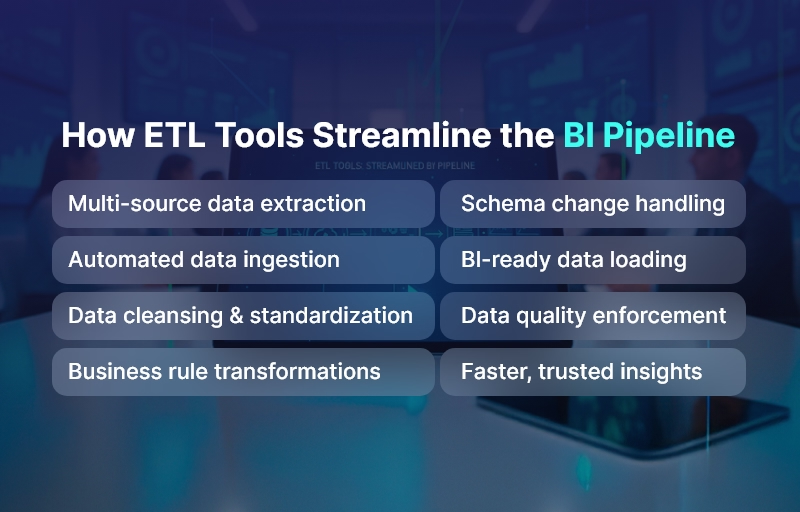
How ETL Tools Streamline the BI Pipeline

What Are ETL Tools in Business Intelligence?

ETL stands for Extract, Transform, Load. They automate this process so analytics teams no longer depend on fragile scripts or manual workflows.

In a BI context, they act as the operational layer between data sources and analytics platforms. As a result, they ensure that dashboards, reports, and KPIs are built on consistent, governed data.

At a high level, ETL tools:

  • Extract data from operational systems
  • Transform raw data into clean, structured formats
  • Load curated datasets into BI-ready storage

Because BI decisions depend on accuracy and timeliness, these tools directly influence business outcomes.

Why ETL Tools Are Critical for BI Pipelines

Without ETL tools, BI pipelines often collapse under scale, complexity, and inconsistency. Therefore, organizations rely on these tools to maintain stability as data volumes grow.

Key reasons these tools are essential include:

  • They standardize data from multiple sources
  • They automate repetitive data preparation tasks
  • They enforce data quality and validation rules
  • They reduce dependency on manual spreadsheets
  • They enable scalable analytics architectures

Consequently, these tools transform BI from reactive reporting into proactive intelligence.

How ETL Tools Streamline the BI Pipeline

They streamline BI pipelines by introducing structure, automation, and governance at every stage of data movement.

1. Data Extraction at Scale

Modern tools connect to dozens or even hundreds of data sources. These sources include databases, SaaS platforms, APIs, flat files, and streaming systems.

These tools simplify extraction by:

  • Supporting prebuilt connectors
  • Handling schema changes automatically
  • Scheduling incremental data pulls
  • Managing API limits and retries

As a result, BI teams gain reliable access to all relevant data without custom engineering.

2. Data Transformation for Analytics Readiness

Raw data is rarely suitable for BI. Therefore, ETL tools apply transformations that align data with analytical requirements.

Common transformations include:

  • Data cleansing and deduplication
  • Data type normalization
  • Business rule application
  • Aggregations and calculations
  • Dimensional modeling (facts and dimensions)

Because transformations are automated and repeatable, these tools ensure consistency across all BI reports.

3. Loading Data into BI Storage Layers

Once transformed, these tools load data into target systems optimized for analytics.

Typical BI destinations include:

  • Cloud data warehouses
  • On-premise data warehouses
  • Data lakes or lakehouses
  • OLAP cubes

By managing load strategies efficiently, they reduce latency and improve dashboard performance.

ETL vs ELT: Which Model Supports Modern BI?

While these tools remain foundational, many BI pipelines now adopt ELT architectures. Understanding the difference is essential.

ETL Model

  • Data is transformed before loading
  • Suitable for legacy systems
  • Strong governance upfront

ELT Model

  • Raw data loads first
  • Transformations run inside the warehouse
  • Ideal for cloud-scale BI

Many modern tools support both ETL and ELT patterns. Therefore, organizations can evolve their BI pipelines without replacing tooling.

Core Capabilities to Look for in ETL Tools

Not all tools deliver equal value. When evaluating tools for BI, prioritize capabilities that reduce operational risk and improve scalability.

Essential features include:

  • Visual pipeline design
  • Automated scheduling and orchestration
  • Error handling and alerting
  • Data lineage and metadata tracking
  • Schema evolution support
  • Security and access controls

Because BI pipelines run continuously, tools must operate reliably with minimal manual intervention.

Tools and Data Quality Management

BI credibility depends on data quality. Therefore, these tools must enforce quality checks throughout the pipeline.

ETL tools improve data quality by:

  • Validating fields and formats
  • Enforcing referential integrity
  • Flagging missing or anomalous values
  • Logging transformation errors

As a result, stakeholders trust BI insights and act on them confidently.

ETL Tools and BI Governance

Beyond data movement, These tools play a central role in BI governance.

They support governance by:

  • Documenting data transformations
  • Tracking source-to-report lineage
  • Enforcing role-based access
  • Supporting audit and compliance requirements

Consequently, ETL tools bridge the gap between analytics agility and enterprise control.

Common BI Use Cases Powered by These Tools

ETL tools enable a wide range of BI scenarios across industries.

Typical use cases include:

  • Executive dashboards
  • Financial reporting and forecasting
  • Sales and marketing analytics
  • Customer behavior analysis
  • Operational performance tracking

Because ETL tools unify disparate data sources, BI teams gain a single source of truth.

Best Practices for Implementing These Tools in BI Pipelines

To maximize ROI, organizations must implement ETL tools strategically.

Follow these best practices:

  • Start with high-impact BI use cases
  • Design modular, reusable pipelines
  • Document transformation logic clearly
  • Monitor pipeline performance continuously
  • Optimize for scalability early

By following these practices, tools remain assets rather than technical debt.

Challenges When Using ETL Tools — and How to Overcome Them

Despite their value, tools introduce challenges if mismanaged.

Common challenges include:

  • Pipeline sprawl
  • Poor transformation design
  • Insufficient monitoring
  • Over-customization

However, disciplined governance, standardized patterns, and regular reviews mitigate these risks effectively.

The Future of ETL Tools in BI

ETL tools continue to evolve alongside BI platforms. Increasingly, they integrate automation, AI-driven optimization, and real-time processing.

Key trends include:

  • Low-code and no-code tools
  • Real-time and streaming ETL
  • AI-assisted data mapping
  • Unified ETL and data observability

Therefore, ETL tools will remain central to BI pipelines for years to come.

Final Thoughts: Why ETL Tools Define BI Success

These tools are not optional infrastructure. They are the operational foundation of every scalable BI strategy. By streamlining data ingestion, transformation, and delivery, tools ensure that insights arrive faster, cleaner, and more reliably.

When organizations invest in the right ETL tools and implement them with discipline, BI evolves from fragmented reporting into a strategic decision engine. Ultimately, these tools do not just move data — they unlock business intelligence at scale.

Frequently Asked Questions (FAQs)

What are ETL tools and why are they important for BI pipelines?

These tools automate the extraction, transformation, and loading of data into analytics systems. They are essential because they ensure data accuracy, consistency, and timely availability for BI reporting and decision-making.

How do ETL tools improve data quality in business intelligence?

These tools apply validation rules, cleansing logic, deduplication, and standardization during data processing. As a result, BI dashboards rely on trusted, analytics-ready data instead of raw or inconsistent inputs.

What is the difference between ETL and ELT tools in BI architecture?

These tools transform data before loading it into the warehouse, whereas ELT tools load raw data first and transform it inside the analytics platform. Modern tools often support both approaches to accommodate cloud BI environments.

Which data sources can ETL tools integrate with?

These tools integrate with databases, cloud applications, APIs, flat files, IoT streams, and legacy systems. This flexibility allows organizations to unify data from multiple operational platforms into a single BI pipeline.

How do ETL tools support scalable BI pipelines?

These tools scale by handling large data volumes, parallel processing, incremental loads, and automated scheduling. Therefore, BI pipelines continue to perform reliably as data and users grow.

Are ETL tools suitable for real-time or near-real-time BI?

Yes, many modern tools support real-time or near-real-time data ingestion using streaming or micro-batch processing. This enables BI teams to deliver up-to-date dashboards and operational insights.

How do tools help with BI governance and compliance?

These tools maintain data lineage, transformation documentation, access controls, and audit logs. Consequently, organizations meet governance, regulatory, and compliance requirements while preserving analytical agility.

What features should BI teams prioritize when selecting ETL tools?

BI teams should prioritize automation, monitoring, error handling, scalability, metadata management, and ease of integration. These features ensure tools remain reliable and manageable over time.

Can ETL tools reduce manual effort in BI reporting?

Absolutely. Tools eliminate manual data preparation, spreadsheet consolidation, and ad-hoc scripting. As a result, analysts focus more on insights and less on data wrangling.

How do tools contribute to faster decision-making?

By delivering clean, timely, and consistent data into BI systems, tools reduce reporting delays and data disputes. Therefore, decision-makers act faster and with greater confidence.
Posted in Superset BITagged Analytics Automation, BI governance, BI Pipeline, Business Intelligence, Cloud Analytics, Data Engineering, Data Ingestion, Data Integration, Data lineage, Data pipelines, Data Quality, Data transformation, Data Warehousing, ELT Architecture, ETL Process, ETL Tools, Metadata management, Modern BI Architecture, Real-time BI, Scalable Analytics

Data Governance Practices for Reliable BI Insights

Posted on December 18, 2025December 18, 2025 by Mandakinee
Data Governance Practices for Reliable BI Insights

Modern enterprises generate more data than ever before, yet nearly 60% of business leaders admit they do not fully trust their analytics (industry research). The problem is not a lack of dashboards or BI tools — it is the absence of strong Data Governance Practices for Reliable BI Insights. Without governance, data becomes inconsistent, insecure, fragmented, and ultimately unreliable for decision-making.

Today, CTOs, founders, and business leaders rely on BI platforms to guide revenue strategy, operational efficiency, customer experience, and compliance. However, when data definitions differ across teams, access is uncontrolled, or quality checks are missing, even the most advanced BI solution fails to deliver value.

This is why Data Governance Practices for Reliable BI Insights have become mission-critical in today’s digital-first landscape. They ensure data accuracy, consistency, security, and accountability — enabling BI systems to generate insights leaders can trust.

In this blog, you will learn why data governance matters, how to implement it effectively, best practices and frameworks to follow, and how Andolasoft helps organizations build future-ready BI ecosystems that scale with confidence.

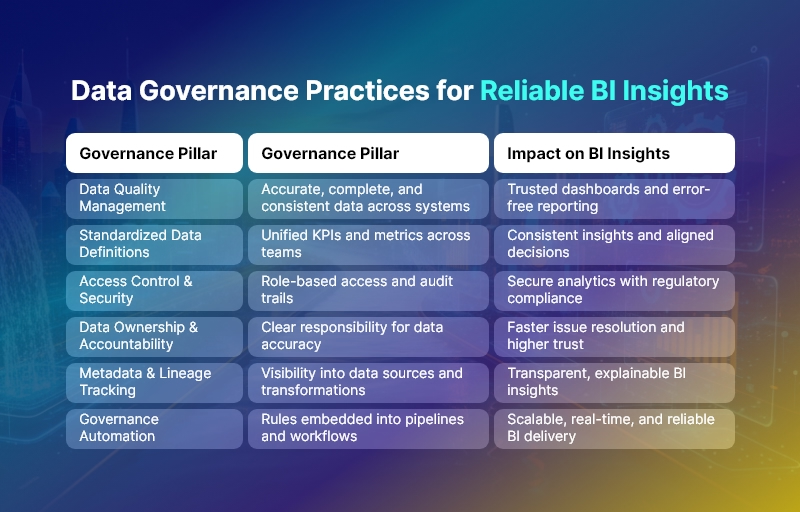
Data Governance Practices for Reliable BI Insights

Business Need & Importance of Data Governance Practices for Reliable BI Insights

As organizations scale, data flows in from multiple sources — ERP systems, CRMs, mobile apps, IoT devices, cloud platforms, and third-party tools. Without Data Governance Practices for Reliable BI Insights, this explosion of data quickly turns into chaos rather than clarity.

Why Data Governance Matters Today

  • Business decisions now depend on real-time analytics, not gut instinct. Without governance, BI insights are inconsistent, delayed, or misleading.
  • Regulatory pressure continues to grow, especially in industries like healthcare, fintech, education, and manufacturing where data privacy and auditability are mandatory.
  • Cross-functional teams consume data differently, making standardized definitions and controlled access essential for alignment.

Industry-Specific Challenges Without Governance

  • Healthcare: Inconsistent patient data leads to reporting errors, compliance risks, and flawed clinical insights.
  • eCommerce: Poor product and customer data governance results in inaccurate sales forecasting and personalization failures.
  • Fintech: Weak governance increases exposure to fraud, compliance penalties, and security breaches.
  • Manufacturing: Inaccurate operational data disrupts supply chains, inventory planning, and production optimization.
  • SaaS & EdTech: Fragmented analytics limit churn analysis, engagement tracking, and product decision-making.

Risks of Ignoring Data Governance

  • Unreliable BI dashboards that erode leadership trust
  • Security vulnerabilities due to uncontrolled data access
  • Revenue loss from incorrect forecasting and insights
  • Increased operational inefficiencies and manual rework
  • Regulatory fines and reputational damage

Therefore, modern organizations must adopt Data Governance Practices for Reliable BI Insights as a strategic foundation — not as an afterthought. Moreover, partnering with a technology expert like Andolasoft ensures governance is embedded into architecture, workflows, and analytics from day one.

Best Practices, Frameworks & Actionable Tips for Data Governance Practices

Implementing Data Governance Practices for Reliable BI Insights requires a structured, scalable, and technology-aligned approach. Below are proven best practices that organizations can implement immediately.

1. Define Clear Data Ownership and Accountability

  • Assign data owners and data stewards for every critical data domain to ensure responsibility for accuracy, quality, and updates.
  • This eliminates ambiguity, reduces errors, and ensures BI teams always know who governs which dataset.

2. Establish Standardized Data Definitions

  • Create a centralized data glossary to standardize KPIs, metrics, and business terms across departments.
  • This ensures sales, finance, and operations interpret BI insights consistently and accurately.

3. Implement Strong Data Quality Management

  • Enforce validation rules, automated cleansing, and anomaly detection across pipelines.
  • High-quality data is the backbone of Data Governance Practices for Reliable BI Insights, ensuring BI dashboards reflect reality.

4. Control Data Access with Role-Based Security

  • Implement role-based access control (RBAC) and audit logs to prevent unauthorized data usage.
  • This strengthens compliance, security, and trust across BI environments.

5. Use Proven Governance Frameworks

  • DAMA-DMBOK: Industry-standard framework for data governance, quality, and lifecycle management.
  • COBIT & ITIL: Align data governance with enterprise IT governance.
    • Modern Data Mesh: Decentralized governance with centralized standards for scalable BI ecosystems.

6. Align Governance with BI Architecture

  • Design BI systems where governance is embedded into ETL pipelines, data warehouses, and visualization layers.
  • This ensures governance does not slow down insights but accelerates trust and adoption.

7. Automate Governance with the Right Tech Stack

  • Cloud data platforms, metadata management tools, and AI-driven data quality checks reduce manual governance overhead.
  • Automation enables governance to scale as data volume and complexity grow.

8. Avoid Common Data Governance Mistakes

  • Treating governance as a one-time project instead of an ongoing program
  • Over-restricting access and slowing innovation
  • Ignoring governance during application modernization
  • Lack of executive sponsorship and cross-team buy-in

How Andolasoft Helps Implement Data Governance Practices for Reliable BI Insights

Andolasoft supports organizations by embedding governance into end-to-end data and BI solutions through:

  • Custom Web & SaaS Development with governance-ready architectures
  • BI, AI & Machine Learning Solutions with governed data pipelines
  • Data Analytics & Warehousing for accurate, scalable insights
  • Application Modernization to eliminate legacy data silos
  • DevOps & Cloud Automation for secure, compliant data workflows

Choosing the right development partner ensures governance enhances BI — rather than restricting it.

Customer Success Example

For example, a mid-sized fintech company partnered with Andolasoft to modernize its BI platform and implement Data Governance Practices for Reliable BI Insights.

The organization struggled with inconsistent reports across finance, risk, and compliance teams. Data definitions varied, access controls were weak, and leadership lacked confidence in BI dashboards.

Andolasoft designed a governed BI architecture that standardized KPIs, implemented role-based access, automated data quality checks, and centralized metadata management.

Results within six months included:

  • 35% faster BI reporting cycles
  • 40% reduction in manual reconciliation efforts
  • Improved regulatory audit readiness
  • Higher executive trust in BI insights
  • Stronger data security and compliance posture

This transformation allowed leadership to make faster, data-driven decisions with confidence.

Key Takeaways: Why Data Governance Can No Longer Be Optional

To summarize, Data Governance Practices for Reliable BI Insights are essential for any organization that depends on analytics for growth and competitiveness.

Key takeaways include:

  • Reliable BI insights depend on governed, high-quality data
  • Governance improves accuracy, security, compliance, and trust
  • Modern frameworks and automation make governance scalable
  • Strong technology partners ensure long-term success

As data volumes grow and AI-driven analytics accelerate, organizations that invest in governance today will outperform those relying on fragmented, untrusted data tomorrow.

FAQs

1. What are Data Governance Practices for Reliable BI Insights?

They are structured policies, processes, and technologies that ensure data accuracy, consistency, security, and accountability across BI systems.

2. Why is data governance critical for BI platforms?

Without governance, BI insights become unreliable, leading to poor decisions, security risks, and compliance failures.

3. How does data governance improve decision-making?

It ensures leaders access trusted, standardized, and high-quality data, enabling faster and more accurate decisions.

4. Which industries benefit most from data governance?

Healthcare, fintech, eCommerce, manufacturing, SaaS, logistics, and education benefit significantly due to compliance and data complexity.

5. Can data governance slow down analytics?

When implemented correctly, Data Governance Practices for Reliable BI Insights actually accelerate analytics by reducing rework and confusion.

6. How does Andolasoft support data governance initiatives?

Andolasoft embeds governance into BI architecture, data pipelines, security models, and analytics workflows.

7. Is data governance a one-time effort?

No. It is an ongoing program that evolves with business needs, data growth, and technology changes.

Posted in BI/Data WarehousingTagged access control in BI, analytics platforms, auditability for analytics, BI data quality, BI reporting, Business Intelligence, Data governance, data governance framework, Data governance strategy, Data lineage, Data Security, Enterprise data governance, Governed data pipelines, Metadata management, Trusted business intelligence

Recent Posts

  • How Retrieval-Augmented Generation (RAG) Is Transforming Government Knowledge Systems?
  • Why Digital Transformation in NBFCs Fails Without Process Visibility?
  • Top Embedded BI Platforms for SaaS Companies
  • Must-Have Enterprise BI Features for Modern Applications
  • ETL Tools to Streamline Your BI Pipeline

Recent Comments

    Archives

    • February 2026
    • January 2026
    • December 2025
    • November 2025
    • September 2025
    • May 2025
    • March 2025
    • February 2025
    • January 2025
    • September 2024
    • August 2024
    • July 2024
    • June 2024
    • May 2024
    • April 2024
    • March 2024
    • February 2024
    • January 2024
    • December 2023
    • November 2023
    • October 2023
    • September 2023
    • August 2023
    • July 2023
    • June 2023
    • May 2023
    • April 2023
    • February 2023
    • January 2023
    • December 2022
    • November 2022
    • October 2022
    • September 2022
    • August 2022
    • July 2022
    • June 2022
    • May 2022
    • April 2022
    • March 2022
    • February 2022
    • January 2022
    • December 2021
    • November 2021
    • October 2021
    • September 2021
    • August 2021
    • July 2021
    • June 2021
    • May 2021
    • April 2021
    • March 2021
    • February 2021
    • January 2021
    • December 2020
    • November 2020
    • October 2020
    • September 2020
    • August 2020
    • July 2020
    • June 2020
    • May 2020
    • April 2020
    • March 2020
    • February 2020
    • January 2020
    • December 2019
    • November 2019
    • September 2019
    • August 2019
    • July 2019
    • June 2019
    • May 2019
    • April 2019
    • March 2019
    • February 2019
    • January 2019
    • December 2018
    • November 2018
    • October 2018
    • August 2018
    • June 2018
    • May 2018
    • April 2018
    • March 2018
    • February 2018
    • January 2018
    • December 2014
    • November 2014
    • October 2014
    • September 2014
    • August 2014
    • July 2014
    • June 2014
    • May 2014
    • April 2014
    • March 2014
    • February 2014
    • January 2014
    • December 2013
    • November 2013
    • October 2013
    • September 2013
    • August 2013
    • July 2013
    • June 2013
    • May 2013
    • April 2013
    • March 2013
    • February 2013
    • January 2013
    • December 2012
    • November 2012
    • October 2012
    • September 2012
    • August 2012
    • June 2012
    • January 2012
    • November 2011
    • June 2011
    • March 2011
    • January 2011
    • October 2010
    • September 2010
    • July 2010
    • June 2010
    • May 2010
    • December 2009
    • November 2009

    Categories

    • Advanced CSS
    • AI
    • Amazon Web Services
    • Analytics
    • Android
    • Angular
    • App Development
    • Application Development
    • Artificial Intelligence
    • Artificial intelligence (AI)
    • Asp.net
    • Automation
    • BI/Data Warehousing
    • Business
    • Business & Marketing
    • CakePHP
    • Cloud
    • Cloud Computing
    • Cloud Management
    • Cloud Technology
    • CMS
    • CRM
    • Cross browser testing
    • Cross Platform Framework
    • Cryptocurrency exchange
    • CSS
    • Custom WordPress Plugin
    • dedicated developers
    • Digital
    • Digital Marketing
    • Digital Transformation
    • Django
    • Ecommerce
    • Employee Benefits Management.
    • FinTech App
    • Fitness App Development
    • Flexbox
    • Flutter
    • Flutter Mobile App
    • Forex Trading
    • Generative AI
    • Guest Blogging
    • HealthCare App
    • Hire Developer
    • Hire Developers
    • Hybrid
    • Infographic
    • Information
    • iOS
    • iOS mobile app
    • IoT
    • Java
    • Javascript
    • JavaScript Framework Development
    • Laravel
    • Laravel App Development
    • Location-Based Marketing
    • Magento
    • Marketing
    • marketing automation system
    • Marketing automation tools
    • Mobile
    • Mobile App Development
    • Mobile Application
    • No-code development
    • Node
    • NodeJS
    • NuxtJS
    • Odoo
    • Open Source
    • Outsourcing
    • Pentaho
    • Performance Testing
    • PHP
    • Plugin
    • Product Development
    • Productivity App
    • Products and Services
    • Programming Languages
    • Python
    • Python application development
    • Python Developer
    • QA
    • Rails
    • React Native
    • ReactJS
    • Real-Estate
    • Remote Developers
    • Retrieval-Augmented Generation
    • Ruby on Rails
    • SaaS
    • SASS
    • Self Goal
    • Service Oriented Architecture
    • Shopify
    • Sober Living
    • Social Media App Development
    • Social Networking
    • Software Development
    • Superset BI
    • Support and Maintenance
    • Technology
    • Technology & Innovation
    • Testing
    • UI Design
    • Uncategorized
    • VueJS
    • Web Designing
    • Web Development
    • WooCommerce
    • WordPress
    • WordPress Websites
    • Финтех

    Meta

    • Log in
    • Entries feed
    • Comments feed
    • WordPress.org
    Proudly powered by WordPress | Theme: siard-envytheme by EnvyTheme.