Must-Have Enterprise BI Features for Modern Applications

Enterprise software no longer competes on features alone. It competes on how fast decisions are made, how accurately performance is measured, and how quickly leaders can respond to change. That is exactly why enterprise BI has moved from a “nice-to-have” analytics layer to a core operating system for decision-making.

Today, every serious enterprise application — whether it is ERP, CRM, HRMS, FSM, construction management, or financial systems — must embed or integrate BI at its core.

However, not all analytics are created equal.

True enterprise BI is not about pretty dashboards. Instead, it is about governance, scale, trust, performance, security, and decision velocity. Therefore, choosing the right BI features is a strategic architecture decision, not a UI decision.

In this definitive guide, you will learn:

  • What enterprise BI really means in modern enterprises
  • Why basic reporting tools fail at scale
  • The must-have BI features for any serious enterprise application
  • How BI drives adoption, ROI, and competitive advantage
  • How to evaluate an BI platform properly

Let us begin with the fundamentals.
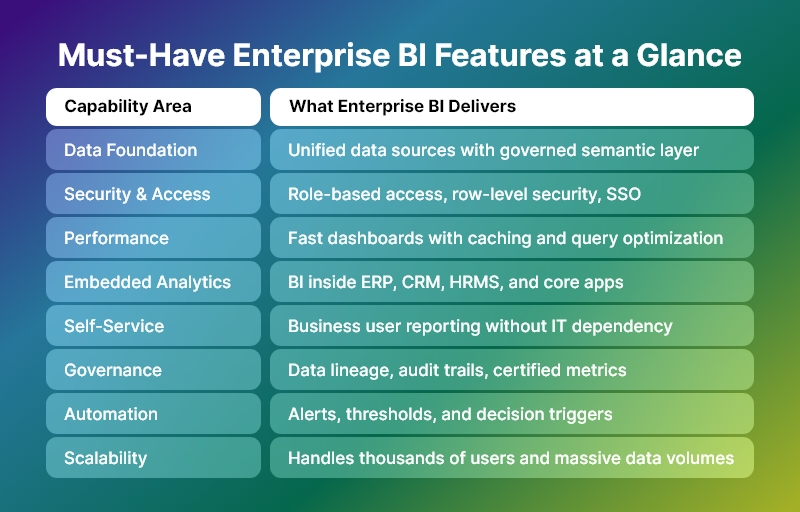
Must-Have-Enterprise-BI-Features-at-a-Glance

What Is Enterprise BI?

It (Enterprise Business Intelligence) is a scalable, governed, secure, and performance-driven analytics layer that supports decision-making across the entire organization—from frontline teams to executive leadership.

Unlike basic BI tools, enterprise BI:

  • Serves hundreds or thousands of users
  • Handles millions or billions of rows of data
  • Enforces data governance and security
  • Supports mission-critical business workflows
  • Integrates deeply into core enterprise applications

In other words, BI is not a reporting tool. It is a decision infrastructure.

Why Basic BI Fails in Enterprise Environments

Many organizations start with simple dashboards. However, they quickly hit limitations.

Basic BI fails because:

  • It cannot scale to large data volumes
  • It breaks under concurrent user load
  • It lacks role-based security and governance
  • It creates multiple versions of truth
  • It depends heavily on analysts instead of business users
  • It does not integrate deeply into enterprise workflows

As a result, enterprises either:

  • Lose trust in data
  • Slow down decision-making
  • Or build expensive, fragmented analytics stacks

This is exactly why enterprise BI exists.

The Strategic Role of Enterprise BI in Enterprise Applications

Modern enterprise applications are no longer transactional systems only. They are decision platforms.

Therefore, BI must:

  • Power daily operational decisions
  • Support strategic leadership decisions
  • Enable cross-department visibility
  • Drive process optimization
  • Enforce data accountability
  • Accelerate business execution

Consequently, BI becomes a core competitive advantage.

Must-Have Enterprise BI Features (Complete Enterprise Checklist)

Below is the definitive feature framework for evaluating or building a true BI system.

1. Enterprise-Grade Data Architecture

BI must handle complexity at scale.

It must support:

  • Multiple data sources (ERP, CRM, HRMS, IoT, Finance, Ops, external data)
  • Structured and semi-structured data
  • Large volumes and high refresh rates
  • Historical and real-time data together

Core capabilities include:

  • Data connectors and ingestion pipelines
  • Data modeling and semantic layers
  • Incremental refresh and caching
  • Support for cloud, on-prem, and hybrid data

Without this foundation, enterprise BI collapses under growth.

2. Single Source of Truth (Semantic Layer)

One of the biggest reasons BI fails is metric chaos.

Therefore, enterprise BI must provide:

  • Centralized metric definitions
  • Business-friendly semantic models
  • Reusable KPIs across dashboards and apps
  • Governance over calculations and logic

Benefits:

  • No conflicting numbers
  • No department-level data politics
  • No spreadsheet shadow systems
  • High trust in executive reporting

In short, BI must enforce truth at scale.

3. Enterprise Security and Access Control

Enterprise BI is useless if it is not secure.

It must support:

  • Role-based access control (RBAC)
  • Row-level and column-level security
  • SSO and enterprise authentication (SAML, OAuth, LDAP, etc.)
  • Audit logs and access tracking
  • Data masking for sensitive fields

Why this matters:

  • Finance, HR, and leadership data must not leak
  • Compliance requirements demand strict controls
  • Large organizations cannot rely on manual permissions

Therefore, security is not optional in BI. It is foundational.

4. Performance at Scale

Enterprise BI must stay fast even when:

  • Data grows 10x
  • Users grow 50x
  • Queries become complex
  • Dashboards become heavier

Critical performance features include:

  • Intelligent caching
  • Query optimization
  • In-memory acceleration
  • Pre-aggregations
  • Load balancing
  • Asynchronous query execution

Because in enterprises:

If dashboards are slow, decisions are slow. And slow decisions cost money.

5. Embedded Analytics for Enterprise Applications

Modern enterprise BI must not live in a separate portal.

Instead, it must:

  • Embed inside ERP, CRM, HRMS, FSM, or industry apps
  • Respect application user permissions
  • Adapt to application workflows
  • Feel like a native feature

Embedded BI enables:

  • Contextual decision-making
  • Higher adoption
  • Better user experience
  • Stronger product differentiation

Today, enterprise BI is a product feature, not a separate product.

6. Self-Service Analytics for Business Users

BI cannot depend entirely on analysts.

It must empower:

  • Managers
  • Operations leaders
  • Finance teams
  • Sales leaders
  • Department heads

Self-service features include:

  • Drag-and-drop reports
  • Filter and slice-and-dice
  • Drill-down and drill-through
  • Custom views and saved dashboards
  • Ad-hoc exploration without SQL

This ensures:

  • Faster answers
  • Less dependency on data teams
  • Higher data culture maturity

7. Advanced Dashboarding and Visualization

Enterprise BI dashboards must support:

  • Executive-level KPI views
  • Operational performance views
  • Departmental scorecards
  • Process monitoring screens

Core visualization capabilities:

  • Interactive charts and tables
  • Cross-filtering
  • Drill-down hierarchies
  • Conditional formatting
  • Alerts and thresholds
  • Storytelling views

However, remember:

Enterprise BI is not about visuals. It is about decisions enabled by visuals.

8. Real-Time and Near Real-Time Analytics

Many enterprise use cases require:

  • Live operations monitoring
  • SLA tracking
  • Incident detection
  • Financial risk control
  • Supply chain visibility

Therefore, BI should support:

  • Streaming or near-real-time data
  • Incremental refresh
  • Low-latency dashboards
  • Operational alerting

This transforms enterprise BI from reporting to control systems.

9. Alerts, Automation, and Decision Triggers

Modern BI must not wait for users to open dashboards.

It must:

  • Push alerts when thresholds are crossed
  • Trigger workflows
  • Send notifications to email, Slack, Teams, etc.
  • Integrate with business processes

Examples:

  • Alert when cash flow drops below limit
  • Alert when project cost overruns
  • Alert when churn risk spikes
  • When compliance metrics fail

This is how enterprise BI becomes proactive instead of reactive.

10. Data Governance and Lineage

At enterprise scale, governance is non-negotiable.

  • BI must provide:
  • Data lineage tracking
  • Impact analysis
  • Change management
  • Certification of datasets
  • Ownership and stewardship models

This ensures:

  • Audit readiness
  • Compliance confidence
  • Trust in enterprise-wide metrics
  • Controlled evolution of analytics

11. Collaboration and Sharing

Enterprise BI is a team sport.

It must support:

  • Shared dashboards
  • Commenting and annotations
  • Versioning
  • Scheduled reports
  • Role-based sharing

This transforms analytics into organizational conversation, not isolated analysis.

12. AI and Advanced Analytics (Optional but Strategic)

Modern enterprise BI increasingly includes:

  • Forecasting
  • Anomaly detection
  • Trend analysis
  • What-if simulations
  • Natural language queries

While not mandatory for every enterprise today, this is rapidly becoming a strategic differentiator.

13. Scalability and Future-Proof Architecture

Enterprise BI must scale across:

  • Users
  • Data volume
  • Use cases
  • Departments
  • Geographies

Therefore, it must support:

  • Modular architecture
  • API-first integration
  • Cloud and hybrid deployment
  • Horizontal scaling
  • Multi-tenant or multi-org setups

How Enterprise BI Drives Real Business Outcomes

When implemented correctly, BI delivers:

  • Faster decision cycles
  • Higher operational efficiency
  • Lower reporting overhead
  • Better leadership visibility
  • Stronger governance
  • Higher ROI from enterprise systems

In short:

BI turns data into organizational leverage.

How to Evaluate an Enterprise BI Platform

Use this checklist:

  • Does it scale to thousands of users?
  • Does it enforce governance and security?
  • Does it embed inside your application?
  • Does it support self-service safely?
  • Does it perform under heavy load?
  • Does it integrate with your data stack?
  • Does it reduce dependency on analysts?

If the answer is “no” to several of these, it is not true BI.

Final Thoughts: Enterprise BI Is Not Optional Anymore

In 2026 and beyond, BI is not an add-on.

It is:

  • A core layer of enterprise architecture
  • A strategic decision platform
  • A competitive advantage
  • A governance system
  • A performance engine

Organizations that treat BI as a strategic system will out-execute, out-learn, and out-scale those that do not.

And that is the real power of BI.

What are the Functionalities and Benefits of Pentaho BI?

Today, millions of terabytes of data is produced everyday. Businesses need this customer data to create winning business strategies. But transforming these data into useful metrics and insightful data requires data integration tools such as Pentaho BI.

But what is Pentaho application development, and how does it work? In this blog post, we’ll take a deep dive into Pentaho, exploring its core features and functionality.

What is Pentaho?

Pentaho is a data integration and business intelligence platform that empowers organizations to turn their raw data into meaningful insights.

It offers a comprehensive suite of tools designed to facilitate data integration, reporting, dashboarding, and data mining. Pentaho is trusted by numerous businesses, from startups to large enterprises, for its flexibility and scalability.

Key Components of Pentaho

To understand how Pentaho works, let’s take a closer look at its core components:

  1. Pentaho Data Integration (PDI):

PDI, also known as Pentaho Kettle, is the ETL (Extract, Transform, Load) powerhouse of Pentaho. It allows users to extract data from various sources, transform it as needed, and load it into a target system.

Never miss an update from us. Join 10,000+ marketers and leaders.

With a drag-and-drop interface, users can design complex data pipelines without writing code.

  1. Pentaho Reporting:

Pentaho Reporting is all about creating visually appealing, interactive reports. Users can design reports in a pixel-perfect manner and embed them in web applications or distribute them via email, PDF, or other formats.

  1. Pentaho Analytics:

This component enables data exploration and interactive analysis. Users can create customized, interactive dashboards with charts, graphs, and tables, allowing for real-time data visualization.

  1. Pentaho Data Mining:

Pentaho’s data mining capabilities help uncover patterns and trends in your data. It’s particularly valuable for predictive analytics, making it easier to anticipate future events or identify opportunities.

  1. Pentaho Metadata:

Metadata in Pentaho simplifies data modeling and allows users to define data structures, hierarchies, and relationships. It provides a consistent view of data across the organization.

How Pentaho Works?

Pentaho’s functionality hinges on its ability to connect to various data sources, process and transform data, and provide reporting and analytics. Here’s how Pentaho works in a nutshell:

  • Data Integration:
    Data is extracted from multiple sources, including databases, spreadsheets, and web services, using Pentaho Data Integration (PDI). The extracted data is then transformed and cleaned as necessary.
  • Data Warehouse:
    The transformed data can be loaded into a data warehouse or a data mart for storage and easy access. This ensures data consistency and provides a central repository for analysis.
  • Reporting and Analytics:
    Pentaho Reporting and Pentaho Analytics come into play here. Users can create reports, dashboards, and ad-hoc queries to explore data, identify trends, and make data-driven decisions.
  • Data Mining:
    For advanced analysis and predictive modeling, Pentaho Data Mining allows users to build data mining models and gain deeper insights into their data.
  • Metadata Management:
    Throughout the process, Pentaho Metadata helps maintain data consistency and provide a unified view of data.

What is The Pentaho Application Development Process?

  1. Understanding Requirements:

The first step is to gather and understand the specific requirements of the business or end-users. What kind of reports, dashboards, or data integration processes are needed? What are the key objectives and functionalities of the application?

  1. Planning and Design:

Once the requirements are clear, developers need to plan the architecture and design of the Pentaho application.

This includes deciding which Pentaho tools and components will be used, how data will be sourced, and how it will be presented. Consider aspects like data sources, data models, and user interfaces.

  1. Data Integration (ETL) Design:

For data integration solutions, a detailed ETL (Extract, Transform, Load) process must be designed. This involves defining data sources, transformations, validation, error handling, and data loading processes using Pentaho Data Integration (PDI).

  1. Development:

Actual development begins at this stage. Developers create the Pentaho application using the chosen components. For BI applications, this may involve designing reports, interactive dashboards, and data visualizations.

For data integration solutions, it involves creating Pentaho ETL workflows, data models, and other data processing components.

  1. Customization:

Depending on the requirements, developers may need to customize Pentaho components, create custom connectors, or design unique data visualization elements to match the specific needs of the application.

  1. Testing:

Rigorous testing is critical to ensure that the Pentaho application functions correctly and meets the defined requirements. This includes testing data accuracy, performance, and user interface usability.

It’s important to identify and fix any issues or bugs during this phase.

  1. Integration:

If the Pentaho application needs to integrate with other systems, such as databases, cloud services, or third-party applications, this integration work is performed in this step.

  1. Documentation:

Create user documentation, including user guides and training materials, to help end-users understand how to use the Pentaho application effectively.

Deployment:

Deploy the Pentaho application to a production environment. This may involve configuring servers, databases, and security settings to ensure a smooth deployment.

  1. Monitoring and Maintenance:

Once the application is live, it’s important to set up monitoring tools and processes to keep track of its performance and data accuracy. Maintenance and updates may be required to address issues and adapt to changing business needs.

  1. User Training:

Provide training to end-users to ensure they know how to use the Pentaho application to its fullest potential.

  1. Feedback and Iteration:

Gather feedback from users and stakeholders to identify areas for improvement. Iterative development may be necessary to enhance the application and add new features.

  1. Security and Access Control:

Implement and regularly review security measures to protect sensitive data and ensure proper access controls.

Benefits of Pentaho Business Intelligence Development

  1. Open Source and Cost-Effective:

Pentaho is an open-source BI platform, making it a cost-effective choice for businesses. There are no licensing fees, which can result in significant cost savings compared to proprietary BI tools.

  1. Flexibility and Customization:

Pentaho’s open architecture allows for extensive customization. Developers can tailor the platform to meet specific business needs, creating custom reports, dashboards, and data integration solutions.

  1. Scalability:

Pentaho can handle both small and large datasets and can be scaled to accommodate growing data requirements. This scalability ensures that organizations can use Pentaho as their data needs evolve.

  1. User-Friendly:

Pentaho offers intuitive, user-friendly interfaces, making it accessible to both technical and non-technical users. Business users can create reports and perform data analysis with minimal training.

  1. Versatile Data Integration:

Pentaho Data Integration (PDI) provides robust ETL (Extract, Transform, Load) capabilities. It allows for the integration of data from various sources, cleansing, and transformation to ensure data accuracy.

  1. Interactive Dashboards:

Pentaho Analytics enables the creation of interactive and visually appealing dashboards. Users can explore data in real-time, providing actionable insights and improving decision-making.

  1. Ad-Hoc Querying:

Pentaho supports ad-hoc querying, allowing users to explore data and generate on-the-fly reports without relying on predefined reports. This empowers users to find answers to specific questions quickly.

  1. Data Mining and Predictive Analytics:

Pentaho Data Mining enables organizations to implement predictive analytics models. This is valuable for tasks like fraud detection, recommendation systems, and identifying patterns and trends in data.

  1. Metadata Management:

Pentaho provides robust metadata management, ensuring data consistency and providing a unified view of data. This is crucial for data governance and understanding data lineage.

  1. Active Community and Support:

Pentaho has a thriving user community, and there are professional support options available. This means organizations have access to a wealth of resources and assistance when needed.

  1. Integration Capabilities:

Pentaho can be integrated with various data sources, databases, cloud services, and big data platforms. This ensures seamless data flow between different parts of an organization’s technology stack.

  1. Improved Decision-Making:

With Pentaho, organizations can make data-driven decisions based on real-time data analysis and reporting, leading to more informed choices that drive business success.

  1. Competitive Advantage:

By harnessing the power of data, organizations using Pentaho can gain a competitive edge by identifying trends, opportunities, and areas for improvement in their operations and strategies.

  1. Data Governance and Compliance:

Pentaho helps organizations ensure data governance and compliance with regulations such as GDPR or HIPAA by providing tools for data protection, security, and auditing.

  1. Cost Savings and ROI:

The cost savings from using an open-source BI tool like Pentaho, coupled with the potential for improved decision-making, often leads to a high return on investment (ROI) for organizations.

List of Various Pentaho Development Services

  1. Pentaho Implementation and Deployment:

Service providers assist in setting up and deploying the Pentaho platform within an organization’s IT infrastructure. This involves configuring servers, databases, and security settings to ensure a smooth deployment.

  1. Custom Report and Dashboard Development:

Developers create custom reports and interactive dashboards tailored to a business’s specific needs. These reports can include charts, tables, and other data visualizations.

  1. Data Integration and ETL Development:

Pentaho experts design and build Extract, Transform, Load (ETL) processes using Pentaho Data Integration (PDI) to efficiently extract, transform, and load data from multiple sources into a data warehouse or other target systems.

  1. Pentaho Plugin and Extension Development:

Developers create custom plugins and extensions to enhance Pentaho’s functionality, allowing businesses to address unique requirements.

  1. Data Mining and Predictive Analytics:

Service providers develop and implement data mining models and predictive analytics solutions using Pentaho Data Mining to help organizations make informed decisions and predictions.

  1. Metadata Management:

Consultants assist in setting up and managing metadata within Pentaho to ensure data consistency and provide a unified view of data.

  1. Performance Optimization:

Pentaho development services may include performance tuning to ensure the platform operates efficiently, particularly when handling large datasets or complex ETL processes.

  1. Training and User Support:

Training sessions are provided to educate users and administrators on how to effectively use Pentaho tools for reporting, data integration, and analytics. User support services help address queries and issues as they arise.

  1. Customization and Integration:

Pentaho development services often involve customizing the platform to meet specific business needs. This includes creating connectors, transformations, and visualizations.

Are you looking for a Pentaho ETL Services

Contact Us

Additionally, service providers help integrate Pentaho with other systems and technologies.

  1. Security and Access Control:

Consultants may set up and enhance security measures to protect sensitive data within Pentaho applications and ensure proper access controls.

  1. Migration Services:

If a business is transitioning to Pentaho from another BI platform or upgrading to a newer Pentaho version, migration services help ensure a smooth transition with minimal disruptions.

  1. Data Governance and Compliance:

Service providers help organizations implement data governance and compliance measures within Pentaho, ensuring that data handling adheres to regulatory requirements.

  1. Continuous Support and Maintenance:

Ongoing support and maintenance services are offered to address issues, updates, and improvements to the Pentaho implementation.

  1. Consulting and Strategy Development:

Pentaho consultants provide strategic guidance on how to best utilize Pentaho to meet business goals, optimize data processes, and drive better decision-making.

  1. Data Strategy and Planning:

Pentaho development services may include assistance in crafting data strategies and roadmaps to align Pentaho implementations with business objectives.

Conclusion

Pentaho is a robust, open-source Business Intelligence and data integration platform that empowers organizations to harness the power of their data.

Its various components, such as Pentaho Data Integration, Reporting, Analytics, Data Mining, and Metadata, work together seamlessly to facilitate data-driven decision-making.

Whether you’re a startup or an enterprise, Pentaho’s flexibility, scalability, and community support make it a compelling choice for your Business Intelligence needs.

Frequently Asked Questions:

  1. What is Pentaho, and how does it differ from other BI tools?

Pentaho is an open-source business intelligence (BI) and data integration platform. What sets Pentaho apart is its open-source nature, which makes it cost-effective, highly customizable, and adaptable to various business needs.

Pentaho’s flexibility, extensive community support, and scalability are key differentiators.

  1. What are the key components of Pentaho that I should be aware of for application development?

The primary components are Pentaho Data Integration (PDI), Pentaho Reporting, Pentaho Analytics, Pentaho Data Mining, and Metadata Management.

These components are commonly used in Pentaho application development to create data integration, reporting, and analytics solutions.

  1. Can Pentaho be integrated with other systems and databases?

Yes, Pentaho can be seamlessly integrated with a wide range of data sources, databases, cloud services, and big data platforms. This integration capability ensures data flows efficiently between various parts of an organization’s technology stack.

  1. What are the benefits of using Pentaho for custom application development?

Some of the key benefits include cost-effectiveness, scalability, customization, user-friendliness, data integration capabilities, interactive dashboards, and data mining support.

These benefits empower organizations to make data-driven decisions and gain a competitive edge.

  1. What types of applications can be developed using Pentaho?

Pentaho can be used to create a variety of applications, including business intelligence dashboards, interactive reports, data integration solutions, data mining and predictive analytics tools, and more.

  1. What is the typical process of Pentaho application development?

The typical process includes understanding requirements, planning and design, development, testing, integration, deployment, user training, and ongoing maintenance. It may also involve customization, optimization, and metadata management.

  1. Is Pentaho suitable for small businesses, or is it primarily for large enterprises?

Pentaho is suitable for businesses of all sizes. Its scalability and adaptable nature make it an excellent choice for small businesses and large enterprises alike.

  1. Can Pentaho applications be customized to meet specific business needs?

Yes, Pentaho applications can be customized extensively to meet unique business requirements. Developers can create custom reports, dashboards, and data transformations.

  1. What is the role of metadata in Pentaho application development?

Metadata in Pentaho helps maintain data consistency and offers a unified view of data. It plays a crucial role in data governance, lineage, and understanding data structures.

  1. Is training available for Pentaho application users and developers?

Yes, training resources and educational materials are available to help users and developers learn how to effectively use Pentaho for reporting, data integration, and analytics.

  1. How can Pentaho applications help improve decision-making within an organization?

Pentaho applications provide real-time insights, analytics, and data visualization, enabling data-driven decisions based on accurate and up-to-date information.