The Growth of Artificial Intelligence in Ecommerce

Technology combined with eCommerce has taken the world by storm even prior to the Covid-19 crisis. Customer satisfaction, brand recognition, and the effectiveness of the sales procedures are the pillars on which the e-Commerce industry thrives. With technology increasingly infiltrating the e-commerce market, retailers are on the lookout for innovative ways to improve these aspects with newer features to automate processes and stay ahead of the curve.

All this reckoned with, the integration of AI proved to be a game-changer for eCommerce and retail platforms, thus shaping retail digitization.

The below graph indicates Statista’s estimates of retail sales to amount to nearly $30 trillion by 2023. Nasdaq estimates 95% of purchases by E-commerce to be facilitated by 2040.
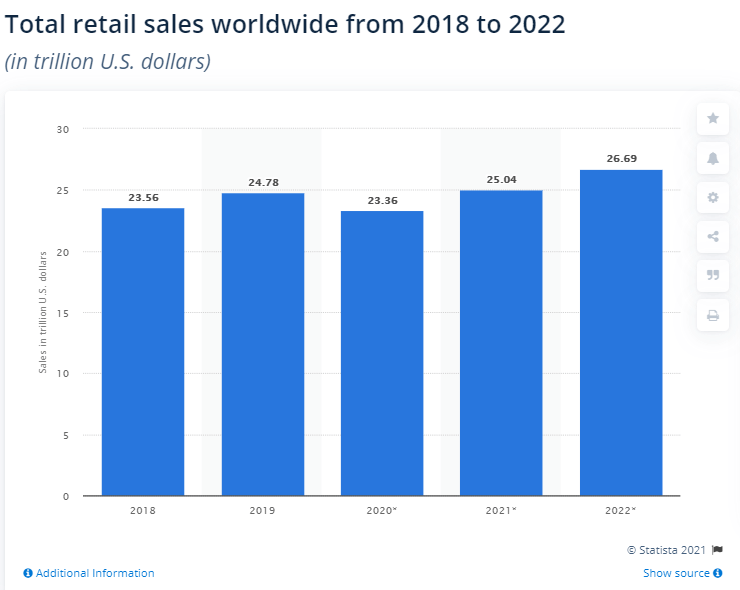
Retail-ecommerce-sales(Source – indatalabs.com)

The implementation of Artificial Intelligence in eCommerce can change business functions with demand forecasting and big data based on behavior, product, and, action. The usage of AI in the eCommerce industry brings a set of unique perks to most retailers. Not only does it provide the luxury of shopping but also reduces costs and strengthens the top line and bottom line of the organization.

Recommendation Systems

Ecommerce application development companies offer intuitive web and mobile apps simplifying online ordering for retail customers. They integrate AI that gathers data based on user’s interests that also drive the rate of up-selling. Amazon is the best example that offers a customized web page to millions of users. Amazon’s recommendation engine is well-known for the use of AI in e-commerce to generate suggestions.

Never miss an update from us. Join 10,000+ marketers and leaders.

Another industry magnate, Netflix, saves $1 billion a year, thanks to AI-powered systems that deliver 75% of content to users through targeted and customized recommendations. These technologies are built on top of big data.

Consumers can also receive non-trivial recommendations aligned to their current location. All in all, AI keeps track of your previous shopping habits and makes intelligent suggestions for similar items that you’ll enjoy just as much.

Definitely, the growth of Artificial Intelligence in the eCommerce industry has increased productivity with fully automated data processing to ease lives.

Chatbots in eCommerce

In 2020, nearly 77% of the most successful businesses generated leads through chatbots.
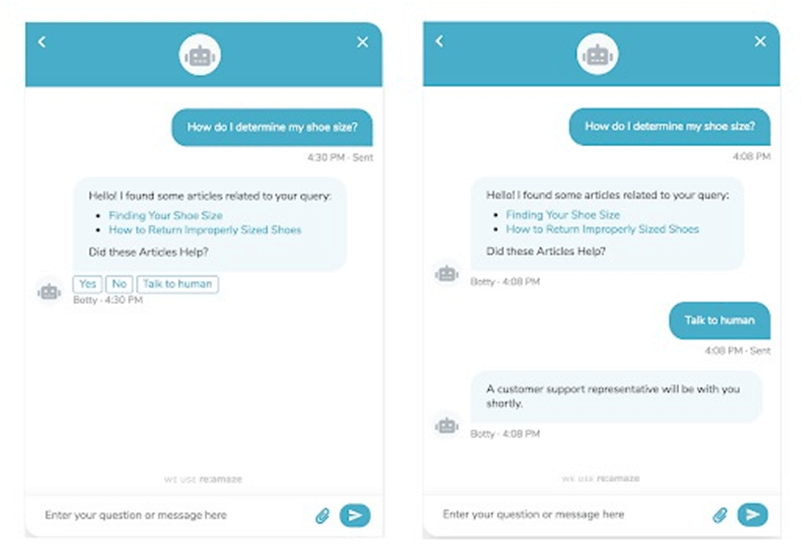
ChatbotChatbots are algorithm-based customer service tools built to enhance customer experience.

According to a study conducted by Bain & Company, businesses that connect and communicate with customers service requests on social media cite a 20% to 40% increase in revenue from those consumers.

Chatbots, which replace human workers, help to make more productive use of the resource by giving them more opportunities to contribute.  High user rating and recommendation, increased sales, and user retention spiked the integration of chatbots in the eCommerce space. Reduction in shopping cart abandonment curbed lengthy checkout procedures. This factor was seen as a major reason for success in retaining customers.

For example, Agromall, a Philippines-based eCommerce store sells consumer goods. Their bot makes it easier to extract key information, delivery details, and talk to a support agent.

The bot was designed with two main objectives in mind:

  • To streamline the sales process.
  • Customers can chat with an agency at any point of the sales process, which will enhance the live chat and service experience.

Argomall’s store bot uses Google’s Site Search API for customers to enter keywords like “Sony TV” and other products.

The results?

After its launch, Agromall generated a whopping 23x increase in ROI, thanks to its chatbots that is the major driving tool for sales and customer service.

Chatbots have made their mark with exponential growth in revenue due to their automated order placement and personalized search results. People who use messaging apps to connect with brands are 53% more likely to shop with a company they can contact.

AR and VR Transforming Ecommerce

Retailers are aiming to create intuitive and friendly shopping experiences by combining current e-commerce stores with immersive technology like Augmented Reality and Virtual Reality (AR/VR). These innovations have revolutionized the e-commerce industry and altered the way companies operate.

The “try before you buy” phrase has earned its reputation in the eCommerce world. All thanks to the AR & VR Technology that possesses the ability to visualize a product of your choice.

How can the power of AR and VR change the future of shopping?

AR and VR can enable customers to visit interactive showrooms and experience products. Customers get to make informed purchase decisions by simply scanning a product through a Smartphone and viewing a list of products available on numerous eCommerce platforms. It lets you flip through retail stores and flipping through product descriptions and dimensions.

AR and VR in Ecommerce
(Source – ecommercegermany.com)

Some of the greatest eCommerce companies are leveraging virtual reality to create incredible experiences and gain a competitive advantage.

Customers are more likely to purchase from brands that use immersive technology to market themselves, according to a recent survey.

On the other hand, retailers can now create virtual versions and take complete control of the exact replica of their physical store. Designing and modifying an online marketplace according to the fluctuating customer trends and product preferences is what the future looks like.

Building an immersive environment capable of simulating real-life is perhaps one of the greatest advantages AR and VR bring to the e-commerce industry.

I’ve worked with the team at Andolasoft on multiple websites. They are professional, responsive, & easy to work with. I’ve had great experiences & would recommend their services to anyone.

Ruthie Miller, Sr. Mktg. Specialist

Salesforce, Houston, Texas

LEARN MORE

AR and VR can allow consumers to immerse themselves further into the e-commerce experience, enabling the opportunity for rapid growth and increased sales, irrespective of a 360-degree video catalog delivery or simply an interactive digital experience.

AI Integrated Ecommerce App Development

Some of the greatest eCommerce app developments enable custom-made solutions using AI to make the right inquiry to the users. Customer analysis, climatic conditions in a specific location, and historical data from previous records can all be used to forecast sales for eCommerce customers.

With SaaS in full swing, it’s critical to hire eCommerce developers who can evaluate and automate a large number of customer interactions and processes on a daily basis. The stress on ever-increasing demands of automation challenges in web and mobile app development companies has had a huge impact on online shopping performance. The demand to hire eCommerce developers with a focus on end-to-end solutions increases the stress of offering a significant increment in user fulfillment.

That being said, automated eCommerce development translates into conveying the right message at the right time to the right set of customers.

AI-driven solutions can piece together a variety of insights to automate eCommerce developments for easing the lives of users. Making informed decisions in a matter of seconds is what AI in eCommerce stands for.

Are you looking help on your eCommerce app development! Lets Discuss

Top Reasons Of Fintech Application For Being The Role Model For Any Industries

The Fintech term is stands for Financial Technology. When the financial system collaborates with the technology and produces an effective outcome, the term Fintech is used in the broad sense.

It is being applied as a term to address start-up affiliated with Fintech and as a verb.

There is no conventional meaning of Fintech since the word is developing within its reach and has reached itself from banking to other exercises like personal finance, mutual funds, and insurance.

You may consider this Fintech is something like logging into your associated bank account to your monthly statement using third-party application line PhonePe, YNAB, or Google Pay.

Beyond this, these financial apps can help you to mage your monthly bills, credit card balance, transitions, paychecks, and all your bank accounts in one place.

But if we look deeper, there are more financial technologies providing alternatives to traditional financial methods and financial services, further democratizing and segmenting the financial sector.

But in reality, financial technology provides more alternatives to the traditional financial methods and financial services as well. It makes the financial system accessible to everyone segmenting the business sector.

Never miss an update for us. Join 10,000+ marketers and leaders.

Types of Fintech Application:

Different types of financial technology offerings endless solutions, from personal to business-scale finance management.

By honing in on different parts of the financial sector, private businesses can compete with traditional financial services – like those offered by major U.S. banks – through FinTech software solutions and focused quality tools.

By pointing/targeting multiple parts of the financial sector, some businesses can take part in conventional financial services. Matter to consider, the major banking system (of different countries) should allow the collaboration with Fintech tool.

Some of the main services of Fintech solution includes:

Note: All the above Fintech tool belongs to US market only.

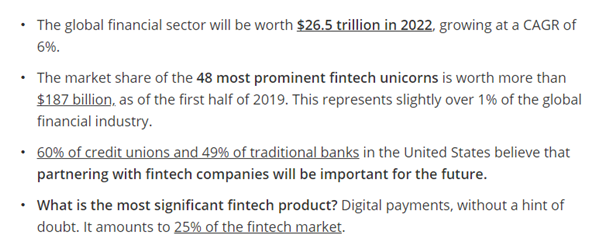
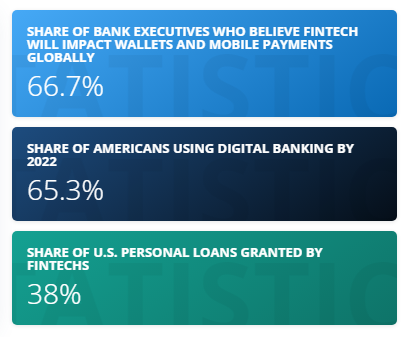
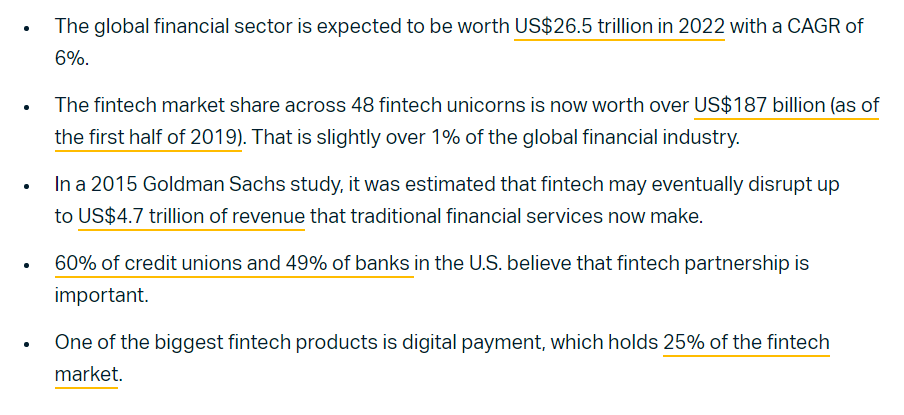
When we come to the US market, let’s see what the statistics are saying regarding Fintech in the USA:

Fintech App Statistics for 2020/2021

Fintech App Statistics for 2020/2021

   Source: Finextra

The Top Reasons

So, the question is why many industries are investing in Fintech? And why are more enterprises are keener to adopt the Fintech solution rather than the conventional financial solution?

Let’s dig into the reasons;

It focuses on user-friendliness

Finances. Certainly, this not a soccer score-checking thing. For some people, it is overly confusing or maybe boring and complex.

So it is a majestic task for a fintech app designer to convince users with a smoother interface, menus, dashboard, and color combination where the banking does not have their expertise.

To make any fintech app successful, simplicity and understanding the customer’s requirements play the core role.

Altogether, the fintech app serves the UX principle befittingly.

I think Steve Jobs rightly described the  “Design” word – “Design is not just what it looks like and feels like. Design is how it works”.

Literally, the financial mobile applications are invented to solve the puzzles that we faced during conventional practices with a minimal effort given by the user.

So you can imagine, how much-leveraged analysis and effort have been given to make a Fintech Application successful.

And judging by the outcomes, numbers of business personalities are willing to join this niche.

High-driven Security

According to the 2019 Global Fintech Report by PwC, “40% of financial institutions believe blockchain will be driving change in the industry in the next two years”.

Security is a major pain point of financial technologies, and blockchain may be the long-awaited solution that will render fintech apps unbreachable.

Due to its distributed architecture and transparency, blockchain-based systems can deter targeted attacks or mitigate the effects of a breach.

With that in mind, the most credible fields of blockchain application in fintech are customer identity validation and payment processing security.

Fintech apps tend to become targets of financial fraud, but blockchain can put an end to it. Blockchain, with its shared transactional records, can be fully anti-fraud and tamper-proof.

When a financial record is created, any action performed on it—editing, copying, deleting, etc.—will be automatically put on the blockchain, making it impossible to conceal a fraudulent operation.

This makes blockchain especially effective for curbing fraud schemes that involve altering financial statements, for example, overstating losses and understating assets.

Strong Features

Fintech apps users appreciate the convenience of having a gateway to any financial operation on their smartphones, but what they also undeniably relish is that tracking their personal finances has become easy.

Now, all fintech apps allow customers to view their financial activities and spending history.

A customer usually has an option to visualize this information as graphs and charts to get a better understanding of their spending habits and patterns.

As a result, 62% of the US customers name a greater awareness of their financial situation as a mobile banking app benefit.

Fintech applications also assist in improving spending habits and making good financial choices.

Some of the more innovative apps went beyond that and implemented AI for evaluating users’ financial health, advising on how to improve it, or warning against reckless actions.

For instance, Status Money gives users spending recommendations and rewards for following them, while another fintech app, Emma, advises an optimal sum of money one can put aside at the end of each month.

Chatbots and Voice Assistants

Recent advances in machine learning and natural language processing laid the groundwork for the mainstream adoption of chatbots.

However, while in most industries customer support remains their only function, a fintech conversational bot serves diverse purposes and is steadily gaining traits of a full-on virtual assistant.

A fintech app user can turn to the conversational interface for different reasons: to check the account balance, to pay bills, to review the transaction history, to solve an issue, and so on.

A 24/7 chatbot swiftly comes up with the answer or performs the needed action, saving customers’ time and energy and the banks’ money spent on traditional support channels.

More sophisticated fintech bots, like Erica by the Bank of America, send reminders about bill payments, warn about a low remaining balance, and offer proactive financial guidance.

Also, a fair share of fintech bots is now voice-enabled, in line with the popularity of Siri and Alexa and the emerging voice payments.

This payment technology is gaining momentum due to its simplicity, and by 2022 up to 31% of US adults will be paying with their voice. The voice technology also makes a big difference to visually impaired clients, allowing them to use digital banking unhindered.

Fintech Is One Big Case Study

Fintech is ramping up, and its impressive growth is partially driven by mobile apps.

Playing catch-up with traditional banking, fintech has made a bold move and adopted the latest innovations to drive personalization, user engagement, and security.

As a result, the niche is steadily winning bank customers over while becoming a hub of transformative solutions.

Therefore, even if your future product has nothing to do with finances, it’s worth taking a close look at fintech mobile applications and explore the features that drive their success.

After all, if you want to learn, then learn from the best.

I’ve worked with the team at AndolaSoft on multiple websites. They are professional, responsive, & easy to work with. I’ve had great experiences & would recommend their services to anyone.

Ruthie Miller, Sr. Mktg. Specialist

Salesforce, Houston, Texas

LEARN MORE

Conclusion

Yes, developing a fintech application from scratch is nothing short of a Herculean feat.

That being said, a proper mindset, dedication, and a certain level of pessimism (you’ll need it to always prepare for worst-case scenarios), paired with a  will get you through.

Don’t forget the core principles of successful fintech application development while you are at it.

Want to develop your FinTech App? Let’s discuss!

The Key Challenges For Fintech App Development

Fintech, this term is the combination of “finance” and “technology”.

It refers to any enterprise taking the advantage of the technical solutions to develop an automated or high-performing financial process.

From insurance to cryptocurrency, investment apps to mobile banking, wealth management apps to personal banking, fetch domains take many shapes and sizes.

Thinking about fintech, probably you may think about new startup businesses that include cutting-edge technologies. But with a broad increase of usage of fintech solutions, the traditional finance industries, as well as banking sectors, are also adapting it.

Fintech applications differ significantly from project to project. Several of them use data science technologies, machine learning algorithms, and cutting-edge technologies like blockchain to perform different tasks.

You may say, this is a brand new industry. Yes, certainly it is. It has evolved rapidly during the last decade.

So, let’s see what statistics are saying..

FinTech Statistics

Obviously, the development of technology to gather shifting needs within the financial segment is not new.

However, today’s fintech is changing the old systems at an unexpected pace. Fintech has quickly included in our daily life as well.

Fintech statics

Source: statista.com

This combines with the skill of digital finance to level the field as long as more fair access to service guides to consider the reach of change today.

In addition to this, the changes of consumer behaviors during COVID-19 resulted in new booming possibilities for the fintech industries.

As the fintech domain continues to gain thrust, different sectors are also adopting this solution.

Benefits of fintech app

Source: Tipalti

The Key Challenges

I think we have made enough discussion regarding the Fintech domain and its outcomes. But certainly, we need to build this. There is no pre-developed theme like the fintech app is available.

And tech experts need to develop it from scratch.

Now let’s see what are the common challenges you can face for fintech app development?

Never miss an update for us. Join 10,000+ marketers and leaders.

Understanding the Business Logic

Each single product or any techno development journey always begins at square one – discovering a market gap and identifying a solution you can implement within your application to fill it.

This stage is quintessential to the overall success of the project, but many people overlook its application on consecutive stages.

If you are planning to include a feature into your product – any feature – your justification needs to be better than it “looks and feels cool”, or “my competitors have it”.

Finding the Perfect Team

Most businesses face the age-old challenge when trying to build an effective fintech development team from the ground up: people with more technical backgrounds are not as well-versed in the business aspect and vice versa.

Well, here’s some food for thought. Should one focus on looking for talent with a financial background or will their experience slow down the technological innovation turning your product into the same old “bank with an app” just because it is safer that way?

Choosing the right Technology

What is a tech stack? In simple words, it is the combination of technologies (frameworks, programming languages, APIs, etc.) that one uses to develop a project.

A tech stack is usually divided between two core elements: The client-side: This is the part of the project users will interact with. Everything from interfaces to navigation and UX goes here.

 The server-side: This is the part that ensures your software works as intended though it is not visible to the user.

Everything that’s taking place between the database and the server goes here. Both should be complimentary of one another. But how do you settle on the perfect tool for the job?

Let’s take a look at Artificial Intelligence (AI) and Machine Learning (ML), Big Data and Data Analytics, Robotic Process Automation (RPA), Blockchain.

It is the most widespread architectural language among fintech development projects, finance management firms, and banks for a reason.

Or several reasons, to be precise. 

Make it Efficient to use 

With the tech stack settled and the team onboard with mission and vision, designing the app is the next logical step.

Think about it: It takes a thorough understanding of what your audience wants and how they want it to develop a competitive fintech solution people will fall in love with from first glance (tap?).

Why? Well, if put simply, the design is more than a pretty interface or a set of user-friendly features. Those are necessary elements, sure, but they are highly subjective.

You will not be able to match everyone’s preferences. Nor should you even try.

Project Architecture

Not that every piece of the puzzle is in place, it is time to set the development process in motion based on the bigger picture – the architecture of your project.

This stage brings a series of decision-making challenges such as choosing card and payment processors, partnering platforms, a services vendor, etc.

On the one side, there’s a lot of SaaS solutions that offer a complex package for KYC, card, and payment processing.

They are relatively accessible and capable of dramatically enhancing time-to-market delivery.

On the other, these solutions often lack the flexibility needed to match the ever-changing regulatory requirements.

In the worst-case scenario, they will force you into an endless loop of sorting out legacy code issues. You don’t want to be running your project in the shoes of Sisyphus, do you?

I’ve worked with the team at AndolaSoft on multiple websites. They are professional, responsive, & easy to work with. I’ve had great experiences & would recommend their services to anyone.

Ruthie Miller, Sr. Mktg. Specialist

Salesforce, Houston, Texas

LEARN MORE

Conclusion

Yes, developing a fintech application from scratch is nothing short of a Herculean feat.

That being said, a proper mindset, dedication, and a certain level of pessimism (you’ll need it to always prepare for worst-case scenarios), paired with a  will get you through.

Don’t forget the core principles of successful fintech application development while you are at it.

Want to develop your FinTech App? Let’s discuss!


How Mobile App Can Bring A Modern Revolution To Competitive Business

Now it is important that all companies have mobile software today.

The mobile application is a growing industry with significant competition: more and more processes from different walks of life are being transferred to smartphones as applications.

The niches in which the applications work is diverse: games, health, office programs or SaaS, eCommerce, etc.

The infographic statistics shows, building mobile applications must be a priority for many organizations, but it is often difficult to choose a better development method because the lines between the various options available are becoming increasingly blurred.

So, before choosing any development method for developing mobile applications, e.g. Web vs. mobile vs Hybrid, we will give the modern and trending integration options mentioned by professionals and the cons for each.

Depending on the project’s business goals and objectives, you can decide which development method you should choose. Also, this infographic will discuss more deeply about the development of mobile applications and their benefits.

Before that, let’s know;

What is the Importance of Developing Mobile Applications?

When developing applications for certain mobile platforms or operating systems, it is known as mobile application development.

They provide optimized performance for customers and have the latest technological advantages such as GPS compared to web applications. There is a special application store for mobile applications where users can access this application.

The leading mobile app stores – App Store and Google Play offer a huge amount of software that solves the tasks of users. However, there is still room for innovation in the market.

How Mobile App Can Bring a Modern Revolution to Competitive Business

Conclusion:

In the last few years, there is an overwhelming increase in popularity in the use of Artificial Intelligence in various fields of business, industries as well as users.

So, it is fair to reveal that AI is the future of mobile app integration and development. App development agency like Andolasoft and many experts are forecasting, this technology will grow rapidly and will offer more benefits to the user.

Want to develop a modern feature-packed mobile application for your business? Let’s discuss!

Best Java Frameworks To Build Extensible Applications

It’s 2020, Java has completed 24 years in the industry but is still popular as the most commonly used programming language worldwide. It is supported by a huge community and above 9 M Java programmers in the world.

Java is a not so simple language, yet chosen mostly for custom web application development. Surprisingly, more than 1, 34,861 websites including Amazon, eBay, Dell, and ESPN, have been using Java Frameworks.

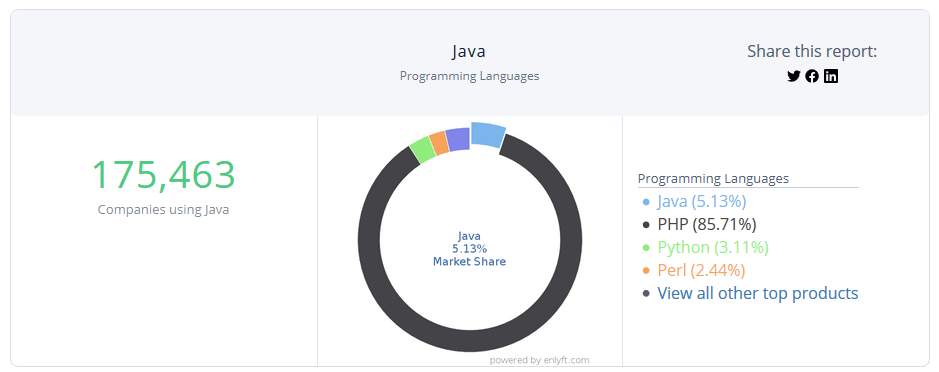
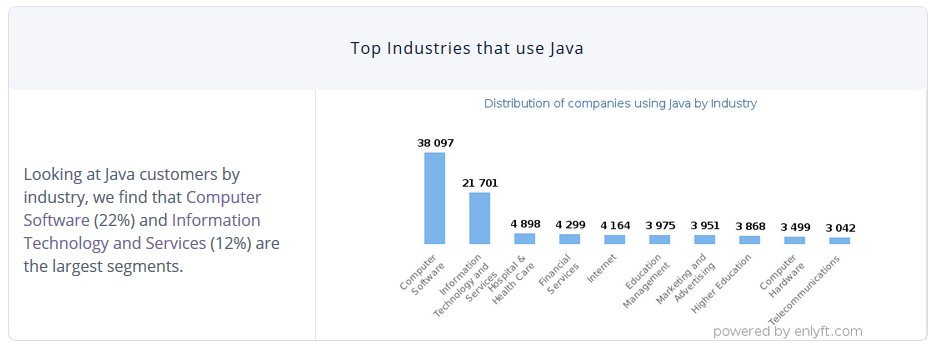
The following chart gives you a clear idea about the use of Java in different industries.

Java TechTop Industries Using Java(Source – https://enlyft.com/tech/products/java)

It is now easier to build highly scalable and secure customer-oriented apps with java web frameworks.

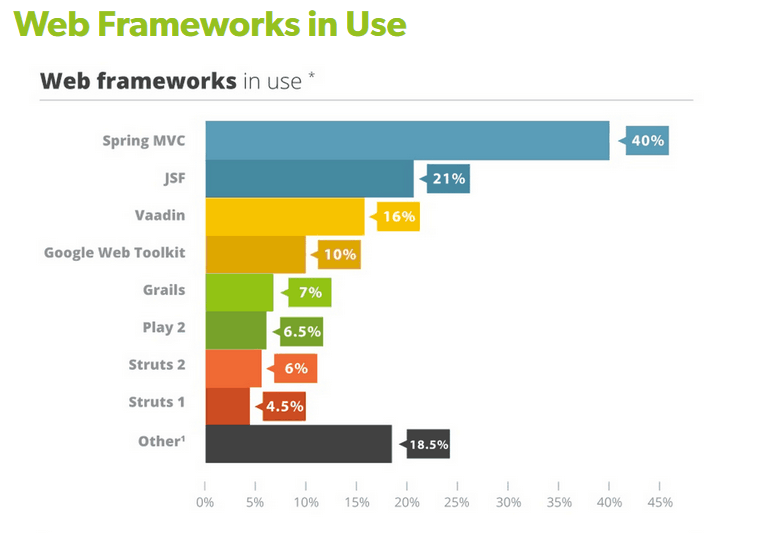
Being a strong and dynamic language, when it gets paired with best Java frameworks, offers exceptional solutions for different industry verticals; from eCommerce and finance to banking, education, healthcare, etc.

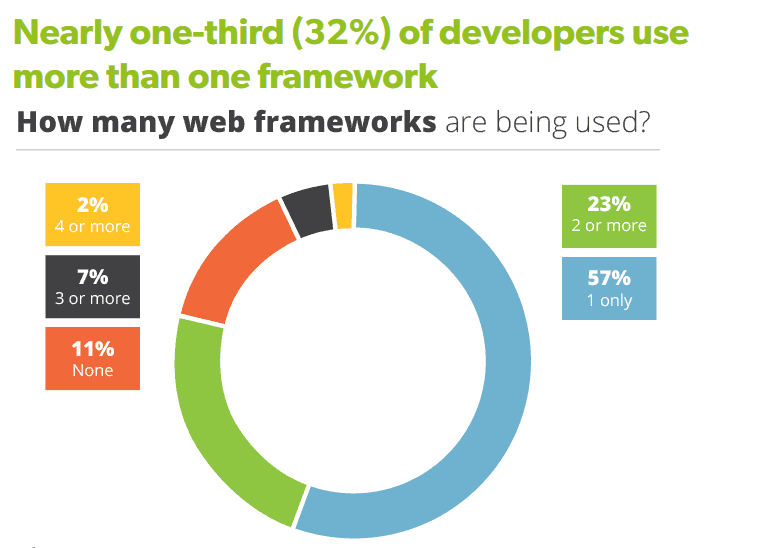
Web FrameworksJava Developer(Source – https://www.jrebel.com/blog/java-web-framework-usage-stats)

Java has little competition when programmers need tools to make enterprise-grade applications. It is very helpful in building windows, mobile, web applications, and more.

If you are a web developer with prior experience in Java, you can start with the best Java frameworks anytime. Well, before you take a plunge into it, let’s have a quick review of Java frameworks, their application, and why you always need to choose the best of them.

Never miss an update for us. Join 10,000+ marketers and leaders.

What Java Frameworks Are?

A Java framework is nothing but a per-written code structure available for faster, easier, and effective development/implementation of web applications.

It is a type of template which comes included with specific tools, libraries, compilers, and APIs for increased productivity of the developer.

Java frameworks give developers the flexibility to go for Java web application development by adding their app code and re-using the basic features in it.

They all have the same coding structure and operate with identical terms, concepts, etc.

What is the Use of Java Frameworks for Application Developer?

A Java framework lessens the burden of writing the application code from scratch. It provides a basic structure to the java developers for web apps while automating so many things for reliable and precise outcomes.

They also have predefined classes and functions to respond well to both software systems and hardware devices, based on their type.

As a Java developer, you are free to use any framework just by calling the related inheritance, functions, etc.

Why Choose the Best Java Framework All the Time?

There are so many options available in Java frameworks. However, you can’t expect them all to be perfect in all aspects.

Each of them has its strengths and weaknesses too. By choosing and using the right framework, you can ensure the long term performance of a Java web application.

As a Java developer, you should find a framework that matches your app requirements, not being the best in features.

This is where most developers go wrong. After all, your objective is to develop a web app that functions well and can be extended in the future.

Top Java Frameworks to Work with

You have different frameworks for Java web application development, serving special purposes, and fitting specific app requirements.

Are you still wondering how to choose the right Java framework for your next project?

Here is mentioned a quick list of the best Java web frameworks for your reference.

1. Spring (Modern & Developer Friendly Java framework)

It is a popular, lightweight, and feature-rich web application development framework used for building enterprise-level apps.

The basic features of the spring are effective for making any kind of Java app such as streaming, Web Socket, web, etc. It is better known as a comprehensive modular framework having REST APIs, secured authentication, SOAP services, and many more add-ons.

This framework is excellent for development as well as the implementation of all layers of a real-time app. With it, you can also develop any specific layer of a real-time app which is not possible with other frameworks.

Spring has additional modules including Spring MVC, Spring Boost, Spring Core, Spring Security, Spring ORM, Spring Transaction, etc.

Strengths

  • Support classes for the JDBC to ensure decreased errors and improved productivity
  • High degree of modularity to add to code readability
  • Facilitates XML and annotation-based bean configuration
  • Simple dependency injection (DI) to test code data through POJOs (Plain Old Java Objects)
  • Provides libraries for backward compatibility and better code testability
  • Utility
  • Web app development
  • Enterprise Java (JEE)
  • Any kind of Java app

Examples: – Amazon, eBay, Netflix (Spring Boot)

2. Struts (Fully Featured Enterprise-level Framework)

Struts is an open-source framework based on the MVC model and designed by the ASF (Apache Software Foundation). It is capable of creating a more coupled MVC structure, unlike Spring MVC. Struts enable Java developers to build easy to maintain Java apps all the time.

It is expandable using plugin architecture so that various project needs can be met. Struts integrate well with plugins specific to the JSON, REST, and Config.

You can manage coding tasks that are not exclusively built in the MVC framework by using Struts in integration with other Java frameworks. For instance, the dependence injection included in the spring plugin can be used for object mapping in Struts.

Developers can use various client-side technologies from HTML with Angular to Java Server Pages to create front-end apps.

Strengths:

  • Long existence makes Struts reliable and free of errors.
  • Compatible with REST, SOAP, and AJAX.
  • Allows modular app development, management, and integration with third-party components.
  • Supports themes and templates.
  • Use of simple POJOs (Plain Old Java Objects)
  • Utility:
  • The Struts 2 version is perfect for MVC-based web app development.
  • It makes use of and expands the Servlet API to let developers adjust to the MVC model.

Examples: – Accenture, Infosys, NexGen Technologies

3. GWT (Free to Use and Open-source Web Framework)

It is one of the best Java frameworks allowing the developers to build front-end Java applications with JavaScript quite fast.

Google Web Toolkit contains core Java API libraries, widgets along with a compiler, and development server. You can develop a Java web app and later cross-compile it into JavaScript with the help of GWT.

You can easily write complex browser-based applications with the use of GWT. It helps in developing and debugging Ajax applications in Java language.

The best thing about Google Web Toolkit is that you don’t need to be proficient in front-end technologies to start with progressive web app development.

It has great functionalities like internationalization, bookmarking, cross-browser compatibility, history management, UI abstractions, etc.

GWT is popular for coding responsive and performance-oriented web apps with relatively less load on server-side and heavy utilization of the client-side.

Strengths

  • Supports code reusability for standard web development activities.
  • Google APIs can be included in apps built with GWT.
  • Ensures support for unit testing, localization, internationalization, etc.
  • Online tutorials are available to learn it easily.
  • Helps the app load easily by separating code into separate JavaScript files.

Utility

  • Helps in developing and maintaining complicated JavaScript front-end apps.
  • Inclusion of Google APIs.
  • Making of progressive web apps.

Examples: – Blogger, Google AdSense, Google Wallet, etc.

4. Grails (Groovy-based Dynamic Framework)

Grails is a full-stack web app framework, supported by the Groovy JVM (Java Virtual Machine) coding language.

It is a dynamic platform written in an object-oriented language, Groovy, which aims to improve the developer’s productivity.

Java Developers can not only enjoy static-typing but are also capable of static compilation with Grails.

Being a developer, you will always find Java-compatible syntax in it which can be later compiled to JVM bytecode.

Grails integrate well with other popular Java components and technologies such as JEE containers, SiteMesh, spring, Hibernate and Quartz, etc.

Since this framework is built on top of the modular Spring Boot, it inherits the time-saving qualities from the same.

Strengths:

  • The Setup procedure is quite easier
  • Object-relational mapping (ORM) becomes easy
  • Ensures a rapid development cycle
  • Integrates with a range of plug-ins for easier coding
  • CSS management is easy
  • Supports dynamic configuration
  • It has clean and clear documentation.

Utility:

  • MVC pattern web apps
  • Rapid application development
  • e-Commerce websites

Examples: – Foodtube, PEP Store, Tropicana, etc.

5. Vaadin (Cross-platform Java Framework)

Vaadin is the last one in the list of top Java frameworks. It is a nice framework focused on UX (User Experience) accessibility.

Vaadin is a robust platform for modernized Java development. You can also use it to build custom component-based web apps.

A big plus of using the Vaadin framework is automated communication between client and server.

Vaadin gives you direct control over the DOM while running on the JVM so that no extra steps will be required to integrate and expand the components.

With the launch of the new version (Vaadin 10), the earlier massive framework has got divided into 2 parts.

Vaadin Flow is the lightweight part among them, handling routing and communication between the client and server.

Vaadin components are easy to integrate with any IDE you choose and use. Due to its cross-platform compatibility, it does not involve any code migration into a separate platform.

Utility:

  • Modernized Java app development
  • Custom component-based web development

Strengths

  • Facilitates data binding with MVP or MVC
  • Dragging and dropping support, together with other, wonderful features that lead to easy development of single-page User Interfaces for Java apps.
  • Web Socket support for automated server-browser communication.
  • Routing with the different levels of the nested route and multiple parameter support
  • Supports Java Virtual Machine languages such as Scala and Kotlin.
  • Built-in Spring support

Examples: – Puma, Volkswagen, Bank of America, etc.

I’ve worked with the team at AndolaSoft on multiple websites. They are professional, responsive, & easy to work with. I’ve had great experiences & would recommend their services to anyone.

Ruthie Miller, Sr. Mktg. Specialist

Salesforce, Houston, Texas

LEARN MORE

Conclusion

The above list is not final as you have many other popular Java frameworks beyond it to cover your project needs.

All the above-mentioned ones are great—as far as popularity and use are concerned. Just remember that once you use a framework and learn to make the most of its features, changing to another one will never be difficult.

Before picking a framework, weigh your app requirements, its level, and your work experience with Web Frameworks and in Java application programming. Then, tick on the framework that fits your needs.

We are here to recommend the most suitable Java framework for your web application development.

Share your app requirements and see how fast we can offer you a solution.

For Java related queries or concerns, chat with us now!

Make The Best Use Of SaaS Development Services

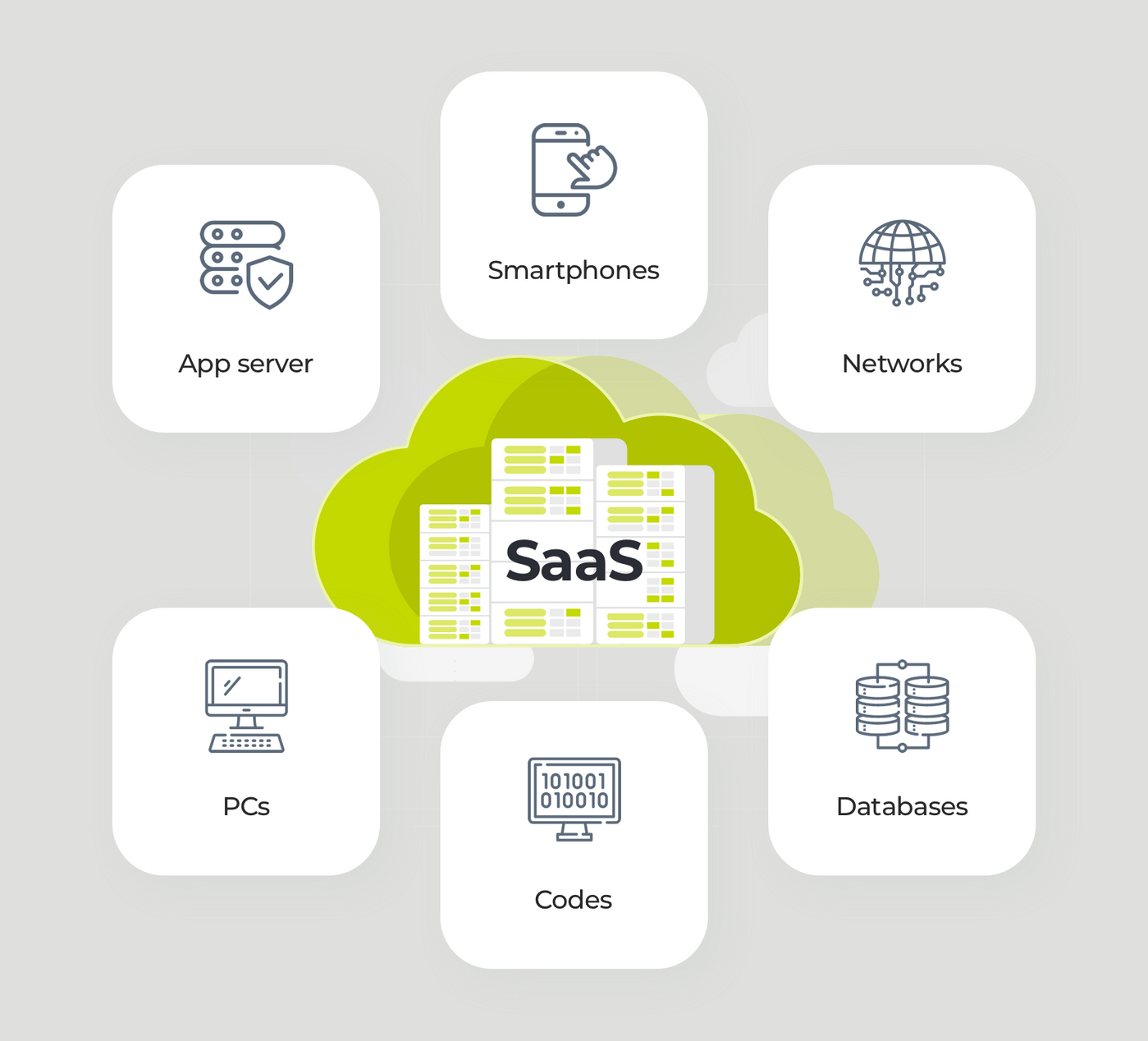
Let’s start with What is Software as a Service (SaaS)?

Gartner describes “Software as a service (SaaS) is software that is owned, delivered and managed remotely by one or more providers. The provider delivers software based on one set of common code and data definitions that is consumed in a one-to-many model by all contracted customers at anytime on a pay-for-use basis or as a subscription based on use metrics.”.

In other words, the application that you can use to deliver and managed remotely, and you can access it via your web browser (and mobile device).

All verified end users can connect to it over the internet at any point in time on a subscription basis or pay as you go basis.

As these Cloud-based SaaS solution which can be accessed from various devices like laptop, tablets, and smartphones. It is more important for workers as they can work from anywhere and at any time. Particularly, on this Covid19 Pandemic situation.

What is SaaS Development

Source: Cleveroad.com

SaaS platforms are ever showing smug with their current growth arrow or customer churn rates, even they are the peak of their performance.

Never miss an update from us. Join 10,000+ marketers and leaders.

In 2022, you need to take a deep dive to assess the productiveness of your SaaS marketing and engagement strategies to find prospective adoptions.

“52% of SaaS companies increased their spending on customer retention last year.”

“55% of SAAS companies rate Customer Retention Cost as the key metric to measure. (Totango)”

Chris Lean – 310creative.com

SaaS And Andolasoft

SaaS application models are only continuing to grow in popularity, thanks to their scalability, flexibility, license cost reduction, and automatic updates.

Yet while it offers many advantages over on-premise solutions, SaaS also present certain unique challenges that companies need to keep in mind.

This infographic shares the core benefits for adapting the SaaS Solution and how Andolasoft can make your development journey clean and clear.

Let’s get started:

Make the Best Use of SaaS Development Services

Conclusion

By choosing the right approach, you will obtain the ability to maintain, distribute, license your product in the most convenient ways.

But while switching to the SaaS model, you must consider your business strategy that will vastly increase your odds of long-term success.

So, do not hesitate to ask your question and seek clarification from our technical gurus. Let’s talk!