
Modern enterprises generate more data than ever before, yet nearly 60% of business leaders admit they do not fully trust their analytics (industry research). The problem is not a lack of dashboards or BI tools — it is the absence of strong Data Governance Practices for Reliable BI Insights. Without governance, data becomes inconsistent, insecure, fragmented, and ultimately unreliable for decision-making.
Today, CTOs, founders, and business leaders rely on BI platforms to guide revenue strategy, operational efficiency, customer experience, and compliance. However, when data definitions differ across teams, access is uncontrolled, or quality checks are missing, even the most advanced BI solution fails to deliver value.
This is why Data Governance Practices for Reliable BI Insights have become mission-critical in today’s digital-first landscape. They ensure data accuracy, consistency, security, and accountability — enabling BI systems to generate insights leaders can trust.
In this blog, you will learn why data governance matters, how to implement it effectively, best practices and frameworks to follow, and how Andolasoft helps organizations build future-ready BI ecosystems that scale with confidence.
Business Need & Importance of Data Governance Practices for Reliable BI Insights
As organizations scale, data flows in from multiple sources — ERP systems, CRMs, mobile apps, IoT devices, cloud platforms, and third-party tools. Without Data Governance Practices for Reliable BI Insights, this explosion of data quickly turns into chaos rather than clarity.
Why Data Governance Matters Today
- Business decisions now depend on real-time analytics, not gut instinct. Without governance, BI insights are inconsistent, delayed, or misleading.
- Regulatory pressure continues to grow, especially in industries like healthcare, fintech, education, and manufacturing where data privacy and auditability are mandatory.
- Cross-functional teams consume data differently, making standardized definitions and controlled access essential for alignment.
Industry-Specific Challenges Without Governance
- Healthcare: Inconsistent patient data leads to reporting errors, compliance risks, and flawed clinical insights.
- eCommerce: Poor product and customer data governance results in inaccurate sales forecasting and personalization failures.
- Fintech: Weak governance increases exposure to fraud, compliance penalties, and security breaches.
- Manufacturing: Inaccurate operational data disrupts supply chains, inventory planning, and production optimization.
- SaaS & EdTech: Fragmented analytics limit churn analysis, engagement tracking, and product decision-making.
Risks of Ignoring Data Governance
- Unreliable BI dashboards that erode leadership trust
- Security vulnerabilities due to uncontrolled data access
- Revenue loss from incorrect forecasting and insights
- Increased operational inefficiencies and manual rework
- Regulatory fines and reputational damage
Therefore, modern organizations must adopt Data Governance Practices for Reliable BI Insights as a strategic foundation — not as an afterthought. Moreover, partnering with a technology expert like Andolasoft ensures governance is embedded into architecture, workflows, and analytics from day one.
Best Practices, Frameworks & Actionable Tips for Data Governance Practices
Implementing Data Governance Practices for Reliable BI Insights requires a structured, scalable, and technology-aligned approach. Below are proven best practices that organizations can implement immediately.
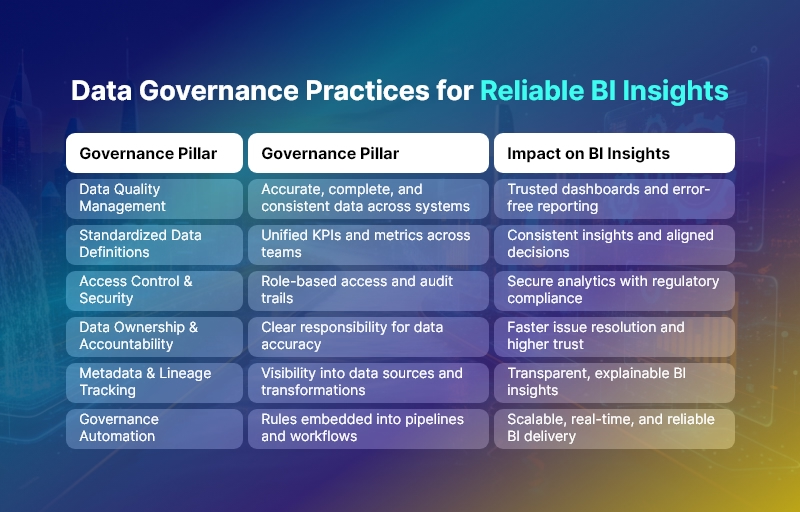
1. Define Clear Data Ownership and Accountability
- Assign data owners and data stewards for every critical data domain to ensure responsibility for accuracy, quality, and updates.
- This eliminates ambiguity, reduces errors, and ensures BI teams always know who governs which dataset.
2. Establish Standardized Data Definitions
- Create a centralized data glossary to standardize KPIs, metrics, and business terms across departments.
- This ensures sales, finance, and operations interpret BI insights consistently and accurately.
3. Implement Strong Data Quality Management
- Enforce validation rules, automated cleansing, and anomaly detection across pipelines.
- High-quality data is the backbone of Data Governance Practices for Reliable BI Insights, ensuring BI dashboards reflect reality.
4. Control Data Access with Role-Based Security
- Implement role-based access control (RBAC) and audit logs to prevent unauthorized data usage.
- This strengthens compliance, security, and trust across BI environments.
5. Use Proven Governance Frameworks
- DAMA-DMBOK: Industry-standard framework for data governance, quality, and lifecycle management.
- COBIT & ITIL: Align data governance with enterprise IT governance.
- Modern Data Mesh: Decentralized governance with centralized standards for scalable BI ecosystems.
6. Align Governance with BI Architecture
- Design BI systems where governance is embedded into ETL pipelines, data warehouses, and visualization layers.
- This ensures governance does not slow down insights but accelerates trust and adoption.
7. Automate Governance with the Right Tech Stack
- Cloud data platforms, metadata management tools, and AI-driven data quality checks reduce manual governance overhead.
- Automation enables governance to scale as data volume and complexity grow.
8. Avoid Common Data Governance Mistakes
- Treating governance as a one-time project instead of an ongoing program
- Over-restricting access and slowing innovation
- Ignoring governance during application modernization
- Lack of executive sponsorship and cross-team buy-in
How Andolasoft Helps Implement Data Governance Practices for Reliable BI Insights
Andolasoft supports organizations by embedding governance into end-to-end data and BI solutions through:
- Custom Web & SaaS Development with governance-ready architectures
- BI, AI & Machine Learning Solutions with governed data pipelines
- Data Analytics & Warehousing for accurate, scalable insights
- Application Modernization to eliminate legacy data silos
- DevOps & Cloud Automation for secure, compliant data workflows
Choosing the right development partner ensures governance enhances BI — rather than restricting it.
Customer Success Example
For example, a mid-sized fintech company partnered with Andolasoft to modernize its BI platform and implement Data Governance Practices for Reliable BI Insights.
The organization struggled with inconsistent reports across finance, risk, and compliance teams. Data definitions varied, access controls were weak, and leadership lacked confidence in BI dashboards.
Andolasoft designed a governed BI architecture that standardized KPIs, implemented role-based access, automated data quality checks, and centralized metadata management.
Results within six months included:
- 35% faster BI reporting cycles
- 40% reduction in manual reconciliation efforts
- Improved regulatory audit readiness
- Higher executive trust in BI insights
- Stronger data security and compliance posture
This transformation allowed leadership to make faster, data-driven decisions with confidence.
Key Takeaways: Why Data Governance Can No Longer Be Optional
To summarize, Data Governance Practices for Reliable BI Insights are essential for any organization that depends on analytics for growth and competitiveness.
Key takeaways include:
- Reliable BI insights depend on governed, high-quality data
- Governance improves accuracy, security, compliance, and trust
- Modern frameworks and automation make governance scalable
- Strong technology partners ensure long-term success
As data volumes grow and AI-driven analytics accelerate, organizations that invest in governance today will outperform those relying on fragmented, untrusted data tomorrow.
FAQs
1. What are Data Governance Practices for Reliable BI Insights?
They are structured policies, processes, and technologies that ensure data accuracy, consistency, security, and accountability across BI systems.
2. Why is data governance critical for BI platforms?
Without governance, BI insights become unreliable, leading to poor decisions, security risks, and compliance failures.
3. How does data governance improve decision-making?
It ensures leaders access trusted, standardized, and high-quality data, enabling faster and more accurate decisions.
4. Which industries benefit most from data governance?
Healthcare, fintech, eCommerce, manufacturing, SaaS, logistics, and education benefit significantly due to compliance and data complexity.
5. Can data governance slow down analytics?
When implemented correctly, Data Governance Practices for Reliable BI Insights actually accelerate analytics by reducing rework and confusion.
6. How does Andolasoft support data governance initiatives?
Andolasoft embeds governance into BI architecture, data pipelines, security models, and analytics workflows.
7. Is data governance a one-time effort?
No. It is an ongoing program that evolves with business needs, data growth, and technology changes.