Today, leaders across industries face a common challenge: business decisions must be faster, more data-driven, and more accurate than ever before. Yet most organizations still struggle with slow reporting cycles, fragmented data sources, and overloaded IT teams. This is where a Self-Service BI Platform creates real competitive advantage.
By empowering teams to independently access, analyze, and visualize data, businesses unlock agility, reduce bottlenecks, and drive high-velocity execution. Moreover, organizations embracing self-service analytics report 30–50% faster decision-making, according to several global BI studies.
In this blog, you’ll discover the top 15 benefits of implementing a Self-Service BI Platform, why it matters in today’s digital era, and how companies can adopt it effectively. You’ll also see how Andolasoft, with its proven expertise in BI, AI, machine learning, SaaS engineering, data analytics, and enterprise solutions, helps global brands transform their data capabilities.
Why Modern Businesses Need a Self-Service BI Platform
In most organizations, analytics has long been an IT-driven process. Departments rely on data teams to prepare reports, extract datasets, or build dashboards. This creates delays, limits innovation, and slows decision-making.
A Self-Service BI Platform resolves these gaps by democratizing access to insights. It enables business users — sales managers, finance teams, marketers, operations leaders, and product managers — to explore data on their own without technical dependencies.
Why It Matters Today
Modern industries — from healthcare and manufacturing to fintech and eCommerce — operate in fast-moving environments. Data volumes continue to explode, yet delayed insights cause missed opportunities. A Self-Service BI Platform resolves these challenges by:
- Reducing the decision-making cycle from days to minutes by enabling users to generate reports on demand.
- Aligning teams on real-time data rather than outdated spreadsheets or manual data pulls.
- Cutting operational inefficiencies caused by poor data visibility or inconsistent reporting practices.
Industry Use Cases
A Self-Service BI Platform delivers measurable impact across sectors:
- Healthcare: clinicians access real-time patient metrics, improving care delivery and operational planning.
- Ecommerce: marketing and product teams monitor campaign performance, purchase behavior, and funnel drop-offs instantly.
- Manufacturing: plant managers analyze downtime, production defects, and supply chain trends without waiting for IT support.
- Fintech: regulatory, fraud, and transaction dashboards become self-operational, reducing compliance risks.
- SaaS: product teams iterate faster using usage analytics, churn insights, and cohort reports.
Risks of Not Adopting Self-Service Analytics
Organizations that do not modernize continue to struggle with:
- Long reporting delays that slow strategic decisions.
- High dependency on IT, delaying innovation.
- Data silos leading to inconsistent insights across teams.
- Security vulnerabilities due to manual exports and spreadsheet sharing.
- Revenue loss from inaccurate forecasting or delayed insights.
In a digital-first world, a Self-Service BI Platform is not a luxury—it is a foundational operational capability that enables enterprises to scale efficiently and securely.
Top 15 Benefits of Implementing a Self-Service BI Platform
Below are the most impactful advantages organizations gain when adopting a modern, enterprise-grade Self-Service BI Platform.
1. Faster Decision-Making Across Departments
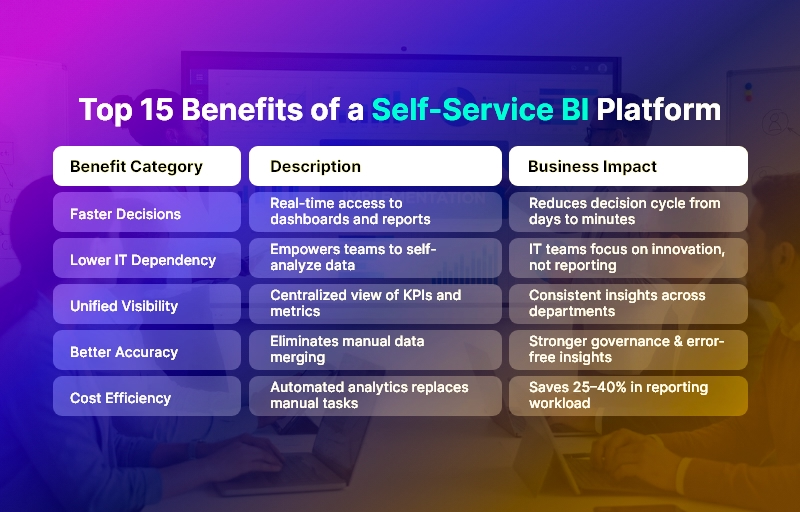
A Self-Service BI Platform eliminates dependencies on IT teams, enabling business users to generate insights instantly. This results in significantly shorter decision cycles, faster approvals, and quicker execution across sales, finance, supply chain, and operations.
2. Reduced IT Workload & Operational Bottlenecks
IT teams often spend 40–60% of their workload on routine reporting tasks. By shifting routine analytics to end-users, a Self-Service BI Platform frees technical teams to focus on strategic initiatives like automation, modernization, or AI implementation.
3. Unified Data Visibility Across the Organization
Self-service BI brings every department onto a centralized data platform, ensuring everyone works with the same numbers. This promotes alignment, reduces conflicts, and eliminates discrepancies in decision-making.
4. Improved Data Accuracy & Governance
With automated pipelines, role-based access, and standardized dashboards, organizations greatly reduce errors caused by spreadsheets, manual consolidation, and outdated reports.
5. Empowered Business Users and Greater Ownership
Teams that can explore their own data develop deeper analytical thinking and take more ownership of KPIs. This creates a performance-driven culture where insights drive action.
6. Real-Time Reporting and Live Dashboards
Traditional BI usually relies on static reports. A Self-Service BI Platform enables dynamic dashboards that refresh automatically, ensuring real-time visibility into KPIs, customer behavior, and operational metrics.
7. Enhanced Collaboration Between Technical and Business Teams
With self-service analytics, business teams independently generate insights while IT teams focus on data quality, security, and architecture. This leads to stronger collaboration and better alignment.
8. Lower Operational Costs
By automating reporting workflows and reducing manual effort, organizations often reduce analytics costs by 25–40%. The Self-Service BI Platform becomes an engine for efficiency and resource optimization.
9. Discovery of New Insights & Opportunities
Self-service exploration encourages curiosity and experimentation. Teams uncover patterns, root causes, and opportunities that would otherwise remain hidden in data silos.
10. Scalability for Growing Teams & Data Volumes
Self-service BI tools are built for scale. As new departments, markets, or product lines are added, the platform can easily expand without architectural bottlenecks.
11. Stronger Data Security Through Centralized Access Controls
A Self-Service BI Platform reduces risk by eliminating unsecured spreadsheets and enabling enterprise-grade permissions, encryption, and audit trails.
12. Automation of Repetitive Analytics Tasks
Scheduled reports, automated alerts, and prebuilt dashboards minimize manual effort. Teams always have updated insights without repetitive data pulls.
13. Better Customer Experience Through Faster Insights
Modern businesses rely heavily on customer analytics. Self-service BI enables rapid insight into churn, retention, behavior, and personalization opportunities.
14. Improved Forecasting and Strategic Planning
With real-time access to historical and current data, leadership teams produce more accurate forecasts, financial models, and growth strategies.
15. Higher Organizational Agility and Competitive Advantage
Ultimately, a Self-Service BI Platform enables companies to react faster, innovate more confidently, and stay ahead of competition by making decisions powered by real-time intelligence.
Best Practices for Implementing a Self-Service BI Platform
Success with self-service analytics requires thoughtful strategy, process alignment, and the right technology foundation. Below are actionable best practices and frameworks.
1. Establish Clear Data Ownership
Define who manages data quality, governance, and access. Clear roles prevent duplication, data drift, or inconsistent definitions.
2. Build a Centralized Data Architecture
Consolidate sources into a unified data warehouse or lakehouse. This ensures reliability, consistency, and scalability for high-volume analytics.
3. Choose a Flexible, Scalable BI Toolset
Evaluate tools based on visualization capabilities, governance, performance, security, and integration ease.
4. Implement Role-Based Access Controls
Ensure users only access relevant datasets. This protects sensitive information while enabling broad adoption.
5. Standardize Dashboards & Metrics
Create a universal KPI library so every team uses the same definitions for revenue, churn, conversion, utilization, and performance.
6. Enable Training & Upskilling for Non-Technical Teams
Provide training programs on data literacy, dashboard building, and analytics best practices.
7. Use Automation Wherever Possible
Automate ETL pipelines, alerts, data quality checks, and scheduled reporting.
8. Monitor Usage & Continuously Improve
Review dashboard adoption, usage statistics, load times, and user feedback to refine BI strategy.
How Andolasoft Helps Companies Build a Powerful Self-Service BI Platform
Andolasoft provides end-to-end BI and analytics expertise across:
- Custom Web Development
- Mobile App Development
- SaaS Product Engineering
- BI, AI & Machine Learning
- Data Analytics Solutions
- Application Modernization
- Enterprise IT Services
- DevOps, Cloud & Automation
We design scalable, secure, and intuitive BI environments that empower business users while maintaining enterprise governance.
Case Study
For example, a mid-sized transportation provider, partnered with Andolasoft to build a BI Platform that unified data from fleet systems, driver apps, billing tools, and telematics. Within 10 weeks, the company achieved:
- 40% faster operational decisions due to real-time dashboards.
- 30% reduction in manual reporting efforts, freeing teams for revenue-generating activities.
- Enhanced route optimization, reducing fuel costs by nearly 18%.
Here’s what changed: managers gained instant access to KPIs, predictive insights improved planning, and operational bottlenecks reduced significantly.
Key Takeaways
A Self-Service BI Platform is no longer optional—it is essential for modern, data-driven enterprises. The most important insights include:
- It accelerates decision-making and reduces IT dependency.
- It creates real-time, unified visibility across the organization.
- It boosts efficiency, accuracy, governance, and competitive advantage.
- It empowers teams to innovate, experiment, and take ownership of outcomes.
Organizations implementing a Self-Service BI Platform today position themselves for long-term scalability, efficiency, and digital transformation.
FAQs
1. What is a Self-Service BI Platform?
It is a modern analytics system that enables non-technical users to access, explore, and visualize data independently, without relying on IT teams.
2. Why do businesses need a Self-Service BI Platform?
It improves decision-making speed, reduces bottlenecks, eliminates data silos, and empowers teams to work with accurate data in real time.
3. Is a the BI Platform secure?
Yes. These platforms use role-based permissions, audit trails, encryption, and centralized governance to ensure data protection.
4. How long does implementation typically take?
Depending on the complexity, implementation can take 4–12 weeks with proper planning, architecture setup, and user onboarding.
5. What industries benefit most from a BI Platform?
Healthcare, eCommerce, fintech, manufacturing, logistics, SaaS, retail, and education all gain substantial advantages from real-time analytics.
6. Does Andolasoft build custom BI solutions?
Absolutely. Andolasoft specializes in end-to-end BI engineering, AI-driven analytics, ML models, SaaS development, and enterprise-grade data platforms.
7. Can a Self-Service BI Platform integrate with existing systems?
Yes, modern BI tools integrate seamlessly with CRMs, ERPs, SaaS apps, databases, cloud systems, and third-party APIs.