BI and AI Explained: Turning Business Data into Predictive Intelligence

In today’s digital-first economy, data is no longer the differentiator — predictive intelligence is. Organizations generate massive volumes of data every day, yet many still struggle to turn that data into timely, actionable insights.

Traditional dashboards explain what happened, but modern businesses need answers to what will happen next. This is exactly where BI and AI come into play.

By combining Business Intelligence (BI) with Artificial Intelligence (AI), organizations can move beyond static reporting and unlock predictive intelligence — insights that anticipate trends, forecast outcomes, and recommend actions before problems arise.

As competition intensifies and decision cycles shorten, this capability has become mission-critical.

In this guide, you will learn how BI and AI works together, why it matters across industries, and how businesses can implement it successfully.

More importantly, you will see how Andolasoft helps organizations design, build, and scale predictive intelligence in data platforms that deliver real business outcomes — not just charts and dashboards.
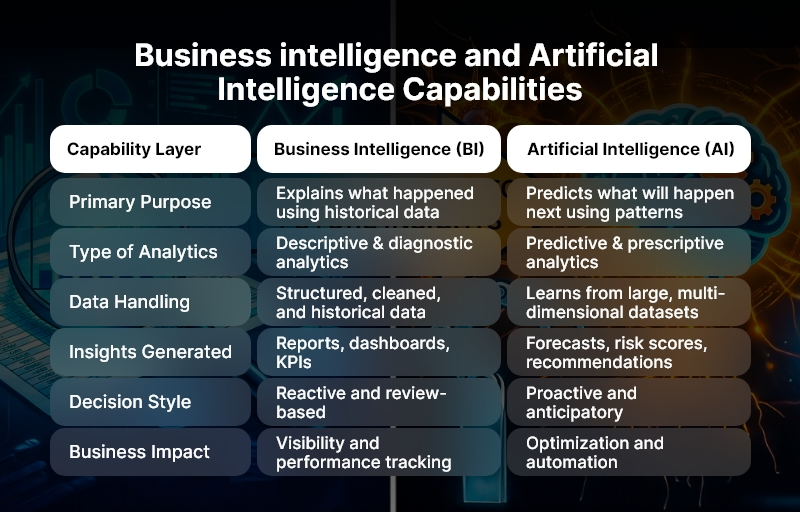
Business intelligence and Artificial Intelligence Capabilities

Business Need & Importance of BI and AI

Modern businesses operate in environments defined by speed, complexity, and uncertainty. Customer expectations change rapidly, markets fluctuate, and operational risks emerge without warning.

In this context, relying on historical reports alone creates blind spots.

Why BI and AI Matters Today

BI and AI matters because it converts raw data into foresight. While BI organizes and visualizes structured data, AI analyzes patterns, learns from historical behavior, and predicts future outcomes. Together, they enable smarter, faster, and more confident decision-making.

Key business drivers include:

  • Exploding data volumes: Data from apps, IoT devices, CRMs, ERPs, and customer interactions is growing exponentially. Manual analysis simply cannot keep up.
  • Demand for real-time decisions: Leaders need insights now, not at the end of the month or quarter.
  • Competitive pressure: Companies that predict customer needs and operational risks earlier gain a clear advantage.

Industry-Specific Impact of BI and AI

Across industries, BI and AI is transforming how decisions are made:

  • Healthcare: Predictive analytics helps forecast patient admissions, detect anomalies in diagnostics, and optimize resource allocation.
  • eCommerce: AI-powered BI predicts demand, personalizes recommendations, and reduces cart abandonment through behavioral insights.
  • Logistics & Supply Chain: Companies forecast delays, optimize routes, and proactively manage inventory risks.
  • Fintech: Fraud detection models and credit risk predictions enhance security and regulatory compliance.
  • SaaS & Technology: Usage analytics and churn prediction enable proactive customer retention strategies.
  • Manufacturing: Predictive maintenance reduces downtime by identifying equipment failures before they occur.

Risks of Not Adopting BI and AI

Organizations that delay adoption face serious consequences:

  • Operational inefficiencies due to reactive decision-making
  • Revenue loss from missed opportunities and late responses
  • Security and compliance risks caused by delayed anomaly detection
  • Poor customer experience driven by generic, non-personalized interactions

Therefore, companies increasingly require strategic, scalable BI and AI solutions, not fragmented tools or legacy systems that fail to evolve with business needs.

Best Practices, Frameworks & Actionable Tips for BI and AI Implementation

Successfully implementing BI and AI requires more than tools — it demands the right strategy, architecture, and execution partner.

1. Start with Business Questions, Not Data

Successful BI and AI initiatives begin with clear business objectives. Instead of asking what data is available, define what decisions need improvement.

  • Identify high-impact use cases such as demand forecasting, churn prediction, or operational risk analysis.
  • Align analytics outputs directly with KPIs that leadership cares about.
  • Avoid building dashboards without a clear decision-making purpose.

2. Build a Strong Data Foundation

AI is only as good as the data it learns from. Data quality, consistency, and governance are non-negotiable.

  • Consolidate data from multiple sources into a centralized data warehouse or lake.
  • Standardize data definitions to eliminate reporting inconsistencies.
  • Implement strong data governance and access controls from day one.

3. Use the Right Architecture

A modern BI and AI architecture typically includes:

  • Data ingestion pipelines for real-time and batch data
  • Cloud-based data storage for scalability and performance
  • BI visualization layers for descriptive and diagnostic analytics
  • AI/ML models for predictive and prescriptive insights

This modular approach ensures flexibility as business needs evolve.

4. Combine Descriptive, Predictive, and Prescriptive Analytics

BI and AI works best when analytics maturity progresses in stages:

  • Descriptive analytics explains what happened.
  • Predictive analytics forecasts what will happen.
  • Prescriptive analytics recommends what actions to take next.

Skipping stages often leads to low adoption and mistrust in AI outputs.

5. Focus on Explainability and Trust

Business users must trust AI-generated insights.

  • Use explainable AI models where possible.
  • Clearly show which factors influenced predictions.
  • Provide confidence scores and scenario comparisons within dashboards.

6. Avoid Common BI and AI Mistakes

Common pitfalls include:

  • Treating AI as a plug-and-play feature rather than a continuous learning system.
  • Overengineering solutions before validating business value.
  • Ignoring change management and user adoption.

7. Quick Wins to Build Momentum

Low-effort, high-impact improvements include:

  • Automating anomaly detection in existing BI dashboards.
  • Adding predictive forecasts to sales and demand reports.
  • Using AI to prioritize leads or support tickets.

How Andolasoft Helps Implement BI and AI

Andolasoft delivers end-to-end BI and AI solutions tailored to business goals, not generic templates. Their expertise spans:

  • Custom Web Development for analytics platforms
  • SaaS Product Engineering with embedded BI and AI capabilities
  • BI, AI & Machine Learning Solutions for predictive intelligence
  • Data Analytics & Visualization for executive decision-making
  • Application Modernization to upgrade legacy BI systems
  • DevOps, Cloud & Automation for scalable, secure deployments

Choosing the right technology partner ensures long-term scalability, security, and ROI from BI and AI investments.

Customer Success Example: BI and AI in Action

For example, a mid-sized eCommerce company partnered with Andolasoft to modernize its analytics and forecasting capabilities. The company struggled with inventory overstocking, frequent stockouts, and delayed reporting that limited proactive decisions.

Andolasoft designed a BI and AI-driven predictive analytics platform that unified sales, customer behavior, and supply chain data into a single predictive intelligence layer. AI models were implemented to forecast product demand, identify high-risk SKUs, and recommend replenishment actions.

Within six months, the results were measurable:

  • 30% improvement in demand forecast accuracy
  • 25% reduction in inventory holding costs
  • 40% faster reporting cycles
  • Significantly improved executive visibility into future trends

Most importantly, decision-making shifted from reactive firefighting to predictive, data-driven planning.

Key Takeaways & Closing

To summarize, BI and AI represents a fundamental shift in how organizations use data:

  • BI provides clarity, while AI delivers foresight
  • Together, they enable predictive intelligence, not just reporting
  • Businesses across industries gain faster decisions, lower risk, and higher efficiency
  • Success depends on strategy, data quality, architecture, and execution

Adopting BI and AI now positions organizations to compete in a future where speed and predictive intelligence define winners. With the right approach and an experienced partner like Andolasoft, businesses can confidently turn data into a strategic asset — not an operational burden.

FAQs

1. What is BI and AI in simple terms?

BI and AI combine business intelligence reporting with artificial predictive intelligence to analyze data, predict outcomes, and recommend actions automatically.

2. How is BI and AI different from traditional BI?

Traditional BI focuses on historical data, while BI and AI adds predictive and prescriptive insights using machine learning models.

3. Which industries benefit most from BI and AI?

Healthcare, eCommerce, fintech, logistics, SaaS, manufacturing, and education see significant value from BI and AI adoption.

4. Is BI and AI only for large enterprises?

No. With cloud and modular architectures, BI and AI is now accessible and scalable for startups and mid-sized businesses.

5. How long does it take to implement BI and AI?

Initial use cases can go live in weeks, while full-scale implementations typically take a few months depending on complexity.

6. What data is required for BI and AI?

Structured and semi-structured data from CRMs, ERPs, applications, and operational systems form the foundation for BI and AI.

7. Why choose Andolasoft for BI and AI projects?

Andolasoft combines deep technical expertise, real-world delivery experience, and business-first thinking to deliver measurable BI and AI outcomes.
Cloud-Based BI: Why Companies Are Migrating in 2026?

In 2025, over 80% of enterprises are projected to rely on Cloud-Based BI for data-driven decision-making, according to a Gartner report.

Yet many organizations still struggle with legacy analytics tools that can’t handle fast-growing data volumes, distributed teams, and real-time insight demands.

This blog explores why Cloud-Based BI is essential for leaders seeking a competitive advantage — plus practical migration strategies and a real-world success example.

With Andolasoft as your trusted partner, you can modernize your analytics and unlock faster value.

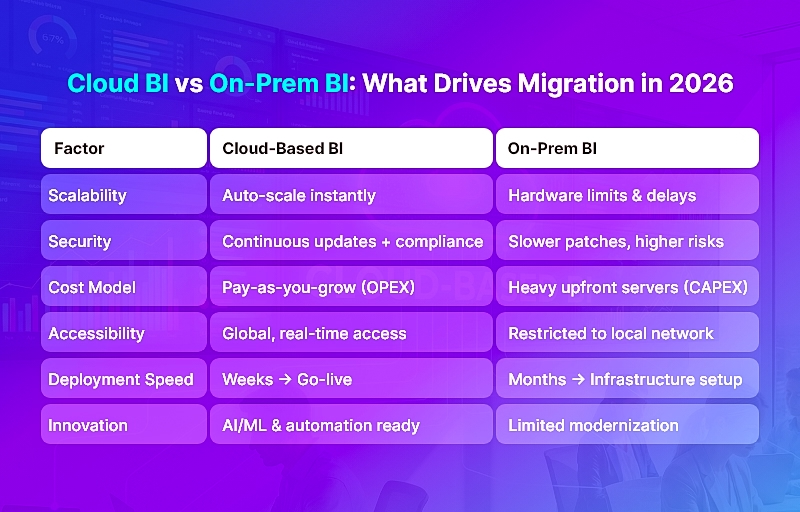
Cloud BI vs On-Prem BI What Drives Migration in 2026

Why Cloud-Based BI Matters for Modern Businesses

As data complexity increases, traditional on-prem analytics become roadblocks. Cloud-Based BI helps organizations:

Key Benefits

  • Scalability on Demand: Instantly scale compute and storage — zero hardware upgrades required.
  • Enhanced Data Security: Cloud-native encryption, identity management, and compliance controls.
  • Cost Predictability: Move from CAPEX to OPEX with flexible pay-as-you-grow pricing.

Industries Transforming Through Cloud BI

  • Healthcare: Real-time patient analytics for better outcomes
  • eCommerce: Personalized offers based on live segmentation
  • Logistics: Smart routing with real-time shipment + traffic data
  • Fintech: Continuous fraud detection automation
  • Education: Adaptive learning and student success analytics

Risks of Staying On-Prem

  • Manual reporting → slower decisions
  • Vulnerable security posture
  • Delayed insights → lost revenue
  • Outdated dashboards → poor user experience

Modern BI demands unified data, automated pipelines, and scalable architectures — and the cloud delivers exactly that.

How to Successfully Migrate: Best Practices & Frameworks

Migration requires planning. Use this proven roadmap:

Define Clear Business Objectives

Align KPIs across teams (e.g., reduced churn, faster operations).

Choose the Right Cloud Deployment

Model Best For
Public Cloud Scalability + low maintenance
Private Cloud Highly sensitive data + compliance needs
Hybrid Cloud Balanced security, cost & control

Adopt Modern Architectures

  • Lambda Architecture → real-time + historical data
  • Data Mesh → decentralized data ownership

Build a Modern Data Stack

  • Ingestion: Fivetran, Talend
  • Warehousing: Redshift, BigQuery, Synapse
  • BI Tools: Tableau, Power BI, Looker

Prioritize Governance & Security

  • RBAC, data masking
  • Automated compliance monitoring (GDPR, HIPAA)

Optimize for Performance & Cost

  • Auto-scaling clusters
  • Query caching & materialized views

Enable DevOps + Automation

  • IaC (Terraform / CloudFormation)
  • CI/CD for BI pipelines

Quick Wins

  • Migrate high-impact dashboards first
  • Introduce self-service analytics
  • Automated anomaly detection for data quality

How Andolasoft Accelerates Cloud-Based BI Adoption

We specialize in:

  • Custom Web & Mobile BI Interfaces
  • SaaS Platform Engineering
  • AI/ML-driven predictive analytics
  • Application modernization & data migration
  • DevOps, Cloud & automation services

Our end-to-end support ensures a seamless journey from discovery → deployment → optimization.

Explore BI & Analytics Services (internal link)

Customer Success Story

A leading healthcare provider partnered with Andolasoft to modernize patient analytics.

Impact Achieved in 3 Months

  • 70% faster reporting
  • 40% reduction in readmissions with predictive risk scores
  • Automated ingestion from 10+ EMR systems

Outcomes

  • Clinicians gained anywhere-access to real-time dashboards
  • Leadership achieved full operational visibility
  • IT costs dropped 30% and shifted from maintenance to innovation

Key Takeaways

  • Cloud BI is essential for scalability, security & real-time insights
  • Modern data frameworks (Lambda, Data Mesh) ensure efficiency
  • Strong governance + automation = long-term success
  • Staying on-prem creates avoidable risk and revenue drag
  • Andolasoft delivers expertise to reduce cost, risk, and timelines

FAQs

What is Cloud-Based BI and why is it important?

A cloud-hosted analytics solution delivering real-time insights, scalability, and cost efficiency for modern data demands.

How do I start migrating?

Set measurable goals, select a cloud model, modernize your data stack, and begin with high-value use cases.

Which industries benefit most?

Healthcare, eCommerce, logistics, fintech, and education see significant ROI through automation and predictive analytics.

What security measures are essential?

RBAC, data encryption, compliance automation (GDPR/HIPAA), and regular audits.

Is Cloud BI affordable for small businesses?

Yes — pay-as-you-go pricing makes enterprise-grade analytics accessible.

How does Andolasoft support BI transformation?

We deliver development, data, AI/ML, and DevOps expertise for secure, scalable implementations.

What pitfalls should we avoid?

Big-bang migrations, poor governance, and lack of stakeholder alignment — use a phased, strategic approach.

How Modern BI Tools Drive Real-Time Decision-Making for Enterprises?

Every 15 seconds, a global enterprise loses over $1 million in opportunity costs due to delayed insights and data silos. Modern BI Tools Drive Real-Time Decision-Making for Enterprises is no longer a luxury — it’s a strategic imperative.

In an era where milliseconds matter, businesses must harness live dashboards, predictive analytics, and AI-embedded insights to stay competitive. Today’s leaders — from CTOs and product managers to founders and business strategists — demand solutions that deliver actionable intelligence instantly, not hours or days later.

In this post, you’ll learn:

  • Why enterprises across healthcare, eCommerce, logistics, and more need real-time BI now
  • Best practices and frameworks for adoption, ensuring security, scalability, and performance
  • How Andolasoft partners with you to implement custom BI, AI, and data analytics solutions
  • A mini case study showcasing measurable results

Let’s explore how Andolasoft’s deep expertise in BI, AI/ML, and enterprise solutions can transform your data into a live strategic asset.

Why Real Time BI Matters

Why Modern BI Tools Drive Real-Time Decision-Making for Enterprises

In today’s fast-paced market, data-driven agility separates winners from laggards. Modern BI tools address long-standing challenges — data latency, siloed reporting, and manual processes — by providing an always-on analytics layer. Gartner reports that by 2025, 50% of enterprises will rely on real-time analytics for operational decisions, up from just 15% in 2021.

  • Bridging data silos: Traditional BI often stitches data manually, causing delays. Modern BI platforms unify disparate sources — ERP, CRM, IoT — automatically, giving teams instant visibility.
  • Enhancing responsiveness: Real-time alerts and drip-feed dashboards empower decision makers to act on anomalies — supply chain disruptions or customer churn signals — within minutes, not days.
  • Leveraging AI-driven insights: Embedded machine learning algorithms continuously learn patterns, forecast trends, and recommend optimized actions, ensuring foresight rather than hindsight.

Without adopting these strategic solutions, enterprises risk inefficiencies, revenue leakage, and missed market opportunities. Patchwork or legacy systems simply cannot support the velocity or scale demanded by modern business.

Business Need & Importance

Enterprises across verticals are facing unprecedented data volumes and velocity:

  • Healthcare providers must monitor patient vitals and resource utilization in real time to improve outcomes and reduce costs.
  • eCommerce platforms need instant visibility into inventory, website performance, and customer behaviors to personalize experiences and prevent cart abandonment.
  • Logistics companies require live tracking and demand forecasting to reroute shipments and optimize fleets.
  • Fintech firms depend on instant fraud detection and regulatory compliance reporting to protect assets and reputation.
  • Manufacturing plants leverage sensor data for predictive maintenance, avoiding costly downtime.
  • Educational platforms analyze learner interactions to tailor content and boost retention.

Risks of Inaction

  • Inefficiencies and manual reconciliation hinder growth, leading to frustrated teams and customers.
  • Security risks amplify when outdated reporting platforms lack modern encryption and role-based access controls.
  • Poor user experiences and delayed insights can drive customers to more agile competitors.
  • Data loss and compliance breaches result from unsupported legacy databases.

Why Strategic, Modern Tech Matters

Adopting a comprehensive, future-ready BI strategy ensures cohesive architecture, robust data governance, and enterprise-grade scalability. Rather than piecing together point solutions, companies must invest in platforms that grow with their data needs, integrate seamlessly with AI/ML models, and provide a unified view of operations. Andolasoft brings decades of real-world delivery experience to architect and implement these end-to-end solutions.

Best Practices, Frameworks & Actionable Tips

Deploying modern BI for real-time decision-making involves more than selecting a tool. It requires an integrated approach across people, processes, and technology. Here are step-by-step recommendations and do’s & don’ts:

Define Clear Business Objectives

  • Align BI initiatives with strategic goals, such as reducing order fulfillment times or improving patient care metrics.
  • Involve stakeholders from finance, operations, and IT early to ensure cross-functional buy-in.

Establish a Scalable Data Architecture

  • Adopt a cloud-first data warehouse (e.g., Snowflake, AWS Redshift) to handle streaming data and on-demand queries at scale.
  • Implement a data lake for unstructured logs and real-time sensor feeds, ensuring a single source of truth.

Leverage Real-Time Data Integration

  • Use ETL/ELT pipelines with tools like Fivetran or Apache Kafka to ingest and transform data continuously.
  • Ensure robust data quality checks and automated schema detection to prevent inconsistencies.

Apply AI & Machine Learning Models

  • Build and deploy predictive models using frameworks like TensorFlow or PyTorch, integrated into your BI dashboards for live scoring.
  • Continuously retrain models with fresh data so forecasts remain accurate.

Prioritize Security & Governance

  • Implement role-based access and row-level security controls to protect sensitive information.
  • Encrypt data both at rest and in transit, adhering to compliance standards like GDPR and HIPAA.

Optimize Performance & Scalability

  • Use in-memory analytics engines (e.g., Apache Druid) to handle high-concurrency, sub-second query responses.
  • Architect microservices and containerized deployments to add capacity dynamically via Kubernetes or Docker Swarm.

Encourage User Adoption

  • Provide intuitive, self-service dashboards built with tools like Power BI, Tableau, or Looker, reducing reliance on IT.
  • Offer training workshops and create data literacy programs to empower business users.

Monitor & Iterate

  • Set up automated monitoring with alerts for data pipeline failures or performance bottlenecks.
  • Schedule regular performance reviews and stakeholder feedback sessions to refine dashboards and KPIs.

Quick Wins:

  • Implement a real-time sales dashboard to track daily revenue and inventory levels.
  • Automate monthly financial close processes, reducing cycle time by 30%.
  • Integrate chatbots powered by AI models to handle routine customer queries, cutting support tickets by 25%.

How Andolasoft Helps?

  • Custom Web Development: We craft interactive, responsive dashboards tailored to your branding and workflows.
  • Mobile App Development: Access live analytics on the go with secure iOS & Android apps.
  • SaaS Product Engineering: Build multitenant analytics platforms that scale with your customer base.
  • BI, AI & Machine Learning Solutions: From data ingestion to model deployment, we deliver end-to-end AI-infused BI.
  • Data Analytics: Our experts design data pipelines, ETL frameworks, and data warehouses that empower real-time insights.
  • Application Modernization: We migrate legacy BI systems to modern cloud-native architectures, eliminating performance bottlenecks.
  • Enterprise IT Services: Benefit from our managed data services, 24/7 support, and governance best practices.
  • DevOps, Cloud & Automation: Continuous integration and deployment pipelines ensure your BI infrastructure evolves without downtime.

Choosing Andolasoft means partnering with a team that combines deep technical expertise with proven delivery frameworks, ensuring your BI transformation is seamless, secure, and sustainable.

Customer Success Example

For example, a healthcare analytics company, partnered with Andolasoft to build a real-time patient monitoring dashboard. Within 12 weeks, they achieved:

  • 40% faster incident detection by consolidating EHR and wearable device data flows
  • 35% reduction in manual data reconciliation through automated ETL pipelines
  • 20% improvement in clinician response times, enhancing patient outcomes

Here’s what changed: clinicians received live alerts on critical vitals, administrators accessed on-demand capacity reports, and HealthPulse leadership made data-driven decisions that improved both operational efficiency and patient satisfaction.

Key Takeaways & Closing

  • Modern BI Tools Drive Real-Time Decision-Making for Enterprises by unifying data, accelerating insights, and embedding AI for predictive foresight.
  • Adopting a cloud-native, security-first BI architecture eliminates data silos and ensures scalability.
  • Following best practices — from defining clear objectives to continuous iteration — guarantees successful implementations.
  • Quick wins like live sales dashboards or automated closings build momentum and user confidence.

Partnering with a proven technology leader like Andolasoft transforms your BI vision into reality, delivering measurable ROI.

In an age where every second counts, embracing real-time BI is no longer optional. Start your journey today and unlock the strategic edge your enterprise deserves.

Ready to build your next digital product? Book a free consultation with Andolasoft.

FAQs

What are Modern BI Tools and why are they important for enterprises?

Modern BI Tools are cloud-enabled platforms that provide live dashboards, self-service analytics, and embedded AI. They are important because they enable real-time decision-making, eliminate data silos, and drive strategic agility across the organization.

How do Modern BI Tools Drive Real-Time Decision-Making for Enterprises?

By ingesting streaming data, applying automated ETL processes, and leveraging in-memory engines, modern BI tools deliver
instant insights. They integrate AI/ML models for forecasting, and use role-based security to ensure data integrity and compliance.

Which industries benefit most from Real-Time BI implementations?

Healthcare, eCommerce, logistics, fintech, manufacturing, and education all benefit. Real-time analytics optimize patient monitoring, personalize shopping experiences, streamline supply chains, ensure regulatory compliance, and tailor learning paths.

What are common mistakes to avoid when deploying real-time BI?

Avoid loading all data at once, skipping data governance, and overlooking user training. Instead, implement scalable architectures, enforce security policies, and invest in data literacy programs to maximize adoption and ROI.

How can Andolasoft help with Real-Time BI and analytics?

Andolasoft offers end-to-end services—from custom web and mobile dashboards to AI/ML model integration, cloud migrations, and DevOps automation. We ensure your BI transformation is swift, secure, and aligned to business goals.

What quick wins can enterprises achieve with Modern BI Tools?

Enterprises can launch a live sales dashboard, automate financial close processes, and deploy AI-powered chatbots for customer support — yielding faster insights, reduced manual effort, and improved customer satisfaction.

How do I measure the ROI of a Real-Time BI initiative?

Track metrics like time-to-insight, reduction in manual reconciliation, increased revenue capture, and improved operational uptime. These KPIs quantify how Modern BI Tools Drive Real-Time Decision-Making for Enterprises and deliver business value.