
Business Intelligence (BI) has become a mission-critical function for modern organizations. Leaders want to make faster, data-backed decisions while teams need real-time visibility into performance, market trends, and operational gaps.
However, leveraging BI isn’t always straightforward. Many businesses invest in BI tools but struggle to actually translate data into meaningful outcomes.
In this guide, we uncover the most common BI challenges businesses face and practical solutions to overcome each, so your BI initiative doesn’t just generate dashboards, but drives profitability and strategic growth.
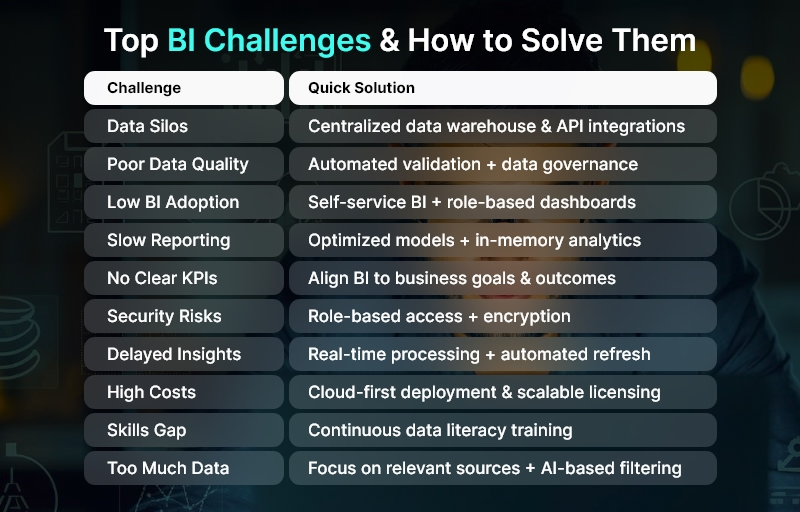
Why Business Intelligence Often Fails: The Real Issue
Even with powerful BI tools available today, success often stalls because teams:
- Don’t know what data is truly valuable
- Face data accuracy or silo problems
- Lack BI adoption across business units
- Fail to align BI with business strategy
The good news? All these challenges are fixable.
Let’s dive into the 10 biggest BI challenges, and how to solve them effectively.
Top 10 BI Challenges and How to Solve Them
-
Data Silos and Lack of Integration
The challenge:
Data lives across multiple systems — CRM, ERP, spreadsheets, marketing tools, and more — making analytics difficult.
The solution:
- Implement a unified data pipeline
- Use ETL (Extract, Transform, Load) automation
- Integrate systems via modern APIs
- Adopt a centralized data warehouse or lakehouse
Outcome → Single source of truth that improves accuracy and data accessibility.
-
Poor Data Quality
Bad data leads to bad decisions.
Common issues:
- Duplicates
- Missing fields
- Outdated records
- Inconsistent formats
Solution strategies:
- Automated data cleaning and validation
- Data governance policies
- Master data management (MDM)
Outcome → Trusted data + confident decision making.
-
Low BI Adoption Among Users
Most employees still rely on Excel and intuition — not insights.
Why adoption fails:
- Tools are too complex
- Limited training
- Dashboards don’t solve real problems
How to fix it:
- Provide intuitive self-service BI tools
- Build role-specific dashboards
- Offer guided onboarding and training
Outcome → BI becomes everyone’s habit — not a reporting chore.
-
Slow and Inefficient Reporting
When dashboards take minutes to load, users abandon BI.
Key improvement tactics:
- Optimized data models
- In-Memory analytics
- Incremental refresh instead of full loads
- Scalability planning
Outcome → Insights available instantly when decisions are needed.
-
Lack of Clear KPIs and Strategy
Without defined business goals, BI becomes random reporting.
How to solve:
- Start BI with business questions
- Identify measurable KPIs linked to goals
- Create data-driven success benchmarks
Outcome → BI aligns directly with growth initiatives and ROI.
-
Security, Compliance & Access Control Issues
Data breaches or unauthorized access can be devastating.
Fix it with:
- Robust role-based access permissions
- Encryption in transit and at rest
- Audit logs and compliance frameworks
- Regular security governance reviews
Outcome → Secure analytics trusted by leadership and IT.
-
Real-Time Data Not Available
Outdated data = outdated decisions.
How to solve:
- Use streaming analytics where needed
- Implement CDC (Change Data Capture)
- Automate refresh cycles
Outcome → Operational agility and faster risk mitigation.
-
High Cost of BI Implementation
Licensing + integrations + skilled resources = $$$
Cost optimization solutions:
- Cloud-first BI deployment
- Scale licensing as users grow
- Use open-source or freemium BI tools initially
- Focus on high-value use cases first
Outcome → Lower TCO (Total Cost of Ownership) without sacrificing capability.
-
Skills Gap in Data Literacy
BI software alone doesn’t create analysts.
Solve by:
- Company-wide data literacy programs
- Hands-on workshops on using dashboards
- Embedded help within BI platforms
Outcome → Data becomes a culture, not a department.
-
Overwhelming Volume of Data
More data doesn’t mean better insights — often it’s the opposite.
How to fix:
- Prioritize relevant data sources
- Archive historical data strategically
- Automate metadata management
- Use AI to surface valuable patterns
Outcome → Right data → right insights → right actions.
Bonus: How to Ensure Long-Term BI Success
A successful BI transformation includes:
| Pillar | Practice |
| Strategy | Align BI goals with business objectives |
| Technology | Choose scalable BI tools with flexible integration |
| Governance | Maintain data quality, security, and ownership |
| Skills | Train users continuously |
| Culture | Promote evidence-based decision making |
BI success isn’t a one-time setup — it’s a continuous journey powered by adoption and improvement.
Conclusion
Business Intelligence can become an organization’s competitive advantage — but only when challenges like data quality, adoption, and integration are handled proactively.
By addressing these BI challenges strategically, businesses unlock:
- Smarter decisions
- Increased productivity
- Reduced operational risks
- Faster revenue growth
Start small. Focus on solving real business problems. And let data guide the future.
FAQs
1. What causes most BI failures?
Lack of adoption, poor data quality, and misaligned goals are the top reasons BI initiatives fail.
2. How can business intelligence drive ROI?
By improving decision-making, reducing errors, optimizing operations, and discovering revenue opportunities.
3. Which BI tools are most commonly used?
Tools like Power BI, Tableau, Qlik, Looker, and modern cloud-native BI platforms.
4. How do I improve BI adoption?
Deliver easy-to-understand dashboards and train users regularly.
5. What industries benefit most from BI?
Retail, manufacturing, finance, logistics, healthcare — and any data-driven business.