
Business Intelligence initiatives promise data-driven decision-making, operational clarity, and competitive advantage — yet, industry studies consistently show that a significant percentage of BI projects fail to deliver expected ROI. The reason is rarely the technology itself. More often, it is BI implementation mistakes made early in planning, execution, and adoption.
In today’s data-saturated landscape, organizations generate massive volumes of structured and unstructured data across applications, platforms, and devices. However, without a well-defined BI strategy, this data becomes fragmented, unreliable, and underutilized. As a result, leaders make decisions based on incomplete insights, outdated reports, or manual spreadsheets.
This blog breaks down the top 10 BI implementation mistakes organizations make — and more importantly, how to avoid them. You will learn best practices, frameworks, and actionable strategies to build BI systems that scale, perform, and drive measurable outcomes.
Drawing from real-world delivery experience, Andolasoft helps businesses design, build, and modernize BI platforms that convert raw data into actionable intelligence — securely and sustainably.
Business Need & Importance of Avoiding BI Implementation Mistakes
Modern businesses operate in environments where speed, accuracy, and insight define success. From healthcare providers optimizing patient outcomes to eCommerce brands improving conversions, BI has become a strategic necessity rather than a reporting add-on.
However, many organizations still struggle because of BI implementation mistakes, such as disconnected data sources, poorly defined metrics, and lack of stakeholder alignment. These issues lead to dashboards that look impressive but fail to answer real business questions.
Why BI matters today:
- Healthcare: Enables predictive analytics, operational efficiency, and compliance reporting — without compromising data security.
- eCommerce & SaaS: Drives personalization, churn reduction, and revenue forecasting through real-time insights.
- Logistics & Manufacturing: Improves demand forecasting, inventory optimization, and cost control.
- Fintech & Education: Ensures transparency, risk management, and performance tracking across complex systems.
Risks of poor BI implementation:
- Inefficient decision-making due to inconsistent or inaccurate data
- Security vulnerabilities caused by unmanaged data access
- Low user adoption when BI tools are complex or irrelevant
- Revenue loss from delayed insights and reactive strategies
Therefore, companies must move beyond patchwork tools and legacy reporting. They need modern, scalable BI solutions designed with clear business alignment — something Andolasoft specializes in through its BI, data analytics, and digital transformation services.
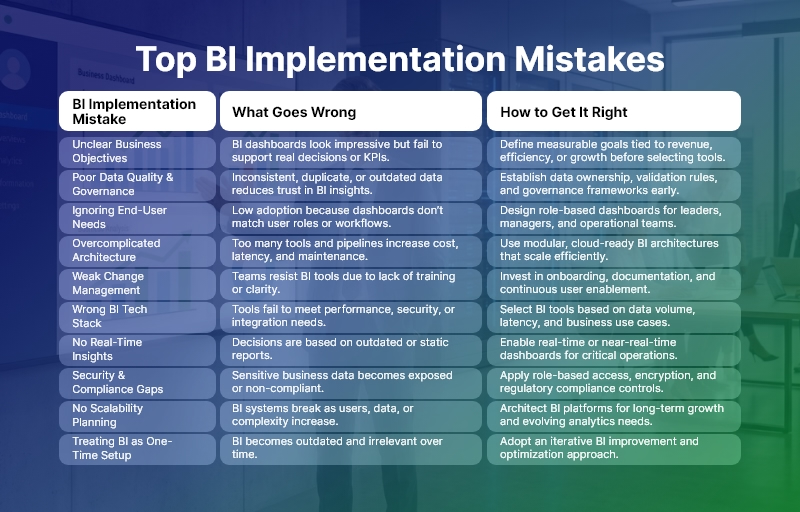
Top 10 BI Implementation Mistakes
1. Lack of Clear Business Objectives
Many BI projects start with tools instead of outcomes. Without defined goals, dashboards become cluttered and unused.
Best practice: Align BI initiatives with KPIs such as revenue growth, operational efficiency, or customer retention.
2. Poor Data Quality and Governance
Inconsistent, duplicate, or outdated data undermines trust in BI systems.
Best practice: Implement strong data governance, validation rules, and ownership models early.
3. Ignoring End-User Needs
BI built only for leadership often fails adoption at operational levels.
Best practice: Design role-based dashboards tailored for executives, managers, and frontline teams.
4. Overcomplicated Architecture
Excessive tools, pipelines, and integrations increase maintenance costs.
Best practice: Use modular, cloud-ready architectures with scalable data pipelines.
5. Underestimating Change Management
Users resist BI if it disrupts workflows without training.
Best practice: Invest in onboarding, documentation, and continuous enablement.
6. Choosing the Wrong Tech Stack
Not all BI tools fit all use cases.
Best practice: Select tools based on data volume, latency, security, and integration needs.
7. No Real-Time or Near-Real-Time Capabilities
Static reports limit agility.
Best practice: Enable real-time dashboards for critical business functions.
8. Weak Security & Compliance Planning
BI systems often expose sensitive data.
Best practice: Apply role-based access control, encryption, and compliance frameworks.
9. Failing to Plan for Scale
What works for 10 users fails at 1,000.
Best practice: Architect BI for future growth in users, data sources, and analytics complexity.
10. Treating BI as a One-Time Project
BI requires continuous evolution.
Best practice: Adopt an iterative improvement model with regular feedback loops.
Customer Success
For example, a mid-sized eCommerce SaaS company partnered with Andolasoft to overcome recurring BI implementation mistakes that limited visibility into customer behavior and revenue trends.
The company struggled with siloed data across CRM, marketing automation, and finance tools. Reports were manually generated, often inconsistent, and delayed by weeks.
Andolasoft designed a unified BI architecture that integrated all data sources into a centralized analytics platform. Role-based dashboards were created for leadership, marketing, and operations teams. Automated pipelines ensured real-time data availability with built-in governance and security controls.
Results within 4 months:
- 35% faster decision-making cycles
- 28% improvement in campaign ROI
- 50% reduction in manual reporting effort
- Single source of truth across departments
The transformation allowed leadership to shift from reactive decisions to proactive, insight-led strategies — demonstrating the value of avoiding common BI implementation mistakes with the right technology partner.
Key Takeaways & Closing
Successful BI initiatives are not about dashboards — they are about decisions, outcomes, and impact. Most failures stem from avoidable BI implementation mistakes, including unclear goals, poor data quality, and lack of user adoption.
The most important takeaways:
- Start with business objectives, not tools
- Invest in data governance and security
- Design BI for users, scale, and continuous improvement
- Choose experienced partners who understand both technology and business
As data complexity grows, organizations that modernize BI thoughtfully will gain a decisive advantage. With deep expertise in BI, AI, data analytics, SaaS engineering, and digital transformation, Andolasoft helps businesses build future-ready BI platforms that deliver lasting value.
Avoid the pitfalls. Build BI the right way — starting now.
FAQs
1. What are the most common BI implementation mistakes?
The most common BI implementation mistakes include unclear objectives, poor data quality, low user adoption, and lack of scalability planning.
2. Why do BI projects fail despite good tools?
BI fails due to strategy, governance, and adoption issues — not because of tools. Avoiding BI implementation mistakes requires business alignment.
3. How long does a successful BI implementation take?
A well-planned BI implementation typically takes 3–6 months, depending on data complexity and integration scope.
4. How can companies improve BI adoption?
User-centric design, role-based dashboards, and training significantly improve BI adoption.
5. Is cloud BI better for modern businesses?
Yes. Cloud BI offers scalability, cost efficiency, and faster deployment when implemented correctly.
6. How does Andolasoft support BI initiatives?
Andolasoft provides end-to-end BI services, including strategy, architecture, development, analytics, and ongoing optimization.
7. Can BI be integrated with AI and machine learning?
Absolutely. Modern BI platforms integrate AI and ML for predictive insights, anomaly detection, and automation.