In today’s digital-first economy, data is no longer the differentiator — predictive intelligence is. Organizations generate massive volumes of data every day, yet many still struggle to turn that data into timely, actionable insights.
Traditional dashboards explain what happened, but modern businesses need answers to what will happen next. This is exactly where BI and AI come into play.
By combining Business Intelligence (BI) with Artificial Intelligence (AI), organizations can move beyond static reporting and unlock predictive intelligence — insights that anticipate trends, forecast outcomes, and recommend actions before problems arise.
As competition intensifies and decision cycles shorten, this capability has become mission-critical.
In this guide, you will learn how BI and AI works together, why it matters across industries, and how businesses can implement it successfully.
More importantly, you will see how Andolasoft helps organizations design, build, and scale predictive intelligence in data platforms that deliver real business outcomes — not just charts and dashboards.
Business Need & Importance of BI and AI
Modern businesses operate in environments defined by speed, complexity, and uncertainty. Customer expectations change rapidly, markets fluctuate, and operational risks emerge without warning.
In this context, relying on historical reports alone creates blind spots.
Why BI and AI Matters Today
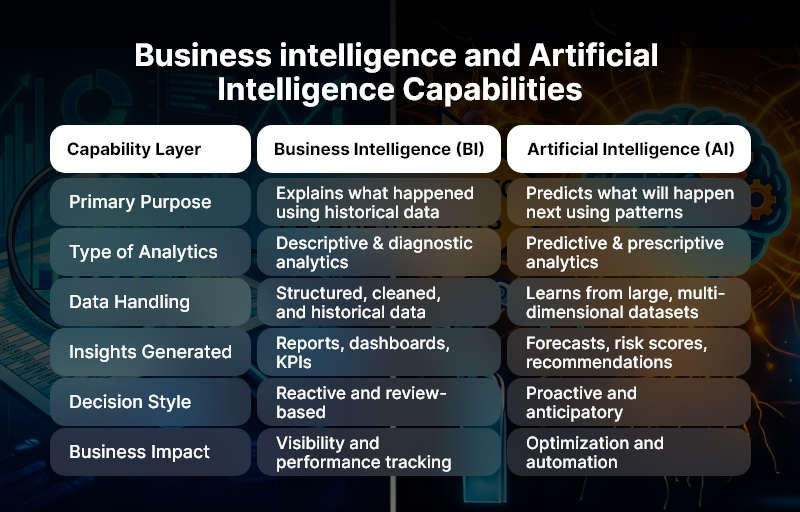
BI and AI matters because it converts raw data into foresight. While BI organizes and visualizes structured data, AI analyzes patterns, learns from historical behavior, and predicts future outcomes. Together, they enable smarter, faster, and more confident decision-making.
Key business drivers include:
- Exploding data volumes: Data from apps, IoT devices, CRMs, ERPs, and customer interactions is growing exponentially. Manual analysis simply cannot keep up.
- Demand for real-time decisions: Leaders need insights now, not at the end of the month or quarter.
- Competitive pressure: Companies that predict customer needs and operational risks earlier gain a clear advantage.
Industry-Specific Impact of BI and AI
Across industries, BI and AI is transforming how decisions are made:
- Healthcare: Predictive analytics helps forecast patient admissions, detect anomalies in diagnostics, and optimize resource allocation.
- eCommerce: AI-powered BI predicts demand, personalizes recommendations, and reduces cart abandonment through behavioral insights.
- Logistics & Supply Chain: Companies forecast delays, optimize routes, and proactively manage inventory risks.
- Fintech: Fraud detection models and credit risk predictions enhance security and regulatory compliance.
- SaaS & Technology: Usage analytics and churn prediction enable proactive customer retention strategies.
- Manufacturing: Predictive maintenance reduces downtime by identifying equipment failures before they occur.
Risks of Not Adopting BI and AI
Organizations that delay adoption face serious consequences:
- Operational inefficiencies due to reactive decision-making
- Revenue loss from missed opportunities and late responses
- Security and compliance risks caused by delayed anomaly detection
- Poor customer experience driven by generic, non-personalized interactions
Therefore, companies increasingly require strategic, scalable BI and AI solutions, not fragmented tools or legacy systems that fail to evolve with business needs.
Best Practices, Frameworks & Actionable Tips for BI and AI Implementation
Successfully implementing BI and AI requires more than tools — it demands the right strategy, architecture, and execution partner.
1. Start with Business Questions, Not Data
Successful BI and AI initiatives begin with clear business objectives. Instead of asking what data is available, define what decisions need improvement.
- Identify high-impact use cases such as demand forecasting, churn prediction, or operational risk analysis.
- Align analytics outputs directly with KPIs that leadership cares about.
- Avoid building dashboards without a clear decision-making purpose.
2. Build a Strong Data Foundation
AI is only as good as the data it learns from. Data quality, consistency, and governance are non-negotiable.
- Consolidate data from multiple sources into a centralized data warehouse or lake.
- Standardize data definitions to eliminate reporting inconsistencies.
- Implement strong data governance and access controls from day one.
3. Use the Right Architecture
A modern BI and AI architecture typically includes:
- Data ingestion pipelines for real-time and batch data
- Cloud-based data storage for scalability and performance
- BI visualization layers for descriptive and diagnostic analytics
- AI/ML models for predictive and prescriptive insights
This modular approach ensures flexibility as business needs evolve.
4. Combine Descriptive, Predictive, and Prescriptive Analytics
BI and AI works best when analytics maturity progresses in stages:
- Descriptive analytics explains what happened.
- Predictive analytics forecasts what will happen.
- Prescriptive analytics recommends what actions to take next.
Skipping stages often leads to low adoption and mistrust in AI outputs.
5. Focus on Explainability and Trust
Business users must trust AI-generated insights.
- Use explainable AI models where possible.
- Clearly show which factors influenced predictions.
- Provide confidence scores and scenario comparisons within dashboards.
6. Avoid Common BI and AI Mistakes
Common pitfalls include:
- Treating AI as a plug-and-play feature rather than a continuous learning system.
- Overengineering solutions before validating business value.
- Ignoring change management and user adoption.
7. Quick Wins to Build Momentum
Low-effort, high-impact improvements include:
- Automating anomaly detection in existing BI dashboards.
- Adding predictive forecasts to sales and demand reports.
- Using AI to prioritize leads or support tickets.
How Andolasoft Helps Implement BI and AI
Andolasoft delivers end-to-end BI and AI solutions tailored to business goals, not generic templates. Their expertise spans:
- Custom Web Development for analytics platforms
- SaaS Product Engineering with embedded BI and AI capabilities
- BI, AI & Machine Learning Solutions for predictive intelligence
- Data Analytics & Visualization for executive decision-making
- Application Modernization to upgrade legacy BI systems
- DevOps, Cloud & Automation for scalable, secure deployments
Choosing the right technology partner ensures long-term scalability, security, and ROI from BI and AI investments.
Customer Success Example: BI and AI in Action
For example, a mid-sized eCommerce company partnered with Andolasoft to modernize its analytics and forecasting capabilities. The company struggled with inventory overstocking, frequent stockouts, and delayed reporting that limited proactive decisions.
Andolasoft designed a BI and AI-driven predictive analytics platform that unified sales, customer behavior, and supply chain data into a single predictive intelligence layer. AI models were implemented to forecast product demand, identify high-risk SKUs, and recommend replenishment actions.
Within six months, the results were measurable:
- 30% improvement in demand forecast accuracy
- 25% reduction in inventory holding costs
- 40% faster reporting cycles
- Significantly improved executive visibility into future trends
Most importantly, decision-making shifted from reactive firefighting to predictive, data-driven planning.
Key Takeaways & Closing
To summarize, BI and AI represents a fundamental shift in how organizations use data:
- BI provides clarity, while AI delivers foresight
- Together, they enable predictive intelligence, not just reporting
- Businesses across industries gain faster decisions, lower risk, and higher efficiency
- Success depends on strategy, data quality, architecture, and execution
Adopting BI and AI now positions organizations to compete in a future where speed and predictive intelligence define winners. With the right approach and an experienced partner like Andolasoft, businesses can confidently turn data into a strategic asset — not an operational burden.
FAQs
1. What is BI and AI in simple terms?
BI and AI combine business intelligence reporting with artificial predictive intelligence to analyze data, predict outcomes, and recommend actions automatically.
2. How is BI and AI different from traditional BI?
Traditional BI focuses on historical data, while BI and AI adds predictive and prescriptive insights using machine learning models.
3. Which industries benefit most from BI and AI?
Healthcare, eCommerce, fintech, logistics, SaaS, manufacturing, and education see significant value from BI and AI adoption.
4. Is BI and AI only for large enterprises?
No. With cloud and modular architectures, BI and AI is now accessible and scalable for startups and mid-sized businesses.
5. How long does it take to implement BI and AI?
Initial use cases can go live in weeks, while full-scale implementations typically take a few months depending on complexity.
6. What data is required for BI and AI?
Structured and semi-structured data from CRMs, ERPs, applications, and operational systems form the foundation for BI and AI.
7. Why choose Andolasoft for BI and AI projects?
Andolasoft combines deep technical expertise, real-world delivery experience, and business-first thinking to deliver measurable BI and AI outcomes.