BI and AI Explained: Turning Business Data into Predictive Intelligence

In today’s digital-first economy, data is no longer the differentiator — predictive intelligence is. Organizations generate massive volumes of data every day, yet many still struggle to turn that data into timely, actionable insights.

Traditional dashboards explain what happened, but modern businesses need answers to what will happen next. This is exactly where BI and AI come into play.

By combining Business Intelligence (BI) with Artificial Intelligence (AI), organizations can move beyond static reporting and unlock predictive intelligence — insights that anticipate trends, forecast outcomes, and recommend actions before problems arise.

As competition intensifies and decision cycles shorten, this capability has become mission-critical.

In this guide, you will learn how BI and AI works together, why it matters across industries, and how businesses can implement it successfully.

More importantly, you will see how Andolasoft helps organizations design, build, and scale predictive intelligence in data platforms that deliver real business outcomes — not just charts and dashboards.
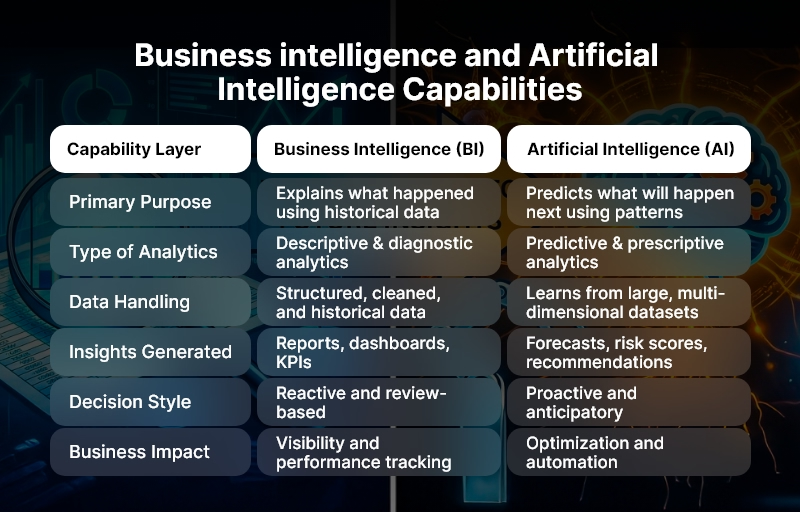
Business intelligence and Artificial Intelligence Capabilities

Business Need & Importance of BI and AI

Modern businesses operate in environments defined by speed, complexity, and uncertainty. Customer expectations change rapidly, markets fluctuate, and operational risks emerge without warning.

In this context, relying on historical reports alone creates blind spots.

Why BI and AI Matters Today

BI and AI matters because it converts raw data into foresight. While BI organizes and visualizes structured data, AI analyzes patterns, learns from historical behavior, and predicts future outcomes. Together, they enable smarter, faster, and more confident decision-making.

Key business drivers include:

  • Exploding data volumes: Data from apps, IoT devices, CRMs, ERPs, and customer interactions is growing exponentially. Manual analysis simply cannot keep up.
  • Demand for real-time decisions: Leaders need insights now, not at the end of the month or quarter.
  • Competitive pressure: Companies that predict customer needs and operational risks earlier gain a clear advantage.

Industry-Specific Impact of BI and AI

Across industries, BI and AI is transforming how decisions are made:

  • Healthcare: Predictive analytics helps forecast patient admissions, detect anomalies in diagnostics, and optimize resource allocation.
  • eCommerce: AI-powered BI predicts demand, personalizes recommendations, and reduces cart abandonment through behavioral insights.
  • Logistics & Supply Chain: Companies forecast delays, optimize routes, and proactively manage inventory risks.
  • Fintech: Fraud detection models and credit risk predictions enhance security and regulatory compliance.
  • SaaS & Technology: Usage analytics and churn prediction enable proactive customer retention strategies.
  • Manufacturing: Predictive maintenance reduces downtime by identifying equipment failures before they occur.

Risks of Not Adopting BI and AI

Organizations that delay adoption face serious consequences:

  • Operational inefficiencies due to reactive decision-making
  • Revenue loss from missed opportunities and late responses
  • Security and compliance risks caused by delayed anomaly detection
  • Poor customer experience driven by generic, non-personalized interactions

Therefore, companies increasingly require strategic, scalable BI and AI solutions, not fragmented tools or legacy systems that fail to evolve with business needs.

Best Practices, Frameworks & Actionable Tips for BI and AI Implementation

Successfully implementing BI and AI requires more than tools — it demands the right strategy, architecture, and execution partner.

1. Start with Business Questions, Not Data

Successful BI and AI initiatives begin with clear business objectives. Instead of asking what data is available, define what decisions need improvement.

  • Identify high-impact use cases such as demand forecasting, churn prediction, or operational risk analysis.
  • Align analytics outputs directly with KPIs that leadership cares about.
  • Avoid building dashboards without a clear decision-making purpose.

2. Build a Strong Data Foundation

AI is only as good as the data it learns from. Data quality, consistency, and governance are non-negotiable.

  • Consolidate data from multiple sources into a centralized data warehouse or lake.
  • Standardize data definitions to eliminate reporting inconsistencies.
  • Implement strong data governance and access controls from day one.

3. Use the Right Architecture

A modern BI and AI architecture typically includes:

  • Data ingestion pipelines for real-time and batch data
  • Cloud-based data storage for scalability and performance
  • BI visualization layers for descriptive and diagnostic analytics
  • AI/ML models for predictive and prescriptive insights

This modular approach ensures flexibility as business needs evolve.

4. Combine Descriptive, Predictive, and Prescriptive Analytics

BI and AI works best when analytics maturity progresses in stages:

  • Descriptive analytics explains what happened.
  • Predictive analytics forecasts what will happen.
  • Prescriptive analytics recommends what actions to take next.

Skipping stages often leads to low adoption and mistrust in AI outputs.

5. Focus on Explainability and Trust

Business users must trust AI-generated insights.

  • Use explainable AI models where possible.
  • Clearly show which factors influenced predictions.
  • Provide confidence scores and scenario comparisons within dashboards.

6. Avoid Common BI and AI Mistakes

Common pitfalls include:

  • Treating AI as a plug-and-play feature rather than a continuous learning system.
  • Overengineering solutions before validating business value.
  • Ignoring change management and user adoption.

7. Quick Wins to Build Momentum

Low-effort, high-impact improvements include:

  • Automating anomaly detection in existing BI dashboards.
  • Adding predictive forecasts to sales and demand reports.
  • Using AI to prioritize leads or support tickets.

How Andolasoft Helps Implement BI and AI

Andolasoft delivers end-to-end BI and AI solutions tailored to business goals, not generic templates. Their expertise spans:

  • Custom Web Development for analytics platforms
  • SaaS Product Engineering with embedded BI and AI capabilities
  • BI, AI & Machine Learning Solutions for predictive intelligence
  • Data Analytics & Visualization for executive decision-making
  • Application Modernization to upgrade legacy BI systems
  • DevOps, Cloud & Automation for scalable, secure deployments

Choosing the right technology partner ensures long-term scalability, security, and ROI from BI and AI investments.

Customer Success Example: BI and AI in Action

For example, a mid-sized eCommerce company partnered with Andolasoft to modernize its analytics and forecasting capabilities. The company struggled with inventory overstocking, frequent stockouts, and delayed reporting that limited proactive decisions.

Andolasoft designed a BI and AI-driven predictive analytics platform that unified sales, customer behavior, and supply chain data into a single predictive intelligence layer. AI models were implemented to forecast product demand, identify high-risk SKUs, and recommend replenishment actions.

Within six months, the results were measurable:

  • 30% improvement in demand forecast accuracy
  • 25% reduction in inventory holding costs
  • 40% faster reporting cycles
  • Significantly improved executive visibility into future trends

Most importantly, decision-making shifted from reactive firefighting to predictive, data-driven planning.

Key Takeaways & Closing

To summarize, BI and AI represents a fundamental shift in how organizations use data:

  • BI provides clarity, while AI delivers foresight
  • Together, they enable predictive intelligence, not just reporting
  • Businesses across industries gain faster decisions, lower risk, and higher efficiency
  • Success depends on strategy, data quality, architecture, and execution

Adopting BI and AI now positions organizations to compete in a future where speed and predictive intelligence define winners. With the right approach and an experienced partner like Andolasoft, businesses can confidently turn data into a strategic asset — not an operational burden.

FAQs

1. What is BI and AI in simple terms?

BI and AI combine business intelligence reporting with artificial predictive intelligence to analyze data, predict outcomes, and recommend actions automatically.

2. How is BI and AI different from traditional BI?

Traditional BI focuses on historical data, while BI and AI adds predictive and prescriptive insights using machine learning models.

3. Which industries benefit most from BI and AI?

Healthcare, eCommerce, fintech, logistics, SaaS, manufacturing, and education see significant value from BI and AI adoption.

4. Is BI and AI only for large enterprises?

No. With cloud and modular architectures, BI and AI is now accessible and scalable for startups and mid-sized businesses.

5. How long does it take to implement BI and AI?

Initial use cases can go live in weeks, while full-scale implementations typically take a few months depending on complexity.

6. What data is required for BI and AI?

Structured and semi-structured data from CRMs, ERPs, applications, and operational systems form the foundation for BI and AI.

7. Why choose Andolasoft for BI and AI projects?

Andolasoft combines deep technical expertise, real-world delivery experience, and business-first thinking to deliver measurable BI and AI outcomes.
What is The Future of AI in Mobile App Development

Mobile apps have transformed the way we live, work, and connect. From ordering food to tracking our fitness, mobile apps have become an integral part of our daily lives. However, what’s driving the next wave of innovation in mobile app development is artificial intelligence (AI).

Mobile app development is the fastest growing technology trend in the world. As more and more users are spending most of their time on mobile devices, they are making desktop a thing of the past.

Considering and large adoption of mobile devices gives business owners and mobile app developers the opportunity to create engaging mobile apps.

Furthermore, integrate AI technologies to provide a comprehensive user experience.

The Growing Demand for Mobile App Development in 2023

The year 2023 continues to witness a tremendous surge in the demand for mobile app development.

The mobile app market is evolving fast and users are not lacking behind in catching up with it.

The advent of AI into the mobile app industry is driving businesses, development companies and users to interact with this digital tools in a new way.

  1. Increasing App Downloads:
    By 2024 the estimated app downloads will reach 800 billion; that’s an average of 40 apps per mobile user. Which signifies that the app downloads have increased significantly from previous years.
  2. Diversified Industry:
    Mobile apps began with a small focus on user productivity and entertainment. Today it has broadened its reach to sectors such as healthcare, finance, real-estate and more.
  3. Technological Advancements:
    With the advancements of technology such as Artificial Intelligence and 5G connectivity the demand for more sophisticated mobile apps have increased exponentially.
  4. Wearable Tech Integration:
    Smartwatches, fitness trackers, smart glasses, VR headsets are being used in conjunction with mobile apps for seamless user experience.
  5. Security and Privacy:
    App developers are investing in security measures and complying with data protection regulations.

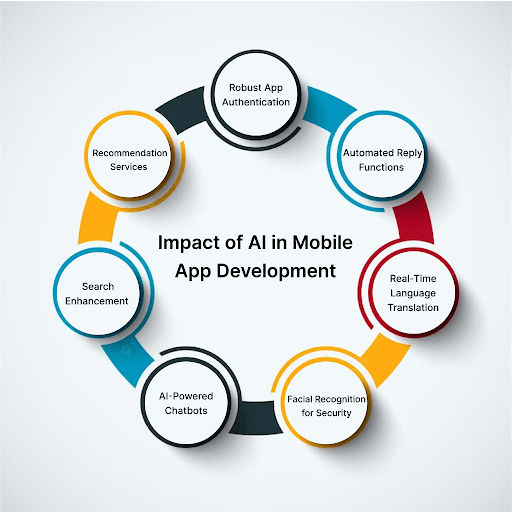
The Impact of AI on Mobile App Development

The Impact of AI on Mobile App Development

AI is reshaping the landscape of mobile applications, bringing with it a multitude of benefits and opportunities.

Let’s delve into the impact of AI on mobile app development.

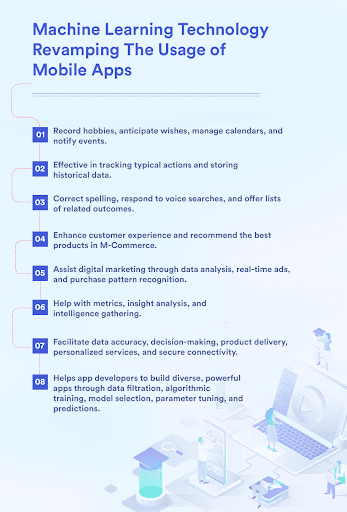
  1. AI-integrated mobile apps are more intuitive and provide a customized user-experience.
    The apps can be optimized to predict user preferences, provide tailored content, and provide personalized recommendations.
  2. Artificial intelligence is empowering mobile apps with cutting-edge features such as voice recognition, chatbots, image recognition, photo apps, etc.
    Basically any mobile app can be integrated with AI tools to enhance app functionality and usability.
  3. It enables mobile app users to make informed decisions, and business owners to improve business strategies, and extract valuable insights from them.
  4. It streamlines and makes app development faster such as testing automation, simplifying bug detection and closure.
  5. AI integrated apps empower businesses to optimize their budget and resources and enable smarter resource allocation.

Application of Machine Learning in Mobile App Development

Application of Machine Learning in Mobile App Development

Here, we explore the diverse applications of machine learning in the mobile app development space.

  1. Machine learning algorithms can analyze user behavior and preferences to deliver personalized content, recommendations and user experiences.
  2. It can accurately predict user behavior, market trends thereby enabling app developers to make data-driven decisions for feature enhancements, marketing strategies and content optimization.
  3. Mobile app developers can employ ML algorithms to enhance data security, identify and prevent fraudulent activities with little to no human intervention. Protecting user data and financial transactions is easier and effective using AI technologies.

Challenges Faced by Mobile App Developers without AI Technology

Here, we explore the difficulties encountered by mobile app developers in the absence of AI:

  1. Without AI, creating personalized user experiences can be challenging.
  2. When not using AI, developers must handle data manually, which is time-consuming and prone to errors.
  3. Mobile apps are not able to offer efficient user assistance, resulting in user dissatisfaction.
  4. AI empowers development teams to automate testing and identify bugs. Without it rigorous manual testing is required thereby increasing development time.
  5. Developers lacking AI may experience higher expenses and slower development cycles.

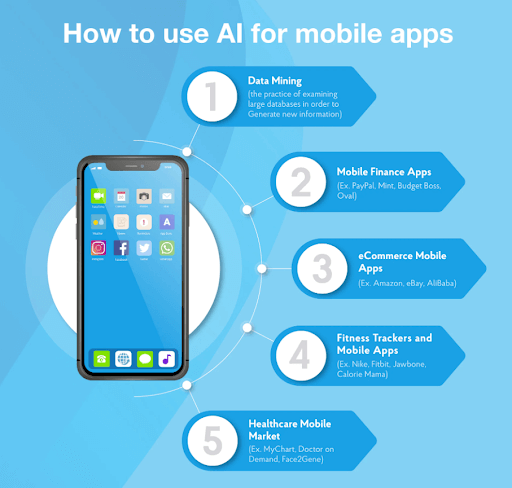
Various Use Cases of AI in Mobile App Development

Various Use Cases of AI in Mobile App Development

Artificial Intelligence has multiple applications in mobile app development.
It facilitates mobile app developers to create innovative apps and solutions that enhance user experiences in various ways.

Here are various use cases of AI in mobile app development:

  1. Digital Assistance:
    AI-driven digital assistants, like Siri and Alexa take voice commands and perform various tasks which enhance user convenience. Moreover, it can connect with various IOT devices and carry out various functions.
  2. Predictive Analytics:
    AI algorithms can predict user behaviour and trends which generates tons of user data thereby enabling app developers to make data-driven decisions to enhance mobile app features and improve marketing strategies.
  3. Object Detection:
    AI-based object detection can be used for various purposes such as barcode scanning, identifying objects in an image, and even creating virtual reality visuals.
  4. Image and Speech Recognition:
    Artificial Intelligence empowers images recognition and speech recognition features. This allows mobile users to interact with their environment in a more meaningful way. Apps can also use voice commands to perform free-hand mobile functions.

Content Recommendation:

Machine learning algorithms analyze user preferences to push recommended content, products, services which can significantly drive user engagement.

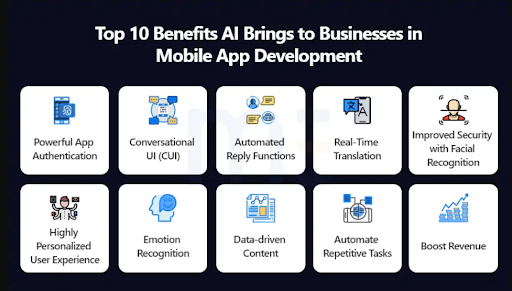
Benefits of AI Integration in Mobile App Development

Benefits of AI Integration in Mobile App Development

AI is revolutionizing mobile app development in remarkable ways, reshaping the user experience and expanding the capabilities of apps.

Artificial Intelligence is not being employed by mobile app developers to make the development process simpler and deliver quality apps faster. Moreover, it gives an opportunity to create more engaging and feature-rich apps.

  1. Enhanced User Experience:
    Mobile app developers employ AI to provide a more engaging user experience to their users. It can automatically analyze user data and behavior to provide personalized content and recommendations.
  2. Developer virtual assistants:
    Mobile app developers can create AI-powered chatbots and virtual assistants to automate customer support, answering queries and solve issues in real-time.
  3. Natural Language Processing:
    AI-driven apps can understand and respond to natural language and provide solutions in a human-like voice.
  4. Accelerated Development:
    Developers can take the help of AI to develop mobile app solutions rapidly, at the same time, automating testing and speeding up the development prices.
  5. Improved User Engagement:
    Developers can analyze user engagement data to optimize the app’s interface content and features which leads to higher user retention rates.

What is the Future of Mobile App Development with AI

The future of mobile app development is increasingly connected with the integration of Artificial Intelligence (AI).

Here are some key insights into what the future holds:

  1. AI will continue to provide more and more personlized and interactive user experiences on their mobile devices. It will adapt to individual preferences and provide recommendations that’s more preferred by users.
  2. It plays a significant role in enhancing the app security. There will be an increase in features such as facial recognition and bahavior analysis which will be employed to ensure secure access and protect user data.
  3. Repetitive tasks such as disk cleanup, reminders, etc in mobile apps will be automated with the help of AI. This includes functions such as customer support through chatbots, content curation, and data analysis which frees up users from manual tasks.
  4. Augmented Reality and Virtual Reality, combined with AI, will transform mobile apps, creating immersive experiences for gaming, shopping, education, and more.
  5. Mobile app developers will increasingly rely on AI-driven insights and analytics to make data-driven decisions regarding app features, content, and marketing strategies.

The future of mobile app development with AI is marked by innovation, personalization, and efficiency.

As the technologies continue to evolve, the possibilities for creating intelligent, user-centric apps are virtually limitless, making way for a more connected and convenient mobile experience.

Top Strategies to Hire AI Mobile App Developers

Hiring AI mobile app developers can be a daunting task, given the specialized skills required. To ensure you make the right choice, consider the following strategies:

  1. Understand Your Project Requirements:
    Before hiring a development team from a mobile app development agency, you need to have a clear understanding of your project’s needs.
    Decide on the type of functionalities and features you are looking to integrate on your mobile app. This will help you identify the skills you need in a developer to successfully deliver your projects.
  2. Collaborate with Development Agencies:
    Consider partnering with mobile app development companies that specializes in AI mobile app development such as Andolasoft.
    The company has a team of skilled developers and can handle your projects from start to finish.
  3. Evaluate Soft Skills:
    Along with expertise in technical skills, you also need to evaluate developer’s soft skills such as effective communication, problem-solving and teamwork capabilities.
  4. Consider Outsourcing Offshore:
    Don’t limit your search just to local talent. You should also seek out Offshore developers from countries like India and Ukraine who can provide cost-effective solutions without compromising on quality.
  5. Non-Disclosure Agreement (NDA):
    Protect your project’s confidentiality with an NDA. Mobile app development often involves sensitive data, algorithms and intellectual properties that need to be protected.

Why Choose Andolasoft for AI Integrated Mobile App Development?

Mobile app development is a crucial aspect of modern business, and choosing the right development agency can make all the difference.

Andolasoft is a leading provider of AI-integrated mobile app solutions. The company provides a comprehensive range of services such as:

  • Android app development
  • iOS app development
  • Hybrid app development
  • Mobile app QA and QC
  • Support and maintenance

Andolasoft is a leading player in the field, and here’s why you should consider for your mobile app development needs:

  1. Proven Expertise:
    Andolasoft is a recognized leader in the mobile app development industry.
  2. Customized Solutions:
    The company offers custom app development services tailored to your specific needs.
  3. Innovation and Growth:
    The team is well-versed in adopting the latest techniques and business logic, facilitating your business growth.
  4. Full-Stack Developers:
    With full-stack remote developers and fast turnaround support, Andolasoft provides a comprehensive range of web and mobile app development services.
  5. Timely Support:
    Andolasoft’s team is known for its rapid development and rocksolid support. They prioritize client satisfaction and troubleshooting, which ensures that any issue or concerns are addressed promptly.

Conclusion

In conclusion, AI is not just a buzzword; it’s a transformative force in mobile app development.

Businesses and developers are leveraging AI to create apps that are more intuitive, efficient, and user-friendly.

As AI technology continues to evolve, we can expect mobile apps to become even more integral to our daily lives, offering solutions that will take the mobile technology years ahead.

Top development companies are also integrating AI to their mobile app development services to keep up with the growing trends.

It facilitates developers to release cutting-edge mobile apps as well as enable users to get more customized solutions from their mobile apps.

Advancement In Ai Its Impact On Mobile App Development

For many years now, artificial intelligence (AI) and machine learning (ML) technologies continue to make their presence felt in the app development world and create more tailored and audience-specific user experiences for users. While these technologies are making apps smarter and more intuitive, they continue to evolve with mobile app projects’ usage.

Today both AI and ML technologies are having significant implications on delivering sophisticated and tailored user experience. The use of automated mobile app UI testing tools to detect flaws in the app flow based upon inputs about user journey is an excellent example of how AI penetrated app development tools. From intelligent chatbots to recommendation engines to the intuitive search function, these technologies add value to app projects in several ways.

The vast majority of industries across all niches now understand that artificial intelligence and machine learning remain vital technologies to make their apps and digital footprints smarter and more optimized for the target audience. But keeping pace with the rapid advancements and trends with AI and ML technologies remains the biggest challenge. It is equally a challenge and opportunity to face the rapid evolution of these technologies and their roles in delivering sophisticated user experience.

The evolving landscape of AI and ML technologies can be best experienced by how virtual assistants and chatbots are growing stronger and more capable. Today for any app to deliver user expectations through in-app content offerings or features based upon user contexts, these intelligent technologies are relied upon. They transformed the way users are addressed with relevant content and features by apps in real-time.

This is why from retail and mobile commerce apps to the entertainment and media streaming apps to the mobile games to enterprise apps, almost all major app niches now rely on intuitive and intelligent capabilities offered by these two technologies. Mobile apps have been at the very front row of this massive revolution facilitated by these two technologies.

Let’s have a quick look at the key facets and contexts of mobile apps where these two technologies made the most significant impact.

Intuitive Mobile Search Engines

The increasing use of voice search and voice interactions across apps offers a clear testimony of how artificial intelligence (AI) and machine learning (ML) technologies are being used to understand voice commands and trigger actions based upon user intents.

Smarter User Authentication

Thanks to these technologies, you no longer need to authenticate yourself with transitional passwords and authentication data. The intelligent face recognition technology can detect the actual user irrespective of your appearance or gait difference.

Smart Camera apps

Some of the most significant advances with AI and ML technologies happened through smart camera apps. An intelligent camera can detect a subject within the screen frame and differentiate objects, faces, food, nature, fireworks, water and accordingly can adjust the settings for best output.

With the help of Artificial intelligence and machine learning, detecting faces and optimizing the image with enhanced effects is now possible. Some camera apps can even see food ingredients and decipher the calories in food platter.

Smart Speaker Systems

Intelligent voice-controlled assistants such as Amazon Alexa are now helping us complete actions with little effort by making simple voice commands. Alexa voice assistant offering excellent compatibility with all kinds of digital interfaces and smart home gadgets is inspiring a whole array of IoT mobile apps to use such intelligent and intuitive interactions.

Thanks to these advanced voice interfaces, users can make interactions more seamlessly with apps than ever before. Thanks to Natural Language Processing (NLP) technology, a subset of AI technology now voice interfaces are becoming more intuitive and user optimized than ever before. By advancing Alexa already established, Google Home is now facilitating context-driven computing triggered by voice commands.

These innovative speaker systems and intelligent voice interfaces are slowly pushing AI into mobile apps to make interactions more intuitive, real-time, and contextual. For example, both Alexa and Google Home can fetching the mobile app data through simple voice commands and operate apps just the same way.

Real-Time language Translation

Intelligent translation apps powered by AI and ML technologies can offer wonderful help to users in foreign countries and in different contexts where language help is crucial to get things done.

The best thing about the AI and ML-based translation apps is that they can equip the smartphone device to carry out the translation tasks without relying on the internet.

Emotional Recognition

The ability to recognize emotions through user inputs and facial expressions captured by the camera is the latest AI technology that can do wonder for mobile app projects. By incorporating AI and ML technologies, now apps can detect the emotional contour and mood of the users and accordingly can provide content and allow interactions.

This has serious implications for the mobile app development industry, with many promises unfolding to make every day digital interactions smarter and more intuitive. AI-powered apps can now differentiate moods and different expressions based upon image inputs and captured voice intonations. On top of that, the AI-powered analytics engine based upon user history and other data-driven inputs can easily detect the emotional state of the mind of users. Accordingly, it can help users with content and interactions.

Conclusion

From using intelligent face recognition to capturing the pronunciation differences in voice commands, from smart recommendation engines to context-aware chariots, AI and ML technologies have penetrated the mobile apps in a never-before manner. The advances made by these two technologies will continue to make the app experience better and richer.

How IoT Creates An Impact On Mobile App Development

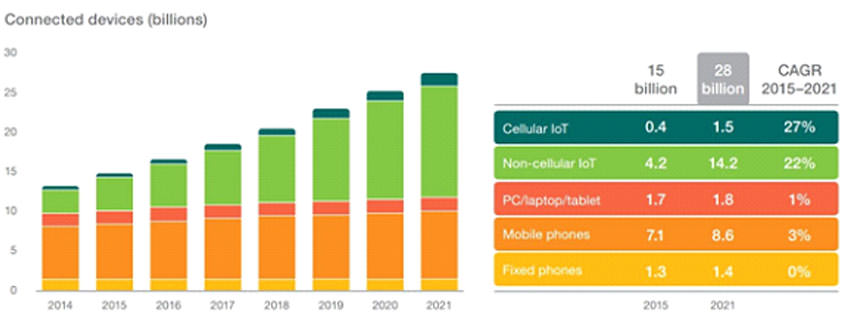
A digital system record adjusts all your interactions and monitors the connected physical items. By 2025, forecasts suggest that there are going to be more than 75 billion Internet of things (IoT) connected devices to be used.

We will get more connected devices than the total number of Earth’s inhabitants. This whole phenomenon is known as the Internet of things or IoT. It refers to the ecosystem that comprises physical objects that are accessed through the internet.

As the Internet of Things (IoT) continues evolving, the concept of smart homes would thrive.

In this era, mobile devices function as the main interface through which we could interact with IoT-enabled devices. Here, I’ll explain how IoT making impacts mobile app development. So let’s move inside;

Never miss an update from us. Join 10,000+ marketers and leaders.

Today, we are living in a world where mobile apps have been dominating daily life routines. Mobile apps are the key to those organizations that create smart devices to enhance every aspect of people’s lives.  

It’s said that mobile apps are the reason behind the rise of the Internet of Things (IoT). Mobile application development isn’t only a preferable option for business, but it also provides support to people from all sectors of life. 

But What Exactly IoT Is?

IoT or the Internet of Things refers to a connected network of devices. The inherent connection between these physical devices can be created anywhere, in your home or at your workplace like a retail store, a manufacturing unit, etc.

These devices may include smart gadgets that can be easily accessed as well as controlled from any remote location. It benefits users from a variety of industries.

IoT has seen a significant rush in the technical era.

When it is powered by the proper capabilities of mobility, technology seems to create new milestones in the forms of innovation, user experience, and business performance.

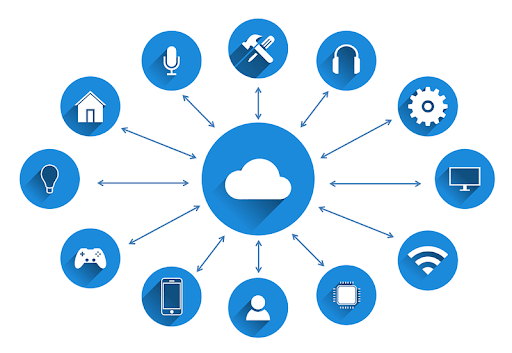
The sensor collects the data and transmits it to the cloud, these can be accessed using the smartphone app. The IoT application development allows data acquisition that enables us to implement data analysis to predict the result and make decisions accordingly. It has the potential to improve the productivity and efficiency of its managing process.

Application Development (Source: Polyuno)

Many industries have started to build the best apps that are easy and helpful to users.

According to Smart Insights, 90% of people spent time on mobile devices for mobile apps. No wonder, mobile apps have grown quite powerful and popular over the last few years, and with time have started to influence the growth of the Internet of Things (IoT).

It’s not a nebulous statement on how IoT has impacted the mobile industry. By 2021, the number of mobile devices integrated by IoT is expected to exceed 1.5 billion.

IOT Impact on Mobile App Development(Source: Finoit)

Now let’s know how IoT creates an impact on mobile app development

  • Centralized App:

IoT has several opportunities and possibilities with its services in the market.

It is focused on providing one centralized platform to the end-users to manage multiple devices.

This has improved the management process and cost-effectiveness for the end-users as well as the app developers.  

  • Provide Hybrid Apps:

Who wouldn’t want to give try to new ideas these days? Almost everyone is looking for a solution that improves the way we interact today.

Mobile app development companies have started using the current technical UI/UX with advanced codes to come up with hybrid apps. 

  • Decreased Human Effort:

IoT sets multiple devices, apps, and functions as one system managing all. Mobile devices with IoT allow you to track cab locations, switch on the light, check security cameras, and more.

Hence, it has made life easier for both the developers and end-users. When users can manage all from a single device, ultimately it reduces the amount of effort being put in by developers while building an app. 

  • High-End Security:

IoT allows an unmatched amount of entry points that can be a big threat to the security of the apps.

Ultimately, it becomes easier for cyber-criminals to exploit the data. App developers need to be focused on cyber-security to eradicate any cybercrime. 

It’s vital to focus on IoT application development for mobile that is safe and secure.

Users’ privacy must not be hampered at any stage. Industries have started to run IoT-enabled devices to put an extra layer of security.

So these are the IoT impacts on mobile application development. Rather than all of the above, it’s also vital to carry in-depth knowledge in IoT app development.

Benefits Of Mobile App Development With IoT:

Valuable Insights:

As IoT is the network of several interconnected devices, servers, sensors, and many other digital items, access, and store sensitive information, and personal information regarding the users. 

The most important advantage of mobile applications with IoT you can use that information to create accurate decisions related to consumers’ behavior and buying patterns in real time and tweak your business process accordingly.

You can create all the necessary changes in inventory and overhaul the marketing strategy in your IoT apps. You can create many differences with customer-driven data and get a personalized and more effective customer experience.

Flexible Accessibility:

Your customers can enjoy accessibility. The integration of IoT and mobile application development, enables users to access any interconnected physical objects from any part of the world with a single touch on their smartphones.

Your IoT application development company needs to ensure your IoT-enabled mobile app will scale with the IoT platforms that enhance functionality and increase the user’s network usage.

Niche Market Entry:

The benefits of IoT are uncountable, most business still avoids using IoT app services that help to get the technology’s full potential. 

I’ve worked with the team at Andolasoft on multiple websites. They are professional, responsive, & easy to work with. I’ve had great experiences & would recommend their services to anyone.

Ruthie Miller, Sr. Mktg. Specialist

Salesforce, Houston, Texas

LEARN MORE

They don’t identify that not developing custom IoT mobile apps will give them a competitive edge and address a niche market that is already developed with IoT-based mobile applications.

So here’re the factors to keep in mind for IoT App Development;

  • Strictly adherence to the license agreements
  • Connectivity mode
  • hardware capabilities
  • Programming protocols

Over To You

The future of the mobile app seems challenging and bright with enticing and innovative possibilities.

Whether you are an owner of a business, a designer, a quality analyst, or an app developer, great times lie ahead in the busy mobile app development world.

With the constant development in the IoT, mobile apps can lead to a better-connected world.

We are recognized as a top California Mobile App Development Company on DesignRush!

Considering all the points, it’s apparent that IoT is one of the biggest digital revolutions in the technology industry.

It is an advanced technology that understands their needs and increases its convenience. And there is no doubt that the IoT in mobile apps has seen a rise in all sectors.

If you want to develop your IoT apps, then contact us, we will be happy to help you in your IoT app development.