Every government department stores enormous amounts of information. Policies, circulars, court rulings, RTI responses, notifications, citizen applications — the list never ends. However, despite digitization, employees still struggle to find the right answer quickly.
An officer often searches across portals, PDFs, and emails before responding to a simple query. Consequently, decisions get delayed, citizens wait longer, and productivity drops.
This is exactly where the Retrieval-Augmented Generation in government changes the equation. Instead of manually searching documents, systems can now retrieve verified information instantly and generate accurate responses based on official records.
In other words, AI stops guessing and starts referencing.
This shift is redefining government knowledge management and enabling the next phase of public sector digital transformation.
The Knowledge Crisis in Government Systems
Government organizations have digitized records for years. However, digitization alone does not equal accessibility.
The real problems still exist
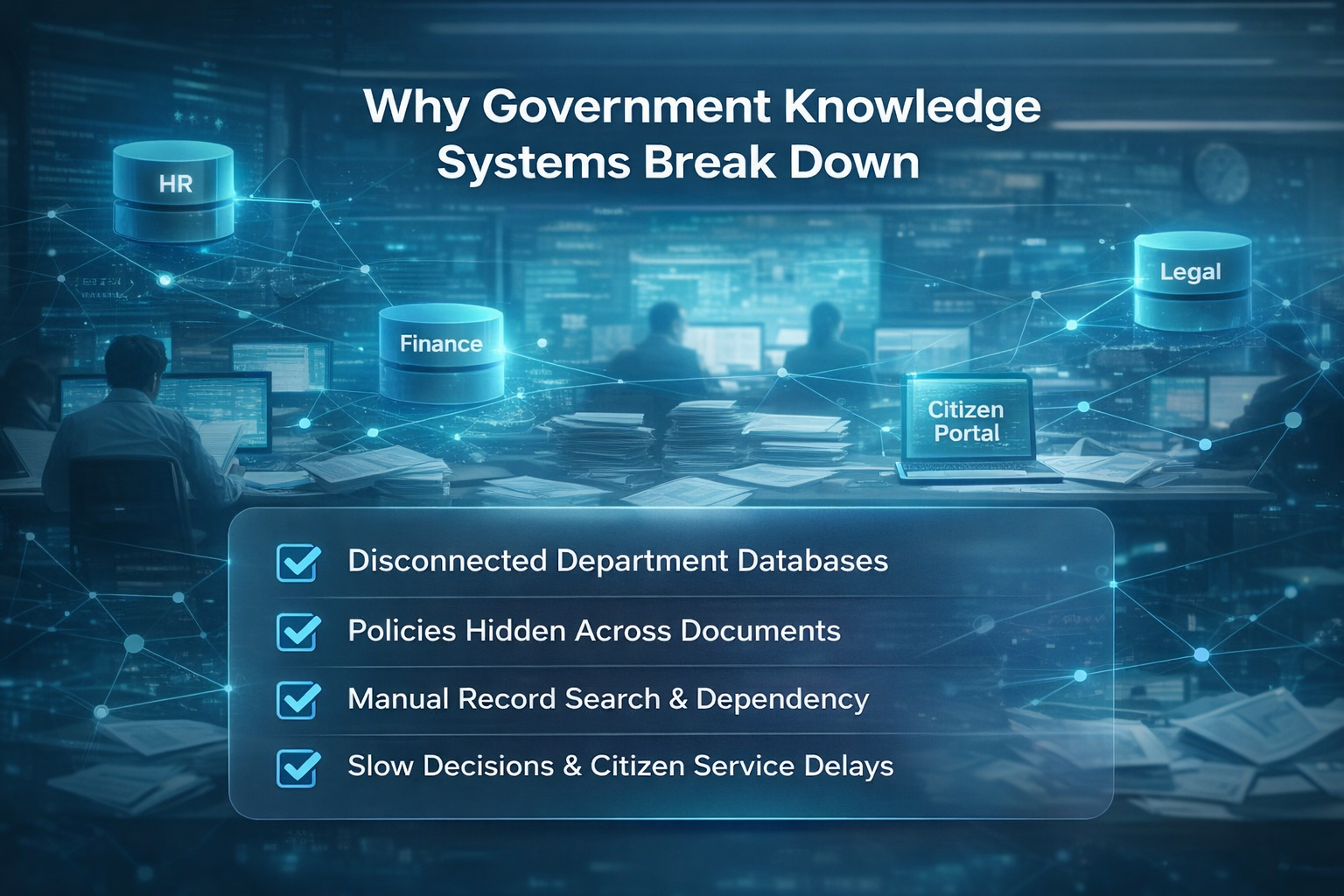
- Data Silos: Different departments maintain separate databases. Therefore, officers cannot access cross-department information easily.
- Policy Complexity: Policies evolve constantly. Moreover, circulars amend previous rules, which creates confusion.
- RTI & Citizen Queries: Officials spend hours searching historical records just to answer a single question.
- Manual Search Dependency: Employees depend on experienced staff because knowledge lives in people, not systems.
- Decision Delays: As a result, approvals slow down, compliance risks increase, and citizen services suffer.
Even though portals exist, information remains buried. Consequently, productivity declines despite digital infrastructure investments.
This is not a technology problem — it is an information retrieval problem.
What Is Retrieval-Augmented Generation in Government?
Retrieval-Augmented Generation in government combines two capabilities:
- AI retrieves relevant official documents
- AI generates answers strictly from those documents
So, instead of predicting an answer, the system grounds responses in government records.
Traditional AI vs RAG
| Capability | Traditional LLM AI | Retrieval-Augmented Generation |
| Knowledge Source | Pre-trained internet data | Government documents |
| Accuracy | Probabilistic | Evidence-backed |
| Updates | Requires retraining | Instant document updates |
| Hallucination Risk | High | Very low |
| Compliance Suitability | Limited | High |
| Transparency | Weak | Strong with citations |
Why Fine-Tuning Alone Fails
Many agencies attempt to train AI models on internal data. However:
- Retraining is expensive
- Data changes frequently
- Security risks increase
- Auditability decreases
Therefore, fine-tuning becomes impractical for governance.
On the other hand, AI-powered document retrieval allows systems to reference live records. Consequently, responses remain updated, traceable, and compliant.
How Retrieval-Augmented Generation in Government Improves Knowledge Systems
Real-Time Document Retrieval
- The system searches millions of files instantly.
- For example: An employee asks — “What is the latest pension eligibility rule?”
- Instead of searching manually: The system retrieves the latest circular and generates a response.
- Therefore, decisions become faster and consistent.
Secure and Compliant AI Usage
Unlike consumer AI tools, secure AI for the government never trains on confidential data.
- Data stays within infrastructure
- Queries remain private
- Access follows permissions
Consequently, departments adopt AI without compliance risks.
Context-Aware Responses
- RAG understands policy context.
- So instead of giving generic answers, it responds like:
- “According to the circular dated 14 March 2024, rule 7 subsection B applies.”
- Therefore, employees trust the system.
Reduced Manual Workload
Officials spend significant time searching documents.
RAG reduces:
- File lookup
- Cross-checking
- Re-verification
- Escalations
As a result, teams focus on decision-making instead of searching.
Improved Citizen Service Delivery
Faster responses mean:
- Faster approvals
- Accurate information
- Fewer grievances
Consequently, AI for public administration directly improves citizen satisfaction.
Key Use Cases Across Government Departments
- Policy Interpretation Assistant
Officers interpret rules consistently across offices.
- Legal & Compliance Support
Systems instantly provide regulation references.
- Citizen Query Resolution
Service centers respond accurately within seconds.
- Internal Knowledge Copilot
New employees learn procedures without training dependency.
- Document Intelligence for Audits
Audit teams retrieve historical decisions instantly.
Example impact:
- Helpdesk response time reduced by up to 70%
- Training dependency reduced significantly
- Decision consistency improved across locations
This drives government data intelligence in daily operations.
Security, Compliance & Data Governance
Government AI adoption depends on trust. Therefore, governance matters more than intelligence.
RAG Enables Safe Deployment
- No training on sensitive data: Models never memorize confidential records.
- On-Premise or Private Cloud: Departments retain control over infrastructure.
- Controlled Access: Responses depend on user role permissions.
- Auditability: Every answer links to source documents.
- Explainability: Officers see “why” an answer exists.
This makes secure AI for the government practically achievable.
The Strategic Impact on Public Sector Digital Transformation
When information becomes instantly accessible, administration changes fundamentally.
- Faster Decisions: Officers verify rules instantly. Therefore, files move quicker.
- Reduced Operational Cost: Manual effort decreases across departments.
- Increased Transparency: Every answer references an official source.
- Better Citizen Trust: Citizens receive consistent responses.
- Intelligent Governance Systems: Policies become executable knowledge.
Industry Insight
Studies show government employees spend nearly 30–40% of their time searching information instead of acting on it. RAG shifts this time toward decision-making.
Additionally, organizations adopting knowledge AI systems report up to 60% efficiency improvement in internal queries.
Therefore, RAG directly accelerates eGovernance innovation.
Why RAG Is the Next Step in eGovernance Innovation
Governments already completed:
- Digitization → Documents online
- Automation → Workflows online
- Integration → Systems connected
Now comes the final phase:
Intelligence → Knowledge accessible
This is where Retrieval-Augmented Generation in government becomes foundational infrastructure.
Future government employees will not search portals — they will ask systems.
The Smart Governance Roadmap
- Phase 1: Data digitized
- Phase 2: Processes automated
- Phase 3: Systems integrated
- Phase 4: Knowledge intelligent (RAG)
Therefore, RAG is not just another tool. It becomes the interface to governance itself.
And this is exactly where enterprise AI solutions for government enable scalable transformation across ministries, municipalities, and public agencies.
From Digital Government to Intelligent Government
Governments have invested heavily in digital platforms. However, access to knowledge still limits efficiency.
Retrieval-Augmented Generation in government changes how administration functions:
- Employees stop searching
- Systems start assisting
- Decisions accelerate
- Citizens benefit
This marks the shift from digital governance to intelligent governance.
Andolasoft enables this transition by delivering secure, scalable AI platforms designed specifically for public sector environments.
FAQs
1. Is RAG safe for confidential government data?
Yes. It does not train on sensitive data and works within secure infrastructure.
2. How is RAG different from chatbots?
Chatbots generate generic answers, while RAG retrieves official documents and responds accurately.
3. Can RAG integrate with existing portals?
Yes. It connects to document repositories, DMS, and databases without replacing systems.
4. Does it support multilingual governance environments?
Yes. RAG systems can retrieve and respond across multiple languages.
5. What departments benefit most?
Citizen services, compliance, legal, administration, finance, and audit teams benefit immediately.